Thursday, July 29, 2021

Once upon a Time Rewatch 1.8, "Desperate Souls"

Read the previous entry in the series here.
Read the next entry in the series here.


1.8, "Desperate Souls"

Written by Jane Espenson
Directed by Michael Waxman

Synopsis

Awkward effects. Ostentatious attire. Yep, that's Evil®.
Image taken from the episode, used for commentary.
After another restatement of the series's premise and the title card, the episode begins with Rumpelstiltskin spinning thread. He limps out into the small village of his home, where soldiers are conscripting children into a war effort, aided by powerful magic. Rumpelstiltskin, holding his son and leaning on a crutch, looks on helplessly; his son notes that his own conscription is coming.

Gold works in his pawn shop as Emma enters; he offers condolences on the loss of the sheriff two weeks past. Gold notes also that Graham's belongings are in his possession, urging Emma to take something that had been his and to tend to Henry due to the transience of youth.

Emma meets with Henry, giving him one of Graham's radios as she tries to comfort him. Henry notes reluctance to proceed against Regina in the wake of Graham's death. He also refuses the gift and, saddened, makes to return home. Emma resumes her law-enforcement duties and is informed that Regina has appointed Sidney Glass to the sheriff's office and dismissed her.

Quite the thing to walk in on...
Image taken from the episode, used for commentary.
That evening, Emma is somewhat dissolute when Mary Margaret returns home. They confer about Emma's dismissal and are interrupted by the arrival of Gold at their apartment. He urges her to challenge Regina.

In the Enchanted Forest, Rumpelstiltskin wakes his sleeping son, Baelfire, purposing to flee before he can be conscripted. He notes the horrors of war before soldiers come upon them; one recognizes Rumpelstiltskin and accosts him for his cowardice. In an attempt to save his son, Rumpelstiltskin humbles himself before the soldiers' leader and is kicked in the face for his trouble.

In Storybrooke, Regina holds a press event to announce the appointment of Sidney to the post of sheriff. Emma intrudes, citing the legal obligation to hold an election and announcing her candidacy for the position.

Rumpelstiltskin continues to fret about how to help his son escape conscription and likely doom. A benefactor confers with him about following another path, and Rumpelstiltskin notes his cowardice and incapacity. The benefactor notes the Dark One's Dagger, an artifact that allows for control over the Dark One whose magic supports the soldiers; he urges Rumpelstiltskin to steal that dagger, thus coming to control the Dark One and the power the Dark One wields. When Rumpelstiltskin demurs, the benefactor urges him instead to become the Dark One.

Gold receives Regina at his shop. She confronts him about his involvement with Emma, and their tête-à-tête soon treats Henry--whom Emma meets in a diner and with whom he discusses his birth in jail. Henry reminds Emma that Regina is underhanded--and he advises her that Gold is even worse than Regina. And when Emma confronts Regina about the news reports of Henry's birth, an explosion blasts the city offices; Regina is immobilized and cries for Emma's help.

In the Enchanted Forest, Rumpelstiltskin has Baelfire help him prepare to take the Dark One's power. The father notes to his son the certainty of his death in battle if he goes to war, warning him against the terrors he himself had fled. Baelfire asks Rumpelstiltskin about the truth of the soldiers' claims of his cowardice, and his father cannot deny it. He makes to help his father even so.

Emma seems to flee Regina, only to return moments later with a fire extinguisher to clear a path for them; they extricate themselves from the town hall. They are met by a crowd and the press, including Sidney. Emma's heroism is noted, and campaign activities begin to coalesce around her--which Henry notices. And Emma notices Gold's handiwork, moving to confront him about it. He does not admit to aiding her, though he lays out hypothetical tactics as he admonishes her.

Aaaaand obligatory castle shot.
Image taken from the episode, used for commentary.
Back in the Enchanted Forest, Rumpelstiltskin works his infiltration with Baelfire, committing arson. In the ensuing confusion, Rumpelstiltskin retrieves the dagger.

Mary Margaret runs into David as she campaigns for Emma--and he for Sidney. They confer briefly and awkwardly. Elsewhere, debate preparations are finalized, Emma doubting her victory. Mary Margaret offers encouragement.

Rumpelstiltskin returns to Baelfire with the dagger. He sends his son home with the note that he will follow soon after; when Baelfire leaves, Rumpelstiltskin summons the Dark One--finding that it is his benefactor as he kills him and himself becomes the Dark One. The power begins to work on him swiftly.

The debate between sheriff candidates gets underway somewhat raggedly. Glass gives a polished opening statement; Emma's is rougher but more authentic, even as it admits culpability. She departs, leaving Regina smiling and the room quiet. After, Emma consoles herself with drink; Henry approaches her with hope. Regina and Glass join shortly after, congratulating Emma on her victory; Regina warns her about Gold.

The soldiers make to conscript Baelfire. The empowered Rumpelstiltskin interdicts them and humbles the soldier's leader who humbled him before--and slays the lot of them before his son's eyes, to his horror. And, in Storybrooke, Gold offers his own congratulations--in sinister fashion.

Discussion

An interesting point comes to attention early in the episode when Regina fires Emma from what would have been a promotion from deputy to full sheriff. In some early English legal structures, the sheriff was a royally appointed officer, one working with local authorities but answering to the crown. (Echoes of the arrangement sound in Disney's Robin Hood, with its parallels to Isengrim and Reynard.) That the sheriff in Storybrooke answers to the mayor may come across as somewhat odd to the mainstream United States audience expected of the series; the sheriff is typically a county-level official, while the mayor is a city-level official who would not normally "outrank" the sheriff. It does, however, make sense in the fairy-tale context; the mayor is, after all, the queen, and so the sheriff would answer to her. The tension makes for interesting interaction of neomedievalist and modern precedents, something good to see handled directly in contemporary media--and (pleasantly) surprising in a series that shows the problems it has negotiating complexities.

Another interesting point comes up in the episode's fixation on lanolin and wool. It firmly fixes the fairy-tale notions of the series in an Anglophone context, despite most of the stories Disney reworked coming from the Continent (several of the "classic" Disney movies note working from Perrault, for example). The wool-focus does so due to the centering of the wool trade in (late) medieval England, to which no few scholars in several disciplines (including Eileen Power) have attested. Again, given the presumed audience for an ABC broadcast, the Anglophone-centering makes sense, even if it might be more subtle than many viewers would necessarily catch. That said, such details do help solidify the context of the series, offering a more stable frame for interpretation--and that is decidedly welcome.

Thursday, July 22, 2021

Once upon a Time Rewatch 1.7, "The Heart Is a Lonely Hunter"

Read the previous entry in the series here.
Read the next entry in the series here.


1.7, "The Heart Is a Lonely Hunter"

Written by Edward Kitsis and Adam Horowitz
Directed by David M. Barrett

Synopsis

Impressive even for a sober guy.
Image taken from the episode, used for commentary.
Following a rehearsal of the series' premise and the title card, the episode opens in Storybrooke with the sheriff seemingly drunkenly playing darts. After winning a bet, he is confronted by Emma, who makes to stalk off before a running argument that spills out into the street, becoming harassment as the sheriff has sudden flashes of images of a wolf. Emma rebukes him, justly, and departs.

Some of the earlier architecture stretches points, but this is just silly.
Image taken from the episode, used for commentary.
The sheriff then calls at Regina's, kissing her in the search for more images; she recalls an episode in the Enchanted Forest in which she, as evil queen, looked over Snow White laying a flower on her father's tomb. The queen offers such comfort to her as can be done, averring her alignment to her stepdaughter. Later, she consults her servitors, exulting in her impending victory; rather than acting directly, she considers a huntsman--the sheriff's alter-ego in the Enchanted Forest. And the sheriff wakes in Regina's bed, remembering dimly; when he leaves, he encounters the wolf from his recollections.

Emma finds a bouquet on the table in the kitchen she shares with Mary Margaret and discards it, only to be chided; the flowers had been a gift to Mary Margaret. The two confer about the latter's relationship with the physician, Dr. Whale. Conversation soon becomes decidedly uncomfortable.

You know this won't end well.
Image taken from the episode, used for commentary.
The sheriff, Graham, runs out into the forest, where he encounters Gold, with a cane and a shovel in his hands. They confer tersely, and Gold heads off after offering cryptic advice; the scene shifts back to the Enchanted Forest, with the huntsman coming into a tavern and being accosted by others therein. A melee ensues, which the huntsman gets the best of; Regina bids him be brought before her.

Graham continues through the woods outside Storybrooke, following the sounds of wolves. He sights the wolf again, approaching it closely and remembering more as he touches it--and it vanishes. Stupefied, he returns, going to speak with Mary Margaret about what he recalls.

The huntsman reports to the evil queen as bidden. She presses him about his upbringing and assesses him as she tasks him with the assassination of Snow White. He presses for the protection of wolves as his fee and accepts the commission.

Conversation between Graham and Mary Margaret begins to point out gaps in their memories, startling both. It also goes to strange places that Mary Margaret connects to Henry's views of the town's fairy-tale origins; she recommends he go home and rest, which advice he heeds.

Back in the Enchanted Forest, the huntsman accompanies Snow White on a walk in the woods, where he means to fulfill his commission. He finds himself unable to do so, however, as Snow White susses out his intent and flees.

In Storybrooke, Regina calls in at the sheriff's office; she and Emma converse regarding Graham. Regina warns her against a romance with him, confusing her. Graham calls on Henry in the meantime, asking him about his stories.

Not the normal pleading, no.
Image taken from the episode, used for commentary.
In the Enchanted Forest, the huntsman catches up with Snow White, and the two confer. She gives him a letter to be delivered to the queen after her death at his hands. He accepts the letter, reading it, and finding that he cannot go through with the act of killing her; he gives her a whistle and sends her on her way, sacrificing a deer to enable her escape. And Graham confers with Henry about his memories and identity, tracing out implications and future events. Henry also notes the location of the sheriff's heart, and Graham rushes off to find it.

Along the way, Emma confronts him, noting his evident illness. His report to her confuses her, until she sees the wolf. Graham gives chase, Emma following, and they find themselves in the town cemetery, standing before a burial vault. He tries to enter, Emma assisting him; they effectively break into it.

In the Enchanted Forest, the huntsman reports to the evil queen, delivering the letter and the deer heart. The queen bids him read the letter aloud, which displeases her. She intimates the source of her enmity towards Snow White and demands the heart; with it delivered, she stalks off, only to recognize the ruse belatedly and punish the huntsman by taking his heart, in turn, effectively enslaving him.

You know this won't end well.
Image taken from the episode, used for commentary.
In the burial vault, Graham searches to no avail. Regina confronts him and Emma, and Graham cuts off the relationship he had had with Regina. And Emma rebukes Regina, as well, only to be punched in the face for her trouble. Emma responds in kind, and is restrained by Graham; later, he tends to her at the sheriff's office. They confer, and Regina enters the inner sanctum of the burial vault, where she enacts a working that kills him--just as Emma moves to return his affections and his memories come back to him.

Discussion

I'm struck in the present episode by the relative cleanliness of people in the medievalist milieu, as well as the relative lack of accoutrements carried by those traipsing about the forest therein. I know it's a fantasy depiction, of course, and I know it's Disney--which tends to mean sanitizing happens (although there is a fairly frank and open note from the putative savior and clear protagonist that extramarital adult sexuality is fine, which surprises in a prime-time series from the company)--so some cleanup is perhaps to be expected. Too, keeping dirtiness consistent is difficult, which vitiates against its inclusion in a weekly series; production demands would seem to argue against it. But it's still a bit disconcerting to see so many people who are shown as involved in agriculture and outdoor pursuits not getting anything on them; I live and grew up in central Texas, and that does not line up with experience, even with ready access to laundry and shower facilities.

No carts, no packs, just some nobles living their best lives...
Image taken from the Bayeaux Tapestry online, used for commentary

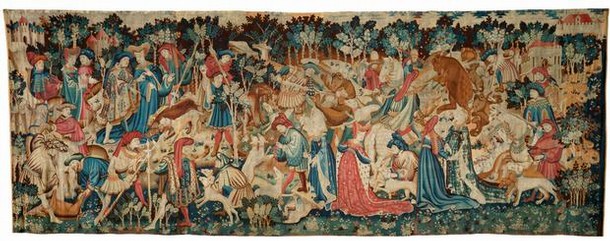
Similarly, the fact that people running around forests without so much as a backpack or a waterskin grates on me. It's one thing, of course, when someone is chased out of their home without time to gather materials; it's quite another when characters deliberately go out on a walk or a ride. Look at hikers now, or joggers; how many go for more than a quick trip up the block and back without at least a water bottle? And consider royal and noble processions, which would, as a matter of course, involve many people, all of whom would want to eat and drink along the way...but then, after looking at some medieval visual depictions of hunting, I have to note that expected baggage trains and carry-ons are absent. I guess, then, that while the series may not have such things true to life, it gets them at least true to (relatively) contemporary depiction, and that's something.

Tapestry with scenes of a boar and bear hunt, probably made in Arras or Tournai, Netherlands, 1425-30. Museum no. T.204-1957
Not a lot of packs, but perhaps a lot of baggage...
Image taken from the V&A, here, used for commentary.

Also, please consider submitting to the Tales after Tolkien Society's offering for the 2022 International Congress on Medieval Studies, discussed here: Twenty-First Century Neo/Medievalisms (a roundtable session). The session seeks to investigate "how a given twenty-first century work (any medium is accepted, and a diversity of media will be appreciated) makes use of the medieval or makes use of earlier works that themselves make use of the medieval, interrogating briefly how the mis/use of the earlier material serves to transmit ideas of the medieval forward. Prepared remarks should run some five to seven minutes, with open discussion to follow as time permits. Ideas in early stages of development are welcome." ***The formal call is here.***

Thursday, July 15, 2021

Once upon a Time Rewatch 1.6, "The Shepherd"

Read the previous entry in the series here.
Read the next entry in the series here.


1.6, "The Shepherd"

Written by Andrew Chambliss and Ian Goldberg
Directed by Victor Nelli

Synopsis

Doesn't look bad, actually...
Image taken from the episode, used for commentary
After a recapitulation of the series premise and the title card, David Nolan returns to his putative home in Storybrooke. He and Kathryn confer about it, and David betrays a lack of memory as he is led into a surprise party and introduced around. The party proceeds, with Henry continuing to propound his ideas about the true identities of the town's residents. David asks about Mary Margaret as Regina presses Kathryn, who does not know how to handle matters. Meanwhile, David wanders out of his party and finds his way to Mary Margaret in town. He pursues her, and she seeks to demur in favor of his present marriage; he avers his choice of her as a beloved, and she refuses him again.

So it's that kind of party...
Image taken from the episode, used for commentary.
Back in the Enchanted Forest, melee proceeds, to applause from an assembled royal delegation. The victor is praised and tasked with slaying a dragon in exchange for a supply of gold generated by the touch of one of the present kings--Midas. Details of the arrangement ensue, as do preparations for assault on the dragon--and the erstwhile victor is slain amid boasting of the victory.

The other king, whose son had been the victor, attends the body in a chamber with a round table. The body is borne out, and plans to replace the slain are made--involving Rumpelstiltskin. The two confer, arriving at a new deal that provides a duplicate heir. Said heir is a shepherd.

In Storybrooke, Emma confers with Mary Margaret about David. Emma advises against Mary Margaret pursuing a relationship with him. David, meanwhile, attempts to reconstruct his memories with Kathryn as he looks over photos from their life before; he ineptly reacts to her marital advances.

In the Enchanted Forest, or near it, the shepherd gathers in a sheep as his mother returns from market and notes an advantageous marriage prospect. He deflects it in favor of wedding for love, and Rumpelstilstkin arrives to strike a deal. Revelations of old dealings are made, and the shepherd resists the notion of accompanying Rumpelstiltskin to the king's assistance.

Or it's this kind of party...
Image taken from the episode, used for commentary.
In Storybrooke, Regina confronts Mary Margaret about Kathryn and David. She warns her away from David; David has left Kathryn, and Regina advises Mary Margaret against further engagement with him.

In the Enchanted Forest, the shepherd makes ready to face the dragon, uncertain of himself and his position. He is advised of his intended role, and the expedition against the dragon proceeds. The ruin it has caused is shown in some detail, and the putative hero is bidden remain in place as others proceed and melee begins--going badly for those who have gone ahead. The shepherd rushes in to assist as he can, which is little enough against the dragon, given his lack of training--but with some cunning and luck, the shepherd emerges victorious.

In Storybrooke, David approaches Mary Margaret. She again tries to deflect him, to push him away, and he refuses, pressing her for acceptance. The sheriff asks Emma to cover a night shift until interrupted by Mary Margaret, who rushes in to seek advice. And David considers matters.

She looks thrilled. Who wouldn't be?
Image taken from the episode, used for commentary.
Back in the Enchanted Forest, the shepherd is lauded. Midas offers his daughter, Abigail's, hand in marriage to the shepherd. After some protestation--taken as humilitas--the offer is accepted.

Once again, my inner Hank Hill...
Image taken from the episode, used for commentary.
In Storybrooke, Regina confronts David, seeking to persuade him back to Kathryn. She gives him directions to his intended goal and sends him on his way--somewhere other than he had intended, away from where Mary Margaret awaits him. But he calls in at Gold's pawn shop, where Gold gives him better directions, and parts of his memory begin to return, to Gold's amusement.

Back in the Enchanted Forest, the shepherd returns to his mother, victorious. She exults in his return, but he tells her he cannot return, being obliged instead to wed Abigail under threat of death--and his mother's death--from the king. In tears, she gives him a ring which she says true love follows, which ring is on Mary Margaret's finger as David finally reaches her. He announces what he remembers to Mary Margaret, noting that he remains confused about his current feelings. She rebukes him for his folly and leaves in tears.

Later, Emma sees a shadowy figure leaping from a window and gives chase. Said figure is the sheriff absconding from Regina's home after an assignation. In disgust, she sends the sheriff on her rounds--and David returns to Kathryn, his memories returning. They confer about the status of their relationship, David noting the need to work and his willingness to do that work--much as he had done with her in the Enchanted Forest. And Mary Margaret begins to find comfort elsewhere.

Discussion

Several points come to mind for me in the episode. One is the bit about the victorious son being slain amid boasting. I find myself put in mind of the Malorian Sir Kay, about whom I've done...some work. And, if I may borrow from Shiloh Carroll's excellent work, well, this comes to mind. I forget my chronologies, so I don't know which example's earlier, but they do certainly both speak to a theme, and it does seem to be one that suits neomedievalist works well enough.

A second, related, is the decidedly Arthurian twin-story--not so much because of the twinning, but because of the backhanded approach to the Beaumains / La Cote Male Tayle type involved. The Fair Unknown would seem to apply, at least in part, here; the heroism seems to be inborn, though there is no exalted lineage on display as yet.

The greatest of the points that come to mind has to do with the adulterous impulses David has in Storybrooke. The whole courtly love trope commonly associated with chivalric romance--and which is attested at least in part by Andreas Capellanus, thus giving it an "authentically medieval" imprimatur--hinges on adultery, on nobles philandering about with more and less success. The perils of such are amply attested, of course; the later parts of Malory offer the example clearest to my mind, although there are certainly others to be found, and penalties for violations of sexual ethics are noted in medieval English law and literature (one example among many is here). Even aside from "true love" moving to the fore, the actions of Prince Charming David seem consistent with the behavior expected of medieval/ist nobility (and, indeed, people in power in most times and places); it's something that the series evidently gets right.

Friday, July 9, 2021

Getting Ready for #Kzoo2022

𝔄s noted in the report from the Tales after Tolkien Society's activities at the 2021 International Congress on Medieval Studies, session proposals were made for the 2022 Congress. Information from the Congress regarding those proposals has been returned, indicating that the Twenty-First Century Neo/Medievalisms Roundtable session has been approved. Further information is forthcoming from the Congress, and submissions will almost certainly be made through Confex.

In the meantime, members and interested parties are invited to draft abstracts for a roundtable talk on the topic/s of how a given twenty-first century work (any medium is accepted, and a diversity of media will be appreciated) makes use of the medieval or makes use of earlier works that themselves make use of the medieval, interrogating briefly how the mis/use of the earlier material serves to transmit ideas of the medieval forward. Prepared remarks should run some five to seven minutes, with open discussion to follow as time permits. Ideas in early stages of development are welcome.

Volunteers to preside over the session will also be appreciated. While it is expected that such volunteers will also need to register through Confex, a brief email to talesaftertolkien@gmail.com indicating willingness to take on such a role will be appreciated.

As ever, members and interested parties are invited to share this information widely. The Society is happy to see work from across academe and outside it, particularly from historically marginalized groups and those approaching from less-commonly-heard perspectives.

Thursday, July 8, 2021

Once upon a Time Rewatch 1.5, "That Still Small Voice"

Read the previous entry in the series here.
Read the next entry in the series here.

There are stereotypical depictions at work in the episode. Just so y'all know.


1.5, "That Still Small Voice"

Written by Jane Esperson
Directed by Paul A. Edwards

Synopsis

Something's very meta about this...
Image taken from the episode, used for commentary.
After a recap of the series' premise and the title sequence, the episode opens with a puppet show being performed in a castle town--and a curly-headed boy picks pockets and purses among the audience. Later, the boy and the puppeteers confer over the performance, considering their ill-gotten gains and the boy's feeling of constraint by them.

In Storybrooke, Henry confers with his therapist, Archie; Henry asserts that the therapist is Jiminy Cricket and that there are no (other) crickets in the town, expounding on his theories. Archie presses Henry about his motives, urging him to think on them.

Elsewhere, Emma accepts a position as a deputy sheriff, refusing a uniform but reluctantly accepting a badge. An explosion rocks the sheriff's station as she does, and the two rush off to the scene of a cave-in at a local mine; Regina attempts to order Emma off, and the fact of her deputization becomes an issue in short order. Archie and Henry arrive on site as Regina expostulates; Henry rejects the idea, only to be dismissed by Regina as the area is cordoned off. Perhaps expectedly, he sneaks off, summoning Archie and Emma to investigate what he sees as a link between Emma and the collapse. Regina again interjects, angrily, and demands he work against Henry.

Ain't this a charmingly typical scene?
Image taken from the episode, used for commentary.
Back in the Enchanted Forest, the puppeteers and their grown son--Jiminy, the alter-ego of Archie--make ready to run another scam. Jiminy again protests and is overruled, guilt-tripped into assisting with the con as rain begins to fall. A boy talks to him about his situation, commenting on crickets, and a gift touches Jiminy's heart strangely.

Henry arrives for another therapy session and presents his idea for investigating matters further; Archie moves to quash what is described as Henry's emerging psychosis. The boy withdraws in anger, and Archie cries over it.

Yeah, this's gonna be a problem...
Image taken from the episode, used for commentary.
Elsewhere in Storybrooke, Mary Margaret plays a word-game with David. His wife, Katherine, arrives, and Mary Margaret withdraws, later confessing her perfidy to Emma over a dessert. They are interrupted by the arrival of a weeping Henry, and Emma goes to confront Archie about what he has done with Henry. The confrontation is interrupted by a call from Regina; it is clear that he has gone to investigate the collapsed mine.

In the Enchanted Forest, Rumpelstiltskin works a spinning wheel as Jiminy approaches, delivering purloined goods for pay. He intuits Jiminy's desires and offers a deal that will allow him to achieve them. Jiminy accepts the deal, somewhat trepidatiously, and leaves.

In Storybrooke, the search for Henry in the mine begins. Emma and Archie follow Henry as he reconnoiters the old mining tunnels, finding broken glass and triggering more collapse; Archie is trapped in the mine. He finds Henry, who leads him further into the mines.

Again, my inner Hank Hill...
Image taken from the episode, used for commentary.
Jiminy returns to his parents as they attempt another con. They are welcomed warmly and ply their work, exchanging a "tonic" for material goods and coin. As the itinerant make to leave, Jiminy realizes that their erstwhile hosts have suffered the effects of his deal with Rumpelstiltskin--and been transformed into puppets. Compounding the deed, the hosts were the parents of the boy who had greeted Jiminy so kindly in the rain.

Archie finds Henry in the mine again, reiterating their danger as search and rescue efforts continue. Arguments ensure, and Emma and Regina set aside their differences to effect the recovery. Meanwhile, Archie and Henry find an elevator, and preparations are made to blast the mine open. The explosion does not help.

David greets Mary Margaret as she makes to leave, asking her to walk with him a while. She agrees, and they stroll together, her asking him about his memories. He notes the surreality of his situation--except for his interactions with her. Katherine arrives again, interrupting them.

Search and recovery continues, Emma employing Archie's dog to help. They uncover an air shaft, and, in the mine, Henry apologizes for causing trouble. Archie apologizes for his outburst with Henry in his office. The mine continues to shift around them as, above ground, work to clear the air shaft continues. They confer further about Henry's ideas, and Emma makes her way toward them.She extricates them just as the elevator gives way, returning both safely to the surface. Archie, emboldened, confronts Regina--successfully.

In the Enchanted Forest, a mournful Jiminy looks to the heavens in hope and makes a wish--that is granted obliquely, making him into the cricket as which he is known and binding him to Geppetto. And in Storybrooke, the crickets return, Gold stalks through his shop, and Mary Margaret resigns from her work at the hospital. Regina, however, looks into the mine with concern, where a shattered container lies.

Discussion

Once again, the series does poorly in rehashing old prejudicial ideas--not by name, of course, because that might be actionable, but in a coded mixture that makes clear what is being referenced without having to speak the name thereof. In this case, the brightly colored wagons and clothing of the puppeteers and their propensity towards theft and grift call up stereotypes about the Roma/Romani (I've seen both terms used, and I'm not sure which is preferred; I know both are preferable to others) long used to persecute the itinerant people. And there might be some who would argue that reliance on the imagery is, in fact, a nod to historical accuracy--but that would betray a misunderstanding of the historical fact; yes, the prejudicial depictions are historically attested, but the accuracy of those depictions is questionable at best. (I do not think "best" really applies in the present case.) It's another bit of sloppiness on the part of the show's...I'm not sure who, really, is responsible, here, actually; I guess everybody involved is complicit at some level, and I and others who watch/ed the series, prompting its continued existence, bear some blame, as well.

The questions, then, are how do we recognize what is wrong and how do we work to make it right?

Thursday, July 1, 2021

Once upon a Time Rewatch 1.4, "The Price of Gold"

Read the previous entry in the series here.
Read the next entry in the series here.


1.4, "The Price of Gold"

Written by David H. Goodman
Directed by David Solomon

Synopsis

You can see where this is going, I think.
Image taken from the episode, used for commentary.
After a recap of the series premise and the title card, the episode opens with three extravagantly dressed young women taking a carriage while another, in rags, cleans. As she does, her fairy godmother appears, introducing herself to Cinderella and offering her a chance at a better life--until she is destroyed and her wand taken by Rumpelstiltskin. Rumpelstitlskin tells Cinderella that he has actually helped preserve her from harm; she pleads to be taken away from her current life, and he strikes a deal with her--for her future good. That done, he sends her along the traditional Cinderella story.

In Storybrooke, Emma and Henry walk down the main street and consider their situation. After Henry goes on his way, the sheriff confronts Emma, thanking her for her assistance and offering her a job as a deputy. She demurs, though he reiterates his invitation with seeming romantic intent. Later, Regina confronts Emma again, noting her lack of connection to the community; Emma ends up spilling cocoa on herself and makes use of a local laundry, where she encounters Cinderella's alter-ego--again working in cleaning. She is pregnant, soon due, and afraid; Emma works to encourage her.

I channeled my inner Hank Hill...
Image taken from the episode, used for commentary.
Mr. Gold, Rumpelstiltskin's alter-ego, closes up his shop and goes out; in his wake, Cinderella's alter-ego, Ashley, breaks into his shop, searching through curiosities and knickknacks for money. Gold confronts her, and she sprays him with pepper spray; he falls, knocking himself out, and she steals a trinket form his unconscious body.

Regina makes ready to attend a council meeting, bidding Henry remain home while she is away. He, of course, steals away at the earliest opportunity to where Emma is unpacking her meager belongings at Mary Margaret's home. He is preceded, however, by Mr. Gold who offers to engage her services to retrieve Ashley and his trinket. She reluctantly agrees as Henry arrives; Gold departs, and Henry voices confusion about Gold. Henry tries to tag along with Emma as she searches for Ashley; she cannot deter him.

...are held for charity, and some for fancy dress...
Image taken from the episode, used for commentary.
Back in the Enchanted Forest, Cinderella's story continues to unfold along the Disney model. She and her prince confer about their nuptials, and they greet Snow White and Prince Charming in advance of a fancy dance. Rumpelstiltskin confronts her about their deal, demanding his price in the form of her firstborn. She packs to flee, and her husband confronts her; she notes her pregnancy and the coming price to be paid, confessing her folly. Her husband avows his love for her, offering another bargain.

Emma pursues leads regarding Ashley, starting with her boyfriend--her child's father, Sean Herman, who is reported to have left her upon learning of her pregnancy. Emma moves on to confront the boyfriend, who lives with his father; the father is the cause of the breakup, having paid Ashley to give up her child--to Gold. Emma presses on, continuing to pursue Ashley--who is heading for Boston, and Emma moves to intercept. Henry notes the inability of people to leave the town, and pursuit intensifies.

Not the most dangerous game, but hardly safe...
Image taken from the episode, used for commentary.
In the Enchanted Forest, Cinderella and her husband join Charming and a dwarf in surveying a cell being prepared for Rumpelstiltskin and a plan to subdue him. Cinderella demurs, but her husband offers to pay the required price. The plan proceeds--as does Emma's pursuit, which finds Ashley's car wrecked just inside the Storybrooke city limits, and Ashley in labor. They rush her to medical attention, Emma expounding on maternal responsibility along the way. Rumpelstiltskin arrives to confer with Cinderella about amending their deal; he resists the machinations of which she is aware, but he seems unable to resist making a new deal, falling victim to the plan and being imprisoned.

At the hospital, Henry confers with Emma about the ability to leave Storybrooke until Gold arrives. Cinderella's husband again reaffirms his love and rushes off to retrieve water for her. He is taken, and Emma rages. Similarly, in Storybrooke, Gold presses for the child, confronting Emma about adopting children. Emma successfully dissuades him from taking the child at the price of a favor to be determined later. Mother and child are well, and Emma rushes Henry home to beat Regina home from her assignation. And Sean arrives at the hospital despite his father's admonitions, trying to be part of their lives again, while Emma accepts the sheriff's job offer.

Discussion

I've commented in this webspace about anachronism and compression of the medieval in neo/medievalist works, certainly, and it seems to be at work again in the present episode and elsewhere. Disney's presentations of fairy tales tend to fall into doing such things already, let alone with the milieu-shifting at work in the series, so it's not a surprise to see them happening once again. Even unsurprising, though, it is annoying to see so much pre-twentieth-century material conflated together, as if time and cultures prior to 1900 are a unitary mishmash of idealized feudalistic romance, Regency pageantry, and Victorian conceit.

I don't know why I should've expected any different, of course. I've already noted that the series is problematic in the ways it, early on, reinforces prevailing stereotypes (something reiterated in the present episode with Regina's clandestine assignation); it's not less so in reinforcing lazy thinking to its broad audience, rather than using its platform to at least try to get things "right" (acknowledging both that concerns of addressing the audience limit what can be done and that "right" is a damned slippery term, in the present context and many others). While overt lecturing would scarcely be appropriate, getting details of setting and costume at least aligned to a consistent time-frame wouldn't be so hard to do. It's not as if there is or has been any shortage of people who do study such things and would be happy to consult (for appropriate fees) on them.

Thursday, June 24, 2021

Once upon a Time Rewatch 1.3, "Snow Falls"

Read the previous entry in the series here.
Read the next entry in the series here.


1.3, "Snow Falls"

Written by Liz Tigelaar
Directed by Dean White

Synopsis

Pretty.
Image taken from the episode, used for commentary.
Following a recap of the series's premise and the title sequence, action opens in the Enchanted Forest with a carriage traveling down a remarkably well-maintained road. Prince Charming is riding in it with an impatient princess--Abigail--when they are stopped and ambushed by a thief--Snow White--who steals a pouch and rides away. Charming gives chase, confronting the thief, who assails him and flees, smiling.

In Storybrooke, Snow White's alter-ego, Mary Margaret Blanchard, is on a date. It does not go well, and she goes home alone, meeting Emma along the way and inviting her to room with her instead of in her small car. Emma demurs.

I'm sure there's some comment to be made here.
Image taken from the episode, used for commentary.
The next day, presumably, Mary Margaret's class volunteers at the local hospital, and Henry finds himself drawn to a comatose patient--Charming's alter-ego, in the event. Student and teacher confer about him, Henry pushing her to recognize him; she does not.

Later, Henry reports to Emma about Charming, citing evidence that she does not entirely accept. He urges Emma to push Mary Margaret towards the comatose patient; she agrees to push the point, and presents the idea to Mary Margaret. There, it meets with some resistance, although Mary Margaret eventually agrees, and that evening sees her read from Henry's storybook to the comatose patient--who reacts, strangely and powerfully, to her doing so.

Nope, nothing to see here. Move along.
Image taken from the episode, used for commentary.
Mary Margaret retrieves the attending physician with the news, and he expresses his doubts based on recorded vital signs. He sends her home, and she departs--after which, he calls Regina, reporting events, to her displeasure.

At home, Mary Margaret continues to read through Henry's book, and the episode shifts to follow the story contained therein--in which she, as Snow White, retrieves loot and departs a forest hideout. She is trapped upon exiting, Charming having found her, promising always to find her and being awarded his sobriquet. They banter aspersively about marriage and arrive at an agreement to retrieve his property.

In Storybrooke, Emma, Henry, and Mary Margaret meet for breakfast. The last reports the events of the night. Henry urges her to read again, and the two start to rush off; Emma, disbelieving, demurs again, but Mary Margaret presses on, and Emma follows. When they arrive at the hospital, they find that the comatose patient is missing, and Regina lashes out. She also explains her involvement, and the attending physician notes the danger of his disappearance; pursuit begins with questioning hospital employees and reviewing security footage. Emma notes that the footage is incorrect, and, after the actual tape is found, a lead to pursue is revealed.

Not Nazgûl, but not Black Riders to be sought, either...
Image taken from the episode, used for commentary.
In the Enchanted Forest, Snow White and Prince Charming travel together to retrieve his goods. They confer tensely along the way, and Snow White notes her anger at the evil queen and her plans to depart from the latter's reach. Snow White also notes the justification for Regina's hatred. They fight again, and Snow White pitches him into a river before fleeing; she does not get far before being intercepted by Regina's forces. They move to retrieve her heart. Charming rushes to Snow White's rescue, defeating two of the queen's forces and giving chase to the third, who had absconded with her. The last rider falls, and Snow White pauses in flight to tender her thanks. They proceed to confront the trolls to whom she had sold Charming's jewels. A fracas soon ensues, in which the two save one another from death and captivity; they affirm their mutual regard in an awkward parting.

Nope, no problems here.
Image taken from the episode, used for commentary.
In Storybrooke, the search for the lost patient continues. Mary Margaret asks Emma about her bounty-hunting work, and they are interrupted by Henry, who claims to know the patient's destination: Mary Margaret. Henry presses them, and they are interrupted by physical evidence of the patient's progress through the woods--and his injury. Pursuit intensifies, and they find him in the water near a bridge; aid is summoned, and work begins to revive him. Mary Margaret's ministrations succeed in bringing him back, not only to life, but also to consciousness--though not to memory. He is returned to the hospital for care--and his wife, the alter-ego of Abigail--joins them. She explains the estrangement that led to her husband's--David Nolan's--hospitalization and moves to address it.

Emma confronts Regina about the inconsistencies in events. They trade barbed threats, and Regina explains the oddities away. Later, Emma takes up Mary Margaret's offer.

Discussion

A comment about the architecture on display as the episode begins seems in order. Admittedly, I am not an architect or a student of that discipline, so my comments will be of a necessarily amateurish nature, but it seems to me there is a mishmash of styles at work. Said amalgamation suggests the compression of the sprawling centuries of the medieval, something noted as at work in no few other media properties that make use of medieval/ist tropes, although it is also the case that a number of medieval edifices were built in stages and parts over time, so that their own architectures are not entirely consistent. But notable among the things in the opening castle-shot is the sheer size of the church contained in the castle walls--identifiable by the abundance of stained glass in the exterior shot. The series does not, at least in its earlier episodes, make much use of religion (aside from the wedding ceremony, which evokes but does not explicitly traffic in Christianity), one of the typifying features of the medieval in popular conception and in documentary history (for the simple reason of who had time and ability to write), so it seems a bit of an oddity to give quite so much space to faith--especially in a castle, which could be expected to have a chapel but not a cathedral that takes up a third of its interior space. Whether this is a more or less authentic thing can, of course, be argued.

Interestingly, the revenge-plot that drives much of the early series begins to be articulated in the present episode, Snow White admitting that she ruined Regina's life and thus spurring the latter's quest for retribution. While revenge plots are hardly unique to the medieval/ist, they are certainly large parts of the stories that continue to be told. Njal's Saga features no small number of instances of vengeance being pursued, not always through legal means (and, notably, spurred on by women depicted); Arthurian legend abounds with them, and not only in Malory. Consequently, while the revenge plot does not, on its own, mark the series as medievalist, it does fall firmly in line with what medievalism is already present, reinforcing it.

Thursday, June 17, 2021

Once upon a Time Rewatch 1.2, "The Thing You Love Most"

Read the previous entry in the series here.
Read the next entry in the series here.


1.2, "The Thing You Love Most"

Written by Edward Kitsis and Adam Horowitz
Directed by Greg Beeman

Synopsis

My heart...
Image taken from the episode, used for commentary.
After a brief recap of the previous episode and the title sequence, the episode opens with Henry staring out over the town and smiling at the now-ticking library clock. The next day arrives and shows the reactions of several other characters to the new day and its bright morning. Regina pores over Henry's book, finding a number of pages torn out. She confronts him about them, only for him to deflect the questions posed and to capitalize on her distraction by the ringing clock bell.

I've seen that kind of smile before. It's never good.
Image taken from the episode, used for commentary.
Regina calls on Emma shortly thereafter, offering her fruit as she urges her to leave town. A flashback to the fairy-tale realm--the Enchanted Forest--serves to illustrate the point, with Regina threatening Snow White and Prince Charming before teleporting back to her chambers and consulting with attendants about retrieving a dark curse from a forbidden fortress.

The fortress looks forbidding enough...
Image taken from the episode, used for commentary.
Traveling thence, Regina meets with Maleficent, where a barbed conversation ensues in which Regina dickers to get the dark curse back, having previously traded it to Maleficent for a sleeping curse that seems not to have worked. Maleficent asks after its origins, and Regina demurs before a fight ensues. Regina emerges victorious, and Maleficent urges her, in vain, not to enact the curse.

Regina makes an attempt to enact that curse, one that fails due to insufficient sacrifice to fuel it. The death of what she loves most is required, and what she initially gives is not it; she is mocked for the failure.

Back in Maine, the local newspaper editor, Sidney, presents Regina with information about Emma, relating details of her past that Regina finds unsatisfactory; he returns to his investigations. Henry confronts Emma again, trying to press her into his work to lift the curse on the town, explaining the situation as he sees it and presenting her the pages torn from his storybook along with a warning about Regina. Emma follows up on it, which leads her to Henry's therapist; he is circumlocutive, although he flagrantly breaches professional ethics and patient confidentiality to help her--as he has been directed to do.

I'm...not sure how to feel about this.
Image taken from the episode, used for commentary.
Emma reviews the file until interrupted by the sheriff knocking on her door--with a claim that Henry's file has been stolen. Given the presence of the file in her room, he takes her into custody as Regina pulls her son aside at school to tell him of the arrest. He rejects her explanation and returns to his lessons. Emma and the sheriff confer until Henry and his teacher--Snow White, as it happens--arrive to make Emma's bail; she vandalizes Regina's property swiftly thereafter, provoking another confrontation.

In the Enchanted Forest, Regina confronts Rumpelstiltskin regarding the dark curse and its failure. He advises her that Snow White has called upon him and that there is a weakness in the curse. He also strikes a deal for his life in the new world in exchange for information about the demands of the curse--the heart of the thing she loves most.

In Maine, Emma finds herself turned out of her lodgings. The sheriff demurs in prosecuting Emma, and Regina rages at him. Emma and Regina confer, and Henry overhears the discussion--as Regina intended. And in the Enchanted Forest, Regina acts upon the information Rumpelstiltskin gave her; she rips her father's heart from his chest, ensuring that the curse will spread even as she is ill at ease with the price she has paid to enact it.

Emma calls on Henry's teacher, thanking her for posting her bail and repaying it; the teacher invites her in for cocoa and conversation. Emma affirms that she means to leave, citing the need to keep Henry from hurting; the teacher argues against it, citing the clear regard Emma has for Henry. And Henry sits silently in his therapist's office until Emma bursts in, apologizing to Henry and affirming her intent to remain in the town--and burning the pages torn from his book to keep them from Regina before they walk out into the town together.

Mr. Gold, Rumpelstiltskin's Maine persona, calls on Regina, informing her that Emma remains in town. He offers his services in eliminating her, for a price, and she rages against him.

Discussion

Henry's book is an interesting bit of medievalism in the present episode (and in future ones, as it happens). It is shown to have illuminated capitals and a number of illustrations, and while the latter is commonplace enough, the former is a deliberate nod back to medieval European manuscript production. The size of the volume is atypical, certainly but that is also somewhat reminiscent of parchment volumes, which were in some ways constrained by the dimensions of the animal from which they came. And it is notable subject to destruction and excision ("It's an old book; stuff's missing."), something that hurts me to see and which plagues studies of older literatures; much is unknown because the pages are simply not present. In some ways, then, the foundation of the series--Henry's book--is a playing with medievalist tropes, grounding the series as a whole in that medievalism even as there are...issues, as discussed previously.

The architecture on display in the episode also rings of the (Disneyfied) medievalist. Regina's chambers in the Enchanted Forest are overwrought Gothic, with vaulted arches and high ceilings in black; the Forbidden Fortress where she meets with Maleficent is very much in the fantastic castle tradition with its thrusting towers and crenellations rising from an impossibly-suspended stone formation, and its interiors seem in that same mode. There is, admittedly, no pretense of authenticity at work; the characters and their fantasy setting are explicitly noted to be fairy-tale constructions, and they are in some senses closer to their older sources that the Disney-working-from-Perrault versions familiar to the presumed audience of the series. (Again, being on a major broadcast network in the United States at prime time has...implications for who is watching.) But there is something to be noted in the carrying-forward of common tropes despite a prevailing informational context that ostensibly (inaccurately and ineffectively, perhaps, as Shiloh Carrol notes throughout her discussion of Martin in this webspace) traffics in a "realistic" medieval.

Thursday, June 3, 2021

Once upon a Time Rewatch 1.1, "Pilot"

Read the previous entry in the series here.
Read the next entry in the series here.


1.1, "Pilot"

Written by Edward Kitsis and Adam Horowitz
Directed by Mark Mylod

Synopsis

That's neither ominous nor disheartening...
Image taken from the episode, used for commentary.
Following a brief textual introduction, a richly-clad rider races along a causeway (that obviously sees a lot of wheeled traffic) and through a forest as snow begins to fall. He joins a group of dwarves who surround the glassy coffin of a pale woman; he bids the coffin opened and kisses the woman within. After a rippling of rainbow magic, she wakes, Snow White responding to Prince Charming once again. The two are wed in a towering, stained-glass-walled room with many in attendance, the ceremony interrupted by the entrance of a dark-clad queen who proclaims her evil intent to destroy the happiness of all there gathered.

Yeah, the aspect's off, and the illustration's odd...
Image taken from the episode, used for commentary.
The whole is revealed to be a story in a book, read by a boy on a bus bound for Boston. As he arrives there, a woman in a red dress makes her way into a restaurant to meet a date--as a pretext to pursue a bail-jumper; she is a bail bondsperson, taking her quarry. After, she returns to a hotel room, where the boy confronts her, naming her as Emma Swan and claiming to be her son, Henry. Emma is understandably taken aback by the revelation, as by the assertion that Henry is the child she gave up for adoption a decade earlier. He tries to enlist her to return to his home: Storybrooke, Maine. She agrees to take him home.

Pretty, yes?
Image taken from the episode, used for commentary.
A castle towers over an inlet amid mountains. In it, the pregnant Snow White muses over the evil queen's threat, with Charming trying to comfort her; she reminds him of the queen's evil and suggests visiting an imprisoned figure. Charming reluctantly agrees.

Emma drives Henry back out of Boston as he resumes reading from his book; he asserts the truth of the stories therein, as well as the power of belief. He notes that Emma herself is in the book, the story from which he reads treating the visit of Snow White and Prince Charming to the imprisoned figure--Rumpelstiltskin. After Snow White agrees to give Rumpelstiltskin the name of her unborn child, he informs her of the queen's machinations; a dark curse is in the offing, one that will trap them all in time and in a place where what they value is gone from them. "No more happy endings," he says, but notes that the child will be their savior on its twenty-eighth birthday; the child's name is revealed to be Emma.

That's neither ominous nor disheartening...
Image taken from the episode, used for commentary.
At length, Emma and Henry reach Storybrooke. She pulls the car to a stop in front of a library with a stilled clock, and Henry notes that time is frozen as he explicates the situation: "The evil queen sent a bunch of fairy-tale characters here," trapping them. His therapist, Archie, meets them, expressing concern and informing Emma that Henry's mother is the mayor; she goes to return him home.

Snow White, Charming, dwarves, and others gather around a round table to confer about what to do. Discussion is not productive until a blue fairy arrives, bringing enchanted wood that can be used to save the as-yet-unborn Emma--and only one other.

Henry resists being returned to his mother, the mayor, Regina Mills. Regina, for her part, is happy to see her son, and she and Emma confer about Henry's situation. The circumstances of his adoption are noted, as are his current difficulties. Emma notes the strange book, which surprises Regina; Emma is surprised in turn to be hastened on her way away, but as she tries to leave town, she sees she still has Henry's book--and she crashes, swerving to avoid a wolf in the road just as she reaches the edge of town.

That's neither ominous nor disheartening...
Image taken from the episode, used for commentary.
Geppetto and his son, Pinocchio, work on the tree to effect Emma's escape from the coming curse. Snow White looks out over her domain before conferring with Charming about which of them will accompany Emma. The decision is made to send Snow White with their daughter, and she goes into labor as the curse begins to encroach.

Emma wakes in jail, having evidently wrecked her car while driving drunk. She, another prisoner, and a local confer briefly before Regina enters, noting Henry's absence; a search for the boy begins, with Emma showing her skills. They point to Henry's teacher--who appears to be Snow White, bird-handling and all. Regina confronts her, but it yields no useful information--but does present an opportunity for Henry's teacher to wax eloquent on the value of story before making a painful gaffe and offering Emma direction.

The birth proceeds as the curse approaches--along with the evil queen. Geppetto's work is completed, and Emma is taken to it for her safety shortly after her delivery; Charming saves the child at the cost of himself. Snow White later finds Charming--and their daughter absent, while the queen gloats over her partial success as the curse takes hold.

In Storybrooke, Emma finds Henry at a dilapidated playscape. He implores her for aid and forgives her for giving him up for adoption; she denies that she is a savior, but she affirms the reason for giving him up for adoption and relates her own background as a foster-child. She also takes him back to Regina once again; their ensuring conversation irks Regina greatly, prompting her to threaten Emma. Henry is despondent, and Regina takes away his book, beginning to panic at events.

Henry's teacher volunteers in a hospital, comforting patients--including one who looks much like Charming. Emma takes a room at a local inn, where a sinister landlord, Mr. Gold, greets her. And the library clock begins to tick again.

Discussion

Okay, so, first thing's first: it's Disney. Given that the series ran on ABC, it's not unexpected--nor yet is the fact that the series, rather than being medievalist in itself, is predominantly neomedievalist--that is, rather than going to medieval antecedents more or less directly, it works from sources that are themselves interpretations or reimaginings of medieval antecedents. In the main, the series uses Disney's interpretations of fairy tales and other public domain narratives as its touchstones, rather than the things Disney interprets. (Kavita Mudan Finn offers discussion of the phenomenon here.) In doing so, the series reinforces the already-existing overdetermination of such narratives by Disney, but that is not to be wondered at; media production is a business, after all, it's better business to pay less for materials than to pay more, and using what you already own is cheap. Nor yet is it to be blithely set aside; yes, "it's just a show," but it's one that does get watched with children, and even adults are often deeply influenced by the entertainment media they consume; consequently, the series is in position to shape and shade popular understandings of the medieval, not because it treats the medieval, but because it is perceived as doing so. (Paul Sturtevant's book, discussed here and here, speaks to the idea, among others.) So there's that.

Even with that, though, there are medievalist things that the episode gets right. The round table, for one thing, calls back powerfully to Arthurian legend, perhaps the medieval narrative most likely to be familiar to the general viewership of the series (a prime-time show on ABC will necessarily be trying to reach the broadest possible audience, something that might explain some of the simplifications, etc., at work in the series). The involvement of the fairies in world-shifting lines up with traditional stories, as well.

There are also things the episode gets wrong (aside from some dubious costume decisions--even aside from the historical issues, to which others can speak with greater knowledge and insight than I, several of the pairs of pants worn look like they would chafe). Although there are people of color present and active in the neomedievalist fairy-tale world, they are not among the "important" protagonists for the most part; they tend to be subordinate figures, with the exception of the evil queen--a Latina coded as overtly and, well, evilly sexual. The stereotyping is...not to Disney's credit, and it problematically reinforces both the usual ills associated with reductive typing and what Helen Young describes as the myth of the monochrome Middle Ages, the notion that the only people, or the only people who mattered, in medieval Europe were white people. And, again, since popular media narratives exercise influence, and those promulgated by Disney are positioned to exercise more influence, the already-problematic stereotyping is...even worse.

As a note, I'll be away on vacation next week, so no update. Join us again on 17 June 2021!