Saturday, June 17, 2023

Playing with Medieval(ist?) Religion in Forum-Based Play-by-Post Roleplaying Games: A Case Study

What appears below is the text of a paper delivered in the Society's session at the 2023 International Congress on Medieval Studies. Minimal editing, other than that needed to suit online presentation and the insertion of illustrative images, has been applied to the text of the paper as given. Owing to some of the limitations of this webspace, notes in the paper are presented as unlinked endnotes, with apologies.

đť”’ne of the means through which people begin to engage with the medieval most directly is roleplaying games. Described as collaborative extemporaneous rules-assisted storytelling,1 the roleplaying game (RPG) can be viewed as a formalization of childhood games of pretend. The most popularly known such game is Dungeons & Dragons (D&D), which Lawrence Schick notes emerged in the mid-1970s from a combination of drunkenness, historical miniatures wargaming, and “rules for monsters and nonhuman races drawn mainly from Tolkien,”2 so that it looks to interpretations of the medieval for its materials, just as other RPGs look to D&D. Given such origins, interpretations of the medieval can be expected to appear even in game-narrative genres that would normally be expected to foreclose such things. Many RPGs, however, overtly and explicitly engage in presenting the medieval--or visions and interpretations thereof. One such is Pendragon, which normally takes place within an amorphously Arthurian milieu, but which can be repurposed to treat more general ideas of what has often been called high medieval Europe.

An iteration of the Pendragon RPG which moved toward a more "historical" medieval appeared as a play-by-post forum-based (PBP) event hosted on the FallenAsh servers. A long-standing online gaming community, FallenAsh permits new and established players to participate in asynchronous collaborative rules-assisted storytelling in a variety of milieux and genres, primarily via PBPs. As of the beginning of February 2023, there were between 130 and 140 members of the community.3 An informal survey of the community conducted in January 20234 noted that a majority of respondents were based in the United States, with some in Brazil, Germany, Japan, and the United Kingdom; community members have also noted living in Canada, as well as in Nordic and Eastern European countries, although they were not among respondents. English is the primary language of the games and their players, although speakers of many different languages and people of divergent backgrounds and positions in life are present and active in the community. Many have extensive experience playing RPGs in tabletop and online venues--decades of it, in no few cases--with some having been involved in developing and playtesting such games. They also tend to be among the more highly-educated. Their treatment of religion in the game can therefore be examined as a useful example of how gaming might understand and make use of religious ideas prevalent in the better-known parts of the European Middle Ages.

About the Pendragon RPG

As I had the privilege to note in previous work, from which the current project derives,5 the fifth edition of Greg Stafford’s Pendragon RPG was published in 2005 by Arthaus, a subsidiary of White Wolf Games6--a publisher most notable for Vampire: The Masquerade and the related World of Darkness games.7 While RPGs are generally neomedievalist (that is, looking back to post-medieval interpretations of the medieval), Pendragon is more avowedly directly medievalist, purporting to look back to “Facts (or at least what are widely considered facts) drawn from [chronicles such as Geoffrey of Monmouth’s]” and “parts from all literary versions” of Arthuriana8--or, at least English / Malorian, French, Welsh, and more modern and radical takes, notably eschewing German, Spenserian, and other visions of Arthur.
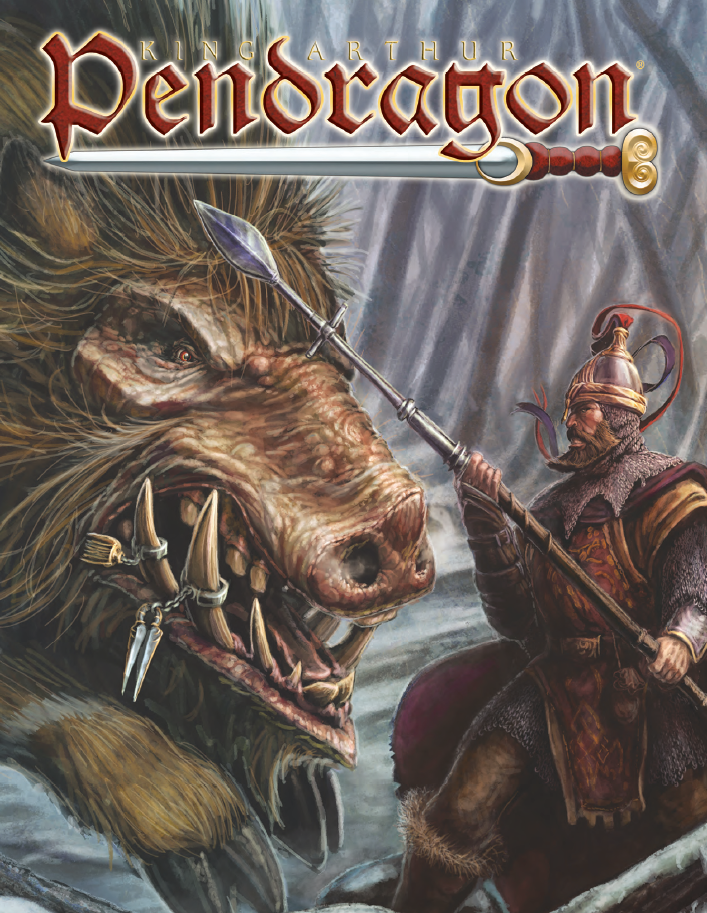
The cover of the
game-book
Even in that grounding, though, the game begins to run into commonplaces of treatments of the premodern: a focus on upper social strata and time-compression.9 The game flatly announces itself as focusing on knights, describing them as the chosen elite.10 While it makes some sense to do so--as I’ve noted elsewhere, “Peasant life is unattractive, particularly to those whom depictions of it might point up their own equivalent status,”11 and many others have attested far more eloquently to the same--to set as of little importance the deeds and doings of a majority of people is no boon to understanding or getting things right. For a game that purports to encapsulate “brutal reality,”12 it is hardly a commendation. Nor yet is the collapsing of the Middle Ages into a short span--“fifteen years of game time approximate a hundred years of real-world medieval history,” so that the noted game-span of 485-565 CE subsumes the late fifth through late fifteenth centuries,13 roughly Gildas to Malory.

Many or most of the sources upon which the game as a whole relies make much of religion, mostly Catholicism, as a prevailing backdrop against which the events of the narratives stand in sharp relief. Prevailing Arthuriana--exemplified in English by Malory--features the knights routinely hearing Mass, recoursing to hermits, and involving the Pope in their familial strifes, and the literary tradition of which Malory is the linchpin extends back to its beginnings through the writings of churchmen such as Geoffrey of Monmouth, Nennius, and Gildas.14 It follows, then, that Pendragon, for all its compressions and simplifications, would do the same--as is the case.

The game as a whole remarks at great length about religion in its primary setting; comments laying out the treatment of religion in the game take up almost as much of the text as explanations of the combats that typify both Pendragon and the RPG in general.15 Publication constraints suggest that space is only given to what is considered important for play. Many RPGs, including D&D, focus heavily on combat, in large part because the rules for combat occupy large parts, if not the majority, of the overall rules-sets. For Pendragon thus to accord religion nearly as much space to religion as to combat bespeaks the relative importance of religion to the game.

As might be expected and as is mentioned above, the focus of Pendragon’s religious discussion is on the shape of Catholic Christianity in Britain during the decades and centuries covered by the game, offering a gloss of history and chronicle, presenting some information on schisms, heterodoxies, and heresies at work, and providing what amount to character blurbs regarding historical religious figures such as the aforementioned Gildas. It must be noted, though, that the game treats a putative paganism still lingering from pre-Christian Britain in its rules. It must also be noted that the discussion of religion in the main game betrays some cynicism: “judgment is consistent--whatever most benefits the Church is upheld by its court.”16 And it further must be noted that, despite the attention given to religion in the main game rules--to the extent that “Knights who follow a strict religious way of life get an advantage in game”17--play-groups are advised against engaging overly much with religious conflict in the game.18

What becomes clear with Pendragon, generally, is that the game simultaneously acknowledges two things: the importance of religion to its venue and, at least obliquely, to the cultures in which its expected player-base exists; and the tensions that necessarily arise when treating such matters in what is an ostensibly fun activity.

About Lionheart

Lionheart is the title of a specific game of Pendragon played by post on the FallenAsh servers in September and October 2021.19 That is, the game was played asynchronously, with players posting in threads gathered into layered forums instead of in real time. Participants were encouraged to secure copies of the Pendragon rules for themselves, and the game, throughout, made ample use of the basic rules-set Stafford had laid out. Rather than taking the standard compressed Arthurian setting assumed by Pendragon, however, Lionheart focused on the coronation of Richard I of England, the eponymous Lionheart, and the short time thereafter that he remained in England before heading off to the Crusades--namely 3 through 12 September 1189.20

The landing page of the game, in all its glory.
While the game swiftly departed from attested history, with players’ characters--PCs--emerging from the players’ imaginations to take up great offices of state, for example, the game made a point of grounding itself in reported events and people. For one example, an option for character creation was to take historical personages as characters; players could have as their characters Henry of Brunswick or Marie de France,21 for instance, and Margaret de Beaumont and William de Warenne were PCs.22 For other examples, discussions of expected conduct were digested from known sources such as the Urbanus Magnus,23 and framing of relative social powers drew from such sources as the Domesday Book.24 Further, much was done to offer broad socio-historical context to the players, with a number of threads laying out general histories from 1066 forward and concerns known to have been current to the coronation.25 As such, Lionheart made a commendable, sustained effort to work within the confines of attested history.

I have to note that, while respondents from the FallenAsh community skew toward the highly educated and tend slightly towards humanistic and literary study, they are not, by and large, specialists in medieval European or medieval English history, broadly defined. Given that and the expected compression and elision of any simulation, any errors in interpretation and representation cannot be said to be made in bad faith. Rather the reverse is true; participants in the game worked to be as close as possible, given constraints of the gaming context, to the best possible understandings of the medieval available to them and to the most sensitive approaches to them circumstances would permit. None of what is noted in this paper should be taken as a condemnation; instead, the majority of participants in the game should be lauded for the effort to get things right.26

What Lionheart Gets Right about Medieval Religion

Participants’ efforts did lead to a number of things coming off as accurate or authentic. For one thing, the relative centrality of organized religion is emphasized in the design of the game itself. As a PBP game, Lionheart required an informational setting in which to exist; for PBPs on FallenAsh, this is almost always in the form of location-based higher-level fora. That is, before play begins, the game’s administrator--the GM, Cearnacht--sets up overarching places for discussion. Some will be for out-of-character talk, but most will be locations in the game where PCs can act and interact. Lionheart featured four general areas--Westminster Abbey, Westminster Palace, Westminster, and London--divided into a total of 19 sub-locations. Westminster Abbey, the first of the general areas, had eight of them, as many as any two of the others. It is a minor thing, perhaps, something that might well be called paratext, but still one that accurately underscores the importance of religion in the life of medieval England.

As noted.

Further, Lionheart openly acknowledged and faced both the presence of Others--and the postcolonial capitalization is apt--in England and the poor treatment of the same by official structures. One of the earliest topics developed by the GM is, in fact, “A Word about Otherness in the Middle Ages,” and it does not shy away from acknowledging that minority populations--including religious minority populations--existed in the England of the time and that they were mistreated by the majority and those in power.27 That alone marks the game off as distinct from many others, which often shy away from such topics by way of romanticizing them, if not flatly ignoring them.28 That is, RPGs, both in their basic settings and in their specific iterations, will frequently gloss over the social problems found in their settings’ sources. Lionheart did not, but very nearly opened with a direct engagement with the known challenges presented by the selected setting.

Lionheart also gets right another key point in its discussion of religion, namely “the Church’s role in adjudicating the acceptability of marriages.”29 Sandra Masters expounds upon that role and its development at some length,30 as do Ryan Patrick Crisp31 and Richard J. Warren.32 It must be noted, too, that the ultimate undoing of Arthur’s kingship lies in his (admittedly unwitting, in Malory) incestuous union with his sister.33 Clearly, incest is a problem, and consanguinity is a concern. Clearly, too, both are involved in concerns of religion in the “real” medieval, both its attested history and its “popular” culture. That the game makes note of such--especially given how infrequently other RPGs do the same--is a particular bit of accuracy.

Lionheart also makes explicit that religion is not a monolithic, all-or-nothing thing, adopting a nuanced view of the rules-set’s presentation of “good” and “bad” visions of the church. Preliminary materials for the game remark that “Most of the things described in the ‘good church’ section are true, or are at least aspired to by this very human institution. Many of the things described in the ‘bad church’ section are also true, at least of some church leaders.”34 The binary view espoused by the rules-set is fairly typical of RPGs. One common plot is for a pious character to become disillusioned by the corruption of an organized religion, and another is for a similarly pious character to be led into that corruption from a belief in the infallibility of such an organization; both require that the church, whatever church it is, be one or the other. In adopting a more nuanced view, Lionheart accords more fully with attested regard for organized religion in medieval Europe, specifically in England; Chaucer’s Canterbury Tales offers perhaps the best-known English example thereof, but traces of the same can be found even in Malory, where the Archbishop of Canterbury is complicit in Merlin’s maneuverings.35 More, it accords with the recognition by a number of scholars--Eleanor Janega36 and Elijah King’ore37 are accessible examples, but not the only ones--of the centralized church acting in ways both helpful and harmful. So Lionheart gets a fair bit about medieval religion right.

What Lionheart Gets Wrong about Medieval Religion

Participants’ efforts did not prevent all inaccuracies, however. Some of them are openly acknowledged. The GM noted, for instance, that the Commandments in the game are but one rendering among many,38 and some historical events of no small significance are outright elided.39

The Most Rev. and the Rt Hon.
the Lord Archbishop of Canterbury, himself
Not all of the errors are as overtly addressed, however. For one, despite structural indications of the importance of religion in medieval England, only two of the seventeen major non-player characters are noted as clergy.40 While one of them is the Archbishop of Canterbury--whose description does offer some of the kind of nuance noted favorably above--that the local priesthood (including the Abbot of Westminster) is not presented in detail seems at odds with that importance. So, too, is the lack of clerical PCs; only one PC is overtly in holy orders, while one other could be assumed to be so.41

Additionally, there are divergences in the services that are presented in the game. To be fair, the services, especially the depiction of Mass,42 hold true to current formal practice. The problem is that that practice, while centuries old, far postdates the times covered in the game. What the game shows is the Tridentine Mass, a standardization promulgated in direct response to the rise of Protestantism and revised repeatedly since, most notably in 1962.43 The form of Mass depicted, therefore, was not current in the 1189 Lionheart purports to reflect. While it may well be the case that the differences to be found are minor, as some older sources hold,44 it is also the case that those differences would have been regarded as of importance at the time, with the game itself remarking upon the problems occasioned by similar questions of doctrine.45 For the game to have missed the more likely Sarum Rite, information about which is accessible,46 seems an unfortunate oversight.

Why It Matters and What Can We Do

There is always, when discussing games, the opportunity for comment against looking too closely into things. A variation on Belisario’s Maxim47--in this case, “It’s just a game”--is usually trotted out, and the case can be made easily that “doing homework” gets in the way of “having fun.” It is true that more information than was deployed in Lionheart is readily accessible, but parsing that information for good and useful material is time-consuming, and serving as a GM is not often compensated labor.

Too, it is to be expected that RPGs like Pendragon, as simulations, will necessarily reduce and compress their sources in the interests of treating them conveniently and in allowing players, most often not specialists in the source materials despite prevailingly high levels of formal education,48 entry into the interactive narrative milieux in which RPGs operate. Making a game accessible, and therefore playable and more likely to be fun, usually means going with what players can find if they do decide to look. While there is substantial overlap between RPG players and people with institutional access (and the time to enjoy it!), the two groups are far from congruent. Many players, perhaps even most, cannot get into the deeper details of setting that breed more accuracy and richness. In effect, they have to take what they can get. What they can get, then, becomes all the more important to prevailing understandings, as such scholars as Sturtevant and Young assert.49

Regarding religion specifically, there may be an additional factor playing into such inaccuracies as are present. RPGs generally have difficulty with real-world religion, owing to several factors, including borderline persecution by organized religious groups.50 Pendragon directly speaks to additional concerns, noting that “Constant argument and bigotry [arising from theological disagreement] is almost sure to destroy a game, and players and Gamemasters alike are advised to use religious conflict in a campaign only with great care,”51 if they treat it at all. Concerns of access to the game may well prompt some elision of religious matters even in contexts where their presence is eminently sensible--such as a coronation of a sacral king in a major hub of worship in advance of that king’s pursuing holy war. Again, access to the game is cited explicitly in the framing of Otherness in Lionheart, with the GM noting explicitly that some deviation from attested history is in place while noting the fraught nature of making such a change and emphasizing that “We’re a community; let’s keep it a good one.”52

Perhaps that is the most relevant thing. RPGs often tend towards the creation of communities, bringing people together for sometimes intensive, sometimes extended, and sometimes extended and intensive, periods of time to make something together. They are formative, and because they are so, it becomes important to ensure that the information from which they work is as accurate as it can be--while at the same time creating an atmosphere in which community can form. An unfortunate truth is that no few gaming communities form in such ways as permit and encourage hate and any number of execrable behaviors, both through emphasis of certain “facts” and elision of others; what FallenAsh shows, in Lionheart and elsewhere, is that the juxtaposition of getting things right and getting them wrong--unavoidably and with intent--can conduce to better community formation. In effect, Lionheart is an example of things being done right; FallenAsh is a series of examples of things being done right.

As the printer puts it, “al is wryton for our doctryne, and for to beware that we falle not to vyce ne synne, but t’exersyse and folowe vertu, by whyche we may come and atteyne to good fame and renommĂ© in thys lyf.”53 Let us read well, and deeply, and often.

Appendix: Survey and Results

The informal survey conducted of the FallenAsh community in January 2023 consisted of a Google Form posted to the #general discussion thread on the community’s Discord. Participants were asked to answer a series of short-answer questions, with the explicit and repeated notes that their participation would be voluntary, anonymous, and uncompensated (save with my kind and polite thanks, which were tendered publicly and generally in the discussion thread). The questions asked after assorted demographic data that had at various times been subjects of discussion in the thread and in other associated venues. They were
  1. In what country do you live?
  2. In what timezone do you live?
  3. What is your primary language?
  4. What is your age?
  5. With what race and/or ethnicity do you identify?
  6. With what gender do you identify?
  7. How would you describe your sexual orientation?
  8. How would you describe your religious outlook / background?
  9. Which of the following best describes your socio-economic status?.
  10. What is the highest level of formal education you have attained?
  11. What was your major / primary field of study, or what is your trained trade?
  12. For how many years have you played tabletop roleplaying games?
  13. What tabletop roleplaying game do you most commonly play?
The survey received 19 responses, between 13.57% and 14.62% of the FallenAsh community. A larger sample size would, of course, be desirable, but for an informal survey, results should give some impression of the community as a whole. (I will note, however, that I am happy to be corrected in later work, if I am wrong in this.)

A large majority of respondents (13) reported living in the United States or one of its territories. Other respondents noted living in Brazil and Germany (2 each), as well as in Japan and in the United Kingdom (1 each).

Respondents were spread across time zones, with a plurality (5) living in US Pacific Time (UTC - 8). Several others live in each of US Central and US Eastern Time, as well as in UTC + 1 (3 each; UTC - 6, - 5, and +1, respectively). Two live in UTC - 4, and one each live in UTC - 9 and UTC + 9. Consequently, respondents live across 18 hours of the day--which does make for some challenges in coordinating player action in games where they all participate.

English is by far the most common primary language among respondents, with 14 of the 19 reporting it. Two respondents identify each of German and Portuguese as their primary language, and one Spanish; of interest, one German-primary respondent made a point of noting English proficiency, and one Portuguese-primary respondent noted working as a translator.

Ages of respondents ranged from 20 to 47. Mean and median age were both 37. Interestingly, no clear mode emerged; two respondents each reported being ages 36, 37, 40, and 46.

The question of race and ethnicity prompted interesting responses. Fifteen of the respondents replied with “White” or some variation thereof, with one reporting “Asian,” one reporting “African American,” and two others making reports not easily classified to someone perhaps overly accustomed to US Census Bureau rubrics. Two respondents identified as Hispanic, as well, with several others reporting national / regional identities not tracked by US Census data. One respondent offered an extended discussion (for a short-answer response) of ethnicity in their country.

The question of gender identification received a more unified response, with 15 respondents identifying as “male,” or a qualification or variation thereof (e.g., “trans,” “most of the time”). Two respondents reported identifying as female, and one as non-binary.

A large majority of respondents (12) identified as heterosexual or some variation thereof (e.g., “straight,” “for all intents and purposes”). Three identified as bisexual or a variation thereof (“bi-curious,” “homoflexible”), two as homosexual, one as asexual, and one as gynesexual.

A plurality of respondents explicitly identified as agnostic, with some addenda amid the responses (e.g., “appreciate many things in Buddhism”). Seven responded with some variation of Christian (three Catholic, two Protestant, and two without other description), and three explicitly identified as atheist. Three other responses were recorded, as well: “spiritual but not religious,” “Satanist,” and “nothing.”

In terms of socioeconomic status, reports from respondents were largely consistent. Sixteen of the 19 reported being among the middle class, with one in the upper and eight in the lower reaches of that group (one of whom noted precarity in that position); the remaining seven added no description. The other three respondents reported being in lower socioeconomic classes.

Respondents appear to be relatively highly educated; all but two reported having some higher education. Ten report having completed degrees, seven of them graduate degrees or the equivalent.

Respondents’ fields of study and training show some bias towards English and literary study, with four respondents indicating as much. Three also comment explicitly on work as teachers. No other clear curricular pattern emerges.

Reported length of experience playing tabletop roleplaying games among respondents ran high, ranging from five to 40 years. On average, respondents report having played for just over 21 years, with a median of 22 years and a mode of 25.

Regarding preferred games, respondents returned multiple answers; most gave more than one response. As might be expected from a long-standing gaming community, a majority of respondents (10) expressed a preference for playing Dungeons & Dragons. Owing to the origins of the community as an extension of a Legend of the Five Rings online game, it was similarly expected that a majority (10) expressed a preference for that game. Pathfinder, something of a spin-off of Dungeons & Dragons, was noted as a preferred game by four respondents, and a smattering of other gaming systems received mention.

As noted above, how representative the respondents are of the overall FallenAsh community is an open question. How representative they are of the overall gaming community is even more open. The responses, however, do seem to offer some indication of where at least a portion of the community falls, some idea what a gamer might actually look like, which is certain to be of some help.

Notes

  1. Daniel Mackay, The Fantasy Role-playing Game: A New Performing Art (Jefferson, NC: McFarland & Co., 2001), 4-5.
  2. Lawrence Schick, Heroic Worlds: A History and Guide to Role-playing Games (Buffalo, NY: Prometheus, 1991), 18-19.
  3. A quick check of the number of participants on the FallenAsh Discord returned 131 people, and a handful of members do not participate on Discord.
  4. See Appendix: Survey and Results.
  5. The work in question was originally a short talk given as part of a summative event at a National Endowment for the Humanities institute on law and culture in medieval England hosted by Western Michigan University in 2021. It was subsequently developed into the roundtable presentation “Laying Down the Law in the Pendragon RPG,” given at the 2022 International Congress on Medieval Studies. The present project both shifts and narrows focus from the earlier work, although it makes free use of the earlier materials without much comment.
  6. “Arthaus Publishing, Inc.” White Wolf Wiki, accessed 15 July 2021, https://whitewolf.fandom.com/wiki/Arthaus_Publishing,_Inc.
  7. “World of Darkness,” Paradox Interactive, accessed 15 July 2021, https://www.worldofdarkness.com/.
  8. Greg Stafford, King Arthur Pendragon, 5th ed. (Arthaus, 2005), 6.
  9. Geoffrey B. Elliott, “Some Notes about the Kerrville Renaissance Festival,” Travels in Genre and Medievalism, Tales after Tolkien Society, 4 February 2019, https://talesaftertolkien.blogspot.com/2019/02/some-notes-about-kerrville-renaissance.html.
  10. Stafford 15.
  11. Geoffrey B. Elliott, “About Oklahoma ScotFest,” Travels in Genre and Medievalism, Tales after Tolkien Society, 23 September 2015, https://talesaftertolkien.blogspot.com/2015/09/about-oklahoma-scotfest.html.
  12. Stafford 4.
  13. Stafford 5-6.
  14. Geoffrey B. Elliott, “The Establishment of Malory’s Le Morte d’Arthur as the Standard Text of English-Language Arthurian Legend” (doctoral dissertation, University of Louisiana at Lafayette, 2012), 1-6.
  15. Chapter 6: Combat spans pages 112 to 131, 19 pages in total. Chapter 7: Ambition and Faith spans 132 to 155; explicit discussion of religion begins on page 138 and ends on page 153, taking up some 15 pages.
  16. Stafford 149.
  17. Stafford 69.
  18. Stafford 138.
  19. It is of interest that the game took place just after the aforementioned National Endowment for the Humanities institute. Character development occurred while that institute was in progress, a happy coincidence that influenced at least some aspects of play.
  20. “Lionheart,” FallenAsh, accessed 6 April 2023, https://pendragon.fallenash.com; please note that following references to the site and its pages will be by URL rather than more formal citation.
  21. https://pendragon.fallenash.com/viewtopic.php?f=5&t=83.
  22. https://pendragon.fallenash.com/viewtopic.php?f=5&t=150.
  23. https://pendragon.fallenash.com/viewtopic.php?f=5&t=122.
  24. https://pendragon.fallenash.com/viewtopic.php?f=4&t=33.
  25. https://pendragon.fallenash.com/viewtopic.php?f=5&t=4, https://pendragon.fallenash.com/viewtopic.php?f=5&t=5, https://pendragon.fallenash.com/viewtopic.php?f=5&t=6, https://pendragon.fallenash.com/viewtopic.php?f=5&t=7, https://pendragon.fallenash.com/viewtopic.php?f=5&t=8, https://pendragon.fallenash.com/viewtopic.php?f=5&t=16.
  26. “Majority” because I was a participant in the game, and if others were not specialists and trained as medievalists, I (ostensibly) am; I worked to do better, but I am not certain I succeeded.
  27. https://pendragon.fallenash.com/viewtopic.php?f=2&t=2.
  28. Helen Young, “Racist Discourses in Fantasy Fiction,” Diverse Fictions, 28 May 2013, http://diversefictions.blogspot.com/2013/05/racist-discourses-in-fantasy-fandom.html.
  29. https://pendragon.fallenash.com/viewtopic.php?f=5&t=3.
  30. Sandra Masters, “Consanguinitas Et Ius Sanguinis: Kinship Calculation and Medieval Marriage” (master’s thesis, Western Michigan University, 1994), https://scholarworks.wmich.edu/masters_theses/3956.
  31. Ryan Patrick Crisp, “Genealogy, Consanguinity, and the Counts of Anjou in the Eleventh Century” (master’s thesis, The Ohio State University, 1999), https://tinyurl.com/2p82jf3z.
  32. Richard J. Warren, "Consanguinity Protocols, Kinship and Incest in Literature of the Anglo-Saxon through Early Renaissance Periods" (master’s thesis, University of Nevada at Las Vegas, 2016), http://dx.doi.org/10.34917/9112206.
  33. Thomas Malory, Malory: Complete Works, ed. Eugène Vinaver, 2nd ed. (Oxford UP, 1971), 27-28.
  34. https://pendragon.fallenash.com/viewtopic.php?f=5&t=3.
  35. Malory 7-10.
  36. Eleanor Janega, “JFC, Calm down about the Medieval Church,” Going Medieval, 7 August 2020, https://going-medieval.com/2019/11/05/jfc-calm-down-about-the-medieval-church/.
  37. Elijah Nderitu King’ori, “Fight against Corruption: A Christian Medieval Historical Period Approach,” European Journal of Philosophy, Culture and Religion 5, no. 1 (2021): 38–57, https://doi.org/10.47672/ejpcr.800.
  38. https://pendragon.fallenash.com/viewtopic.php?f=5&t=122.
  39. https://pendragon.fallenash.com/viewtopic.php?f=2&t=2.
  40. https://pendragon.fallenash.com/viewtopic.php?f=5&t=18.
  41. https://pendragon.fallenash.com/viewtopic.php?f=5&t=150.
  42. https://pendragon.fallenash.com/viewtopic.php?f=20&t=304.
  43. Paul Halsall, “Medieval Sourcebook: Mass of the Roman Rite,” Fordham University, May 2023, https://sourcebooks.fordham.edu/basis/latinmass.asp.
  44. Adrian Fortescue, "Liturgy," The Catholic Encyclopedia (New York: Robert Appleton, 1910), vol. 9, accessed 10 May 2023, http://www.newadvent.org/cathen/09306a.htm.
  45. https://pendragon.fallenash.com/viewtopic.php?f=5&t=7.
  46. Frederick Thomas Bergh, “Sarum Rite,” The Catholic Encyclopedia (New York: Robert Appleton, 1912), vol. 13, accessed 10 May 2023, https://www.newadvent.org/cathen/13479a.htm; William Renwick, “About,” The Sarum Rite, accessed 10 May 2023, https://hmcwordpress.humanities.mcmaster.ca/renwick/about/.
  47. “Bellisario’s Maxim,” TV Tropes, accessed 11 April 2023, https://tvtropes.org/pmwiki/pmwiki.php/Main/BellisariosMaxim.
  48. Note, however, that there are no few people who get into their areas of study in part because they started studying to be able to play their RPGs better.
  49. Paul B. Sturtevant, The Middle Ages in Popular Imagination: Memory, Film, and Medievalism (IB Tauris, 2018); Helen Young, “Who Cares if Game of Thrones Is Authentically Medieval?” Travels in Genre and Medievalism, Tales after Tolkien Society, 12 June 2014, https://talesaftertolkien.blogspot.com/2014/06/who-cares-if-game-of-thrones-is_12.html; Helen Young, “Who Cares About Historical Authenticity? I Do,” Travels in Genre and Medievalism, Tales after Tolkien Society, 16 June 2014, https://talesaftertolkien.blogspot.com/2014/06/who-cares-about-historical-authenticity.html.
  50. Geoffrey B. Elliott, “Unchurched: On the Relative Lack of Religion in Tolkienian-Tradition Fantasy Literature” (presentation, International Congress on Medieval Studies, Kalamazoo, MI, May 2014); Mackay 4.
  51. Stafford 138.
  52. https://pendragon.fallenash.com/viewtopic.php?f=2&t=2.
  53. William Caxton, preface to Malory: Complete Works, ed. Eugène Vinaver, 2nd ed. (Oxford UP, 1971), xv.

Thursday, June 15, 2023

Author Interview - Jessica A. McMinn!

Hello and welcome to our latest author interview with grimdark fantasy author, Jessica A. McMinn!

Please tell us a little bit about yourself and your writing.

Oh, gosh, would it be cliched to say, 'I've wanted to be a writer for as long as I can remember'? It sounds bloody corny but it actually is the truth; aside from a moment of insanity when I declared I wanted to be gymnast (or a vet, or a jockey...) being a writer is one of my earliest aspirations. I wrote my first 'epic' story when I was seven, in one of my primary school exercise books I clearly was not using for homework (it was eleven pages, I felt like a wordsmitthing beast), and continured to write shockingly melodramatic misadventures featuring female protagonists all through primary school and into highschool, before going on to major in Creative Arts/Creative Writing at University. Eventhough I took a different career path (I was always afraid to 'work' as a writer because I didn't want to burn myself out creatively), I stuck with my passion project and now, after two decades, it's finally out in the world!

My debut novel, The Ruptured Sky, is a character-driven epic grimdark fantasy, set in a world where the gods are dead, the sky is torn, and the land wasted by magic. Led by one kickarse female main character, the plot follows an ensemble cast of morally grey characters who become involved in a madman's plot to revive the dead goddess and prevent the rise of a dark and dangerous power -- but it may destroy the world in the process...

It is the first installment of the Gardens of War & Wasteland quartet, and Book II (The Blood Curse) is slated for a late 2023/early 2024 release!

Who would you say your biggest literary influences are?

I'm actually quite a naughty writer in that a lot of my influences haven't actually come from literary sources... I've been working on Gardens of War & Wasteland for just on two decades now and the 'foundation stage' of building this world took place when I was in highschool (ages 15-18) and at that time I was really heavily into videogames and Japanese manga/anime. Story based RPGs such as Final Fantasy, Fire Emblem and the 'Tales of' series have been hugely inspirational, and more recently, 'darker' franchises such as The Witcher, Bloodborne, Dark Souls and Elden Ring really helped put the finishing touches on everything. In fact, Bloodborne was what inspired me to really commit to the dark and twisty, which is how I ended up being a grimdark author as opposed to the fantasy adventure quest it started out as. 

To speak specifically on literature, I do have to credit David Eddings's The Belgariad as being the first real high fantasy series I read and it introduced me to practically all of the most popular tropes of the genre. And, I don't think I could be a writer of modern fantasy without being influenced by George R.R Martin. I actually started reading A Song of Ice & Fire around the time I was doing some pretty heavy, structural rewrites of Gardens of War and Wasteland, and that's how I came to tell the story through multiple POVs. It wasn't something I had considered before--I always thought there needed to be just ONE hero whose story we'd follow, and so originally, I was just writing from Amika's headspace. After reading Ice & Fire, I started to realise that the perspectives of the supporting characters can be equally, or perhaps even more important at times, and that was when I started weaving in Kio, Kriah and Rei's experiences. 

While I certainly don't plan on expanding the cast to GRRM levels, a new perspective will be added in later books. 

How has the history of the middle ages impacted/influenced your work?

Yes, actually, I've been doing a lot of research into the Black Death and what the pandemic response was back in that time ... So that's been fun!

At its core, my fantasy world (Whyt'hallen) is built upon the foundations of British/European middle ages. I wouldn't say it's as strongly influenced as say, A Song of Ice & Fire, but the flavour is definitely there.

Do you feel like your writing has been impacted/influenced by Tolkien? If so, in what way(s)?

Not my writing so much, buy my imagination, most definitely. 

I never wrote (or even read) hard fantasy until I saw Lord of the Rings -- prior to that I'd been more paranormal/supernatural with aliens, spirits, fairies and what have you. But once I saw LotR was I was absolutely obsessed. The depth of world building, the characters, grand battles and epic quests... It was truly eye-opening -- and inspiring. 

While I have not actually read the books (I did read The Hobbit and my little 14yo brain struggled with the density of it I never could bring myself to tackle the trilogy) I fully acknowledge and respect the impact Tolkien has had on the genre. I don't think anyone who reads/writes fantasy could say they remain entirely untouched by his influence.

One specific Tolkien homage I will draw attention to is that magical forests and beings of Whyt'hallen were strongly inspired by Lothlorien and the elves. While there are some notable differences between the Meah-Hyren and Tolkien's elves, Lothlorien/Kherunis, I don't think I'll ever separate the connection in my mind. 

What do you think the current innovations in your genre(s) are?

Strong female protagonists. There definitely does seem to be a boom of take no shit, kickarse female leads in fantasy fiction in general and I am so here for it!

What is something in your genre(s) you'd like to see more of?

More openly female authors in epic, dark and grimdark fantasy! I say openly in that their identity is not obsecured behind pen names or ambigious initials as a means of hiding gender and avoiding stigma. Basically, I like to just see that stigma erased! 

What is something in your genre(s) you'd like to see less of?

Sexual violence (against women) as a a plot device, whether to propel the narrative or a character arc. It's pretty rampant in the grimdark genre because, let's face it, it's a heinous crime. I'm not saying it should be erased from literature altogether but it would be nice to not see it used so frequently (on page) as means of establishing 'evil'. There's so many other horrible, shocking things to do instead. 

Is there anything else related I didn't ask a question about that you'd like to add?

No - it's been a great interview. Thank you!:)

Where online can our readers find you and your work?

The Ruptured Sky is available in digital format exclusively through Amazon, and is enrolled in Kindle Unlimited. 

Paperbacks can be purchased from most online retailrs (Amazon, Barnes & Noble, Waterstones, Booktopia etc)

Two FREE prequel novellas can also be found at jessicaamcminn.com

Character merchandise is also available from https://www.etsy.com/au/shop/jamjamcrafts (more options including bookmarks, signed paperbacks etc to come!)

And of course, readers can connect with me on Facebook, Instagram and Twitter all @jessicaamcminn
Come and say hi! :)

Jessica, thank you so much for joining us today and sharing your thoughtful answers!

Sunday, June 11, 2023

Author Interview - Kerree Kendall

Hello and welcome to our latest author interview with fantasy author, Kerree Kendall!

Please tell us a little bit about yourself and your writing.

Well… My name is Kerree (pounced Kerry, like the county in Ireland). I have been working in Heritage and Archaeology for around thirteen years and specialise in Maritime Archaeology. Sorry, this is beginning to sound like the start of a job interview. I started writing when I was about ten, I think, or early teens. My passion for history and archaeology is always a significant influence in my books (so far, I have plans to change that in the future).

Who would you say your biggest literary influences are? 

I mostly reread classic horror titles, so Bram Stoker, H.P. Lovecraft, Edgar Allan Poe, H.G Wells… The list goes on! But I can quite honestly say my Times Of Change series (TOC) would not have been written without Andrzej Sapkowski and Ben Dylan Aaronovitch. To be honest, I never thought I was such a fan of fantasy until I discovered the Witcher series; then, I was hooked! I read all the books, played all the games, and I mean ALL the games, yes! Including the first one! I have made Geralt’s armour and Yennefer’s outfit from the third game. I even have a ruddy Witcher tattoo! It was the first fantasy series I read that was really accessible to me. There were no made-up words, the characters didn’t have long and complicated names, the magic was somewhat grounded, and the world sucked me to the point where people may say I am a little obsessed. However, not all the credit can be given to Sapkowski as I probably wouldn’t have started writing again if I hadn’t read Aaronovitch’s Rivers of London series. He has the most visual way of writing I have ever experienced in a book before; when I read his work, I feel like I can see it all playing out in front of me like a film. Which, in technical writing terms, I hope I replicate in my works. 

How has the history of the middle ages impacted/influenced your work? 

Erm… Massively! Even before my career in Archaeology began, I had always been fascinated with Anglo-Saxon Britain. Why? To be honest, I can’t tell you exactly why, but the country being divided into Kingdoms, the different Kings, the artefacts, clothing, jewellery, the way of life. I can not put my finger on it exactly, but it fascinates me! Although… I can tell you excavating Anglo-Saxon sites can be a real bore! Much better to research!

Do you feel like your writing has been impacted/influenced by Tolkien? If so, in what way(s)? 

I think every fantasy author has been impacted and/or influenced by Tolkien in some way or another. Unfortunately, although I enjoy the story, I have never thoroughly read Lord Of The Rings. I just can’t, I have tried on multiple occasions, but it is far too detailed, and to be completely honest, if his book was released today, I think it would go through a massive editing process. Yes, very controversial of me to say, I know. I’m sorry if this upsets people, but it is just my opinion. Also, I do not like the culture created around the LOTR series, especially The Silmarillion. Some fantasy readers think they are superior to other fantasy readers because they have read all of J. R. R. Tolkien’s works, or you are not considered a ‘real’ fantasy lover unless you read high fantasy. And honestly, this attitude was the reason I steered clear of reading and writing fantasy for a very long time.

What do you think the current innovations in your genre(s) are? 

As previously mentioned, I read very little fantasy. And since I have been writing the TOC series (since 2020), I have not read any fiction as I do not want it to influence my work. So, unfortunately, I have no idea what is happening in the world of fantasy at the moment other than the reviews I see on social media.

What is something in your genre(s) you’d like to see more of? 

Again, as I said. I read very little fantasy. Once I finish my TOC series in September 2023, I will definitely be exploring more fantasy, but if I can find more series like Witcher. I will be laughing. 

What is something in your genre(s) you’d like to see less of? 

As mentioned, this is my opinion, but I can not stand YA fantasy. I have tried reading a few of the more popular ones over the years due to constantly being recommended, but I don’t understand why adults would want to read about young adults. I prefer to read characters who are bitter, rough and corrupted by their life experiences, just like myself! I understand it may be a genre young adults may be interested in, but it isn’t for me.

Is there anything else related I didn’t ask a question about that you’d like to add?

Erm… Nope, don’t think so. I have ranted enough. Sorry… 

Where online can our readers find you and your work? 

All my books are available on Amazon and free to read on KU. I am on ALL of the social media and Goodreads. All links can be found via  

linktr.ee/KerreeKendall 

THANK YOU!

Kerree, thank you so much for joining us today and sharing your thoughts and experiences!

Monday, May 29, 2023

Author Interview - Gemma Clatworthy

Hello and welcome to our latest author interview with urban fantasy author, Gemma Clatworthy!

Please tell us a little bit about yourself and your writing.

I started writing during the 2020 lockdown (my first book was called The Girl Who Lost Her Listening Ears, which tells you all you need to know about lockdown!). I soon switched to urban fantasy because I love mixing the magical with the mundane, especially if it involves dragons! 

I've got one complete series out featuring a half-dwarf, an arrogant elf and dragons set in modern day Cardiff and my current series is urban fantasy with a dash of murder mystery - think if Jessica Fletcher worked in IT, lived in an English village and had magic.

I live in the magical county of Wiltshire in the UK with my family and two cats. When I'm not writing, I enjoy playing board games, drinking tea and eating chocolate.

Who would you say your biggest literary influences are?

This is so tough because I love reading -anything from Jane Austen, Tolkein of course, Agatha Christie, through to more modern authors like Jonathan Stroud or Nicholas Eames. I really love eclectic British authors. My absolute favourite is Terry Pratchett - his Discworld series is incredible. I also enjoy Jasper Fforde's Thursday Next series, Tom Holt and more modern fantasy authors too. Recently, I've gotten into cosy fantasy (I'm sorry, I just can't bring myself to spell it with a 'z'!) and enjoyed Legends and Lattes and The Bookshop and the Barbarian. 

How has the history of the middle ages impacted/influenced your work?

I actually used to do medieval reenactment at university and studied it a bit too, so it's important to me to get details right. While I usually write more modern urban fantasy, when it comes to the big battle in Attack on Avalon (book 5 of my Rise of the Dragons series), I definitely drew on more middle ages style warfare and weaponry. For example, did you know that you don't 'fire' an arrow? Unless it's literally on fire, you 'loose' it or shoot it. I try to aim for accuracy where I can because I always appreciate it when I read books that you know the author has researched. 

Do you feel like your writing has been impacted/influenced by Tolkien? If so, in what way(s)?

My Rise of the Dragons series has been described as 'Bridget Jones meets Lord of the Rings' so his writing has definitely influenced me. I was a teenager when the films came out and remember reading the books for the first time - the vivid sense of this other world and the journey through it with this cast of intriguing characters was so amazing and gave me a sense of just how epic a fantasy world can be. I reference his books quite a bit too - you can find the mead halls of Rohan discussed in one of them! One big difference between Tolkein's writing and mine is that his humour was more subtle whereas my writing is much more irreverent.

What do you think the current innovations in your genre(s) are?

I'm really enjoying seeing more representation in the fantasy genre as a whole and urban fantasy in particular. I always try to have a diverse set of characters, and it's something I try to work on. I'm reading Legendborn at the moment and enjoying the new take on Arthurian legends and that it doesn't shy away from issues around race. I want to read more books like this.

What is something in your genre(s) you'd like to see more of?

[answered in 5]

What is something in your genre(s) you'd like to see less of?

I'm a little bored of the chosen one trope, I much prefer it when a hero learns and grows into their power. The accidental or reluctant hero is much more interesting to me. Another thing that I don't enjoy reading so much is the young hero who is an expert in their craft or a master assassin by the time they're sixteen. When I was a teenager, I was a mess - not a hot mess, just a mess -  and even now I don't think I'd say I was the top of my field in anything, unless you count eating chocolate! 

Is there anything else related I didn't ask a question about that you'd like to add?

Nope

Where online can our readers find you and your work?

You can find me at my website www.gemmaclatworthy.com where you can also join my mailing list and get some free stories (you can unsubscribe straight away, I don't mind!)

You can also find me on most of the socials if you want to hang out and chat books and I'd really appreciate some follows on Amazon or Bookbub if you can!

The Socials:
Fb page: www.facebook.com/gemmaclatworthy
Book Wyrm Facebook reader group: https://www.facebook.com/groups/227215732518863
Tiktok: https://www.tiktok.com/@gclatworthy_author
Instagram: www.instagram.com/gemmaclatworthy
Patreon: www.pateron.com/G_Clatworthy
Amazon: https://www.amazon.co.uk/Books-G-Clatworthy/s...
Goodreads: https://www.goodreads.com/author/show/21719551.G_Clatworthy
Website (where you can join my awesome newsletter!): www.gemmaclatworthy.com
Bookbub: https://www.bookbub.com/authors/gemma-clatworthy

Gemma, thank you so much for joining us today and sharing your thoughts and experiences on Post-Tolkien and Post-Middle Ages influence!

Wednesday, May 17, 2023

Moving Further toward #Kzoo2024

â„‘n a bit of an update, the Society has submitted to the 2024 International Congress on Medieval Studies for a business meeting and the four sessions decided upon at the 2023 Annual General Meeting. All events have been requested to be blended online/onsite, with virtual options preferred if hybrid is not available. The texts submitted for consideration are below, so get started planning your papers early!

Alternative Medievalisms against the Tolkienian Tradition–A Paper Session

While it is the case that Tolkien’s works are a primary lens through which contemporary popular culture views the medieval, it is far from the only such lens, and the English and European medieval from which Tolkien’s works borrow so extensively are not the only medievals to be found. This paper session seeks to examine how contemporary works employ medievalisms other than those commonly associated with the Tolkienian tradition, how that employment contrasts with that tradition, and how that contrast can better illuminate how current popular cultures understand, and *can* understand, the medieval in its multitudes.

Off of the Printed Prose Page: Multimodal Medievalisms–A Paper Session

Other media than literature, ranging from the obvious movies to video games and music, among others, make much of the medieval and the kinds of ideas of the medieval that are promulgated and propagated by Tolkienian-tradition works. Rich as other arts are, and borrowing from the medieval as they do, there is relatively little discourse that focuses on how contemporary works in multiple media make use of the medieval, as such. The proposed paper session seeks to open conversations about how non-literary works look to popular mis/understandings of the medieval, making use of and influencing commonplace perceptions of the medieval.

Tolkien and Twenty-First Century Challenges–A Roundtable

That the works of Tolkien continue to be read and adapted decades after their publication bespeaks ongoing interest in those works and the continuing dialogue with the present in which those works engage. The proposed session seeks to examine how Tolkien’s works can be read against the backdrops of late-stage capitalism and hyper-concentration of wealth; resurgent authoritarianism, religious intolerance, and ethnocentrism; increasing precarity in many areas of endeavor, including but not limited to the academic; climate change; building tension between great-powers realignment and regional autonomy and independence; terrorism, state-sponsored and otherwise; and other issues of concern that occupy current attention.

Continued Lessons from the Professor: Borrowings from Tolkien, 2020+–A Roundtable

The Tales after Tolkien Society seeks to foster scholarship on medievalism in popular culture, recognizing the works of Tolkien are a primary lens through which popular culture views the medieval. In acknowledgment of this, the Society proposes a discussion focusing on how primary sources published or otherwise produced in 2020 and after borrow from Tolkien’s works or otherwise make use of them. In doing so, the roundtable will facilitate discussion of the continuing influence of Tolkien on prevailing perceptions of the medieval, helping to situate more formal discussions to come in a more stable sociocultural context.

We hope to have several panels for your papers, and we hope to see you--virtually or otherwise--at the 'zoo!

Saturday, May 13, 2023

#Kzoo2023 Report (and an eye toward #Kzoo2024)

đť”—he Tales after Tolkien Society continued its work at the online International Congress on Medieval Studies hosted by Western Michigan University in Kalamazoo, Michigan. For the 2023 iteration of the event, the Society sponsored and presented a paper session and conducted its annual general meeting. Notes about each appear below.

The Session

The Society's paper session, Religion along the Tolkienian Fantasy Tradition: New Medievalist Narratives, was organized by Society President Geoffrey B. Elliott and presided over by Society VP (USA) Luke Shelton; it was presented at 8am, UTC-6, on Friday, 12 May 2023. Papers were given by Society Secretary and Social Media Officer Rachel Sikorski and by the Society President. The session, per Congress materials, was set "to examine deployment of religious structures and ideologies in medievalist narratives derivative of or notably or avowedly influenced by Tolkien’s Legendarium (although excluding works by Tolkien himself). It is a commonplace that medieval life was permeated by specific religious structures; medievalist narratives across media might well make much of religious groups and ideologies, therefore. To what extent such is the case, and in what media and what bodies of work, indicates the extent to which popular understanding of the medieval accepts its own commonplaces, offering insight into how knowledge of the medieval works in the world."

The paper by Sikorski, "Do You Even Pray Though? Examining the Worship of the Great Mother Goddess in Tamora Pierce's Tortall Universe," was "A look at religion within Tamora Pierce’s Tortall Universe and how it relates to the Post-Tolkien fantasy tradition of worship versus the historical period this genre pulls from," per Congress materials. Plans to post the paper to the Society blog were noted.

The paper by Elliott, "Playing with Medieval(ist?) Religion in Forum-Based Play-by-Post Roleplaying Games: A Case Study," noted that "One way people begin to engage with the medieval most directly is roleplaying games, of which many overtly and explicitly engage in presenting ideas of the medieval. One such is Pendragon, and one iteration thereof appeared as an online event among reasonably representative gamers whose interpretations exemplify popular understandings," per Congress materials. Plans to post the paper to the Society blog were noted.

The Meeting

Per §5.1 of the Society Constitution, an Annual General Meeting of the Society was held during the 2023 Congress, taking place on a Zoom meeting and called to order at 3:02pm, UTC-6. The Society President presided, with the Society Secretary and Social Media Officer taking minutes. Present were the two officers aforementioned, as well as VP (USA) Luke Shelton and founding member Molly Brown

As had been noted previously, the agenda for the meeting was as follows:

  1. Election for VP (At-large)
  2. Election for Secretary
  3. Selection of Sessions to Propose for the 2024 International Congress on Medieval Studies
    • Alternative Medievalisms against the Tolkienian Tradition
    • Off of the Printed Prose Page: Multimodal Medievalisms
    • Tolkien and Twenty-First Century Challenges
    • Continued Lessons from the Professor: Borrowings from Tolkien, 2020+
  4. Other Business
    • Coordination with Other Societies (e.g., ISSM, Lone Medievalist, the many Tolkien societies)
    • Sessions at Other Conferences than the Congress
    • Publications?

As to the first point, Molly Brown graciously agreed to resume her former position and was acclaimed as VP at-large.

As to the second point, incumbent Rachel Sikorski agreed to continue in her position and was acclaimed as Secretary.

As to the third point, discussion determined to propose all four sessions for the 2024 Congress. The first two, Alternative Medievalisms against the Tolkienian Tradition and Off of the Printed Prose Page: Multimodal Medievalisms, will be proposed as paper sessions. The remaining two, Tolkien and Twenty-First Century Challenges and Continued Lessons from the Professor: Borrowings from Tolkien, 2020+, will be proposed as roundtable discussions.

As to the fourth point, more overt efforts will be undertaken to coordinate with other learned societies. Vice-President Shelton agreed to note to Tolkien at Kalamazoo the sessions the Society will propose for the 2024 Congress, helping the reduce duplication of efforts and affording members of both groups additional presentation opportunities. Vice-President Shelton also noted online resources, both Robin Reid's Online Conference Project and those of the International Society for the Study of Medievalism (here), the latter of which is hosting an online conference likely to be of interest to Society members (here). Of particular note and emphasis is the Mythopoeic Society's "Fantasy Goes to Hell," contributions to which will close soon as of this writing.

Related to the last is an idea that the Society has considered before. In light of the panel offered, as well as of panels at past Congresses, the notion that the Society would compile a volume of essays treating the deployment of religion in medievalist works suggests itself strongly. Efforts will be made to formalize a proposal for such and transmit it appropriately through contacts known to the Society.

As the meeting was conducted via Zoom, it ended upon the software's time-limit at approximately 3:45pm, UTC-6, foreclosing further discussion.

Friday, May 5, 2023

Author Interview - Hallie Christensen

Hello and welcome to our latest author interview with children's book author, Hallie Christensen!

Please tell us a little bit about yourself and your writing.

Hi! My name is Hallie Christensen and I am a children's book author. Since I was a child, I wanted to write a book and always had a notebook with me where I would scribble down interesting things that happened in my day that I hoped to use for inspiration for my book. My inhibitions held me back for years. I didn't start to really focus on writing until after I graduated from college. I had a degree in English and had read a lot of literature in those years and was really inspired by the classics - Tolkien, Bronte, Dickens, Behn, etc.

My writing style is very descriptive, which I see a lot in Tolkien's writing. I like for the reader to visually be able to see what world they're reading about. My first published book was a children's picture book about a vegetarian dragon - Daisy the Nice Dragon. I self-published this book a few years back. After getting my feet wet in writing, I decided to try and write a novel. I joined online writing groups that helped me with honing the craft of creating a storyline and a character arc. After writing a few short stories, I entered a novella contest. While I didn't win the contest, my book basically won Miss Congeniality and I realized I might have something here. It was a middle grade fantasy/adventure story and it was a lot of fun! After pitching to agents and publishers for a year, I was picked up by a small press and one year later Enchanted Misadventures with Great-Aunt Poppy was published. It has since won a few writing awards and gained fans.

Since publishing Enchanted Misadventures, I got a literary agent, wrote a paranormal middle grade story that is currently on submissions, and wrote a middle grade fantasy that is in the editing stages. I enjoy writing children's books. There's always excitement and wonder in them and it makes me happy to travel back to that age and experience things all over again.

Who would you say your biggest literary influences are?

I have very fond memories of going to the library in the summer and checking out so many books, I needed a bag to carry them in. I've always loved to read, and I am sure I have been influenced by every book I've picked up.

As a child, I enjoyed series, like Hank the Cowdog, or even the Olsen twins' mystery series. As I grew older, I had a period of time where all I read were historical fiction about the 1800s and early 1900s. I also read any book with a medieval character on the front, especially if it was a princess (Ella Enchanted, The Ordinary Princess). Any classic children's book out there, I've probably read it.

As I got older, I wanted to expand my mind, so I read classics like The Catcher in the Rye, Great Expectations, and The Scarlet Letter. Being a teen, I also enjoyed YA Contemporary and read my fair share of The Princess Diaries, too. I adored The Hobbit and as I've mentioned, Tolkien's visual writing style intrigued me. Needless to say, my reading style was eclectic. But all of it helped to shape and form the way I write.

How has the history of the middle ages impacted/influenced your work?

I LOVE the middle ages. I took English Lit in college and focused on it heavily with my master's. There are a lot of the middle ages that are also connected with the fantasy genre: Lord of the Rings, Game of Thrones, Ella Enchanted, How to Train Your Dragon, etc. Even Dungeons and Dragons is a fantastical world set during the middle ages. There's a reason why people focus on this time period when it comes to fantasy. There's a magic, mystery, and awe found there that we can't seem to find in our own time. My latest manuscript is a MG Fantasy and it is set during the middle ages.

Do you feel like your writing has been impacted/influenced by Tolkien? If so, in what way(s)?

Definitely. Tolkien created entire worlds of magic and fascination and they were so descriptive and beautiful. I have noticed in my own writing that I like for the reader to know exactly where they are and what everything looks like. I also like for there to be a sense of adventure in all of my stories. Tolkien stories were always filled with adventure, curiosity, and wonder. I hope my books provide the same wonderful escape as Tolkien's did for me. Tolkien also created sympathetic characters. I hope that my characters are the same and that people can connect with them.

What do you think the current innovations in your genre(s) are?

I write MG and honestly, I feel like the genre is growing! MG can be hard to write for. Kids these ages are venturing from picture books and chapter books to full-size novels, so your story needs to keep them hooked. They like to feel emotions! They love adventures, friendships, and characters that they can relate to. 

There isn't just one genre that is being fixated on right now in the publishing world. I see tons of new spooky/horror MG books, contemporary, and fantasy!

What is something in your genre(s) you'd like to see more of?

MG is really well represented when it comes to genres, but I do see a need for more contemporary novels dealing with marginalized characters and their lives. Kids like to see themselves represented in stories and see the character's going through the same things they are. So, we definitely need more of that.

What is something in your genre(s) you'd like to see less of?

MG is such a fun genre. There's really nothing I want to see less of, ha.

Is there anything else related I didn't ask a question about that you'd like to add?

Whatever genre you are wanting to write in, read books in that genre. Reading, in general, is important, but especially for MG, there is a certain style and voice that is needed when talking to kids. You will understand the style and voice more when you read in that genre.

Where online can our readers find you and your work?

Most everywhere, ha. My books are available online wherever books are sold. My website is www.authorhalliechristensen.com, and from there you will see links to all my social media accounts: Tiktok, Instagram, Twitter, and Facebook.

Hallie, thank you so much for joining us today and sharing your thoughts and experiences on Post-Tolkien and Post-Middle Ages influence!

Monday, April 17, 2023

Tales after Tolkien Society Annual General Meeting Survey Results

ℌello once again, all!

Results from the survey conducted online beginning 20 March 2023 are in. The Zoom meeting, which will be hosted by the Society and presided over by Geoffrey B. Elliott, will occur on Friday, 12 May 2023, at 3:00pm in UTC-6. The invitation will go out across the Society email list, so if you have not confirmed that we have your correct email address, please do so to be able to get on and join in.

Agenda items for the meeting will be, in order

  1. Election for VP (At-large)
  2. Election for Secretary
  3. Selection of Sessions to Propose for the 2024 International Congress on Medieval Studies
    • Alternative Medievalisms against the Tolkienian Tradition
    • Off of the Printed Prose Page: Multimodal Medievalisms
    • Tolkien and Twenty-First Century Challenges
    • Continued Lessons from the Professor: Borrowings from Tolkien, 2020+
  4. Other Business
    • Coordination with Other Societies (e.g., ISSM, Lone Medievalist, the many Tolkien societies)
    • Sessions at Other Conferences than the Congress
    • Publications?

The survey also suggested a report on the blog itself might be in order. Given constraints of Zoom meetings, the report will be posted to the blog itself. Contributions to the blog are, as always, welcome. Rachel Sikorski's author interview series remains open, and the general call for guest work is ever available.

Any members of the Society interested in standing to office, please let the Society know; if you're on the list, you're eligible.

As ever, thank you for your continued interest and support!

Thursday, April 13, 2023

Author Interview - Erin Casey

Hello and welcome to our latest author interview with fantasy author, Erin Casey!

Please tell us a little bit about yourself and your writing.

I'm an urban fantasy and YA/Medieval fantasy writer. Let's just say I dabble in all things fantasy, and definitely have a lot of authors to thank for that. Non-writing wise, I'm a bird mom to six feathered kids who actually helped inspire the werebirds in one of my series. As an advocate for mental health, I talk about my experiences with depression, anxiety, ADHD, and my eating disorder across social media. I believe it's important to be transparent (if you're comfortable) to help others know it's okay to talk about these issues. Mental health issues often show up in my characters. I'm also a supporter and part of the LGBTQIA+ community.

Writing wise, I've published three books in my Purple Door District series. It's an urban fantasy series about parahumans (werebirds, vampires, werewolves, fae, witches, magi, etc.) living in safe spaces called Purple Door Districts, and the Hunters trying to eradicate them. 

This is a smaller series based on a bigger one that my co-author and I are currently writing together. We decided we wanted to dip our toes into the market and see if people found our stories/characters interesting, and so far the series has had a positive reception! I also write pieces for anthologies (I've had a mix of medieval/YA/urban fantasy accepted). I also have a medieval fantasy series sitting on the back burners, waiting for me to heavily revise it before it sees the light of day. 

I should also mention that I'm a founder of a writing organization called The Writers' Rooms in Iowa. It's a non-profit corporation focused on providing a free, safe environment to all writers. I currently lead one of the groups under it called The Violet Realm in which I teach folks about fantasy/science fiction elements. It's a great community and I'm honored to be part of it. 

Who would you say your biggest literary influences are?

Oh gosh, that's a hard one.

Susan Fletcher: Her dragon stories made me start writing my own dragon series in elementary school. Every morning I'd wake up and scribble down my tale on pieces of notebook paper and store them in a Lisa Frank folder. Ah, the days before computers. 

Brian Jacques: author of the Redwall series, he made me really love storytelling and taught me how to paint pictures with my words. His series is actually how I met my co-author. We met one another while on a Redwall RPG forum, and we've been friends ever since. 

Patricial Briggs: She introduced me to the world of urban fantasy/paranormal romance. 

How has the history of the middle ages impacted/influenced your work?

A lot, actually. Most of my early writing has medieval elements. The first full trilogy I wrote (which I still need to edit), is set in a medieval-like period. I researched a lot to prepare myself for the book including types of swords/weapons, jousting, castle construction and fortification, heraldry, medieval food, holidays and customs, agriculture, and more. I wanted my series to be as accurate as possible while also embodying fantasy. I use that knowledge to help me in my short stories, and in apothecary/witch work in my urban fantasy series. I have way too many books about medicinal herbs and uses. 

Do you feel like your writing has been impacted/influenced by Tolkien? If so, in what way(s)?

Oh definitely. While I didn't list Tolkien as a writing influence simply because I'm more familiar with Lord of the Rings as films rather than as books, his stories heavily influenced my writing. I would watch the trilogy over and over again to get inspiration. I spent long hours listening to the soundtrack to put me in the writing mood. I studied the different weapons and clothing the characters used/wore, and that helped me in my own studies, or gave me ideas on how to dress some of my characters, with my own fantasy flare, of course. I was always drawn to the elegance of the elves and usually included some kind of ethereal race. The long, powerful speeches also helped inspire some of my characters' own speeches. 

What do you think the current innovations in your genre(s) are?

I think urban fantasy is becoming more accepting of including LGBTQIA+ characters as well as strong female characters. There's less of the damsel in distress trope (depending on the series), and more of the female main characters rescuing the men, or rescuing themselves, which I absolutely adore. Urban fantasy books are starting to show more diversity as well. The more people represented, the better! 

What is something in your genre(s) you'd like to see more of?

I'd like to see more trans representation in my genres. We're starting to see more LGBTQIA+ characters and relationships, but not as many trans characters. I'd also like to see mental health discussed more so it's less taboo. It would be so nice to have more plus-sized characters, and not just as a joke. Let's also continue adding more diversity to books! 

What is something in your genre(s) you'd like to see less of?

I'd like it if token characters aren't killed off (usually Black or LGBTQIA+ characters). Appropriation is a big issue too. Writing a diverse cast is great, but when you start appropriating cultures without paying proper respect, or you try to write through the eyes of someone outside of your lane, it becomes a problem. There are ways to write diverse characters without acting like you personally know their struggles. Hiring sensitivity readers can really help with this. 

Is there anything else related I didn't ask a question about that you'd like to add?

Not that I can think of. 

Where online can our readers find you and your work?

I'm on most social media platforms like Instagram, Twitter, Facebook, Tiktok, Goodreads, Amazon, etc. You can find all my links either through my website at erincasey.org or at   https://linktr.ee/erincaseyauthor You can also find my work at erincasey.org or on Amazon.com/author/erincaseyauthor

Erin, thank you so much for joining us today and sharing your thoughts and experiences on Post-Tolkien and Post-Middle Ages influence!