Showing posts with label RPGs. Show all posts

Saturday, June 17, 2023

Playing with Medieval(ist?) Religion in Forum-Based Play-by-Post Roleplaying Games: A Case Study

What appears below is the text of a paper delivered in the Society's session at the 2023 International Congress on Medieval Studies. Minimal editing, other than that needed to suit online presentation and the insertion of illustrative images, has been applied to the text of the paper as given. Owing to some of the limitations of this webspace, notes in the paper are presented as unlinked endnotes, with apologies.

đť”’ne of the means through which people begin to engage with the medieval most directly is roleplaying games. Described as collaborative extemporaneous rules-assisted storytelling,1 the roleplaying game (RPG) can be viewed as a formalization of childhood games of pretend. The most popularly known such game is Dungeons & Dragons (D&D), which Lawrence Schick notes emerged in the mid-1970s from a combination of drunkenness, historical miniatures wargaming, and “rules for monsters and nonhuman races drawn mainly from Tolkien,”2 so that it looks to interpretations of the medieval for its materials, just as other RPGs look to D&D. Given such origins, interpretations of the medieval can be expected to appear even in game-narrative genres that would normally be expected to foreclose such things. Many RPGs, however, overtly and explicitly engage in presenting the medieval--or visions and interpretations thereof. One such is Pendragon, which normally takes place within an amorphously Arthurian milieu, but which can be repurposed to treat more general ideas of what has often been called high medieval Europe.

An iteration of the Pendragon RPG which moved toward a more "historical" medieval appeared as a play-by-post forum-based (PBP) event hosted on the FallenAsh servers. A long-standing online gaming community, FallenAsh permits new and established players to participate in asynchronous collaborative rules-assisted storytelling in a variety of milieux and genres, primarily via PBPs. As of the beginning of February 2023, there were between 130 and 140 members of the community.3 An informal survey of the community conducted in January 20234 noted that a majority of respondents were based in the United States, with some in Brazil, Germany, Japan, and the United Kingdom; community members have also noted living in Canada, as well as in Nordic and Eastern European countries, although they were not among respondents. English is the primary language of the games and their players, although speakers of many different languages and people of divergent backgrounds and positions in life are present and active in the community. Many have extensive experience playing RPGs in tabletop and online venues--decades of it, in no few cases--with some having been involved in developing and playtesting such games. They also tend to be among the more highly-educated. Their treatment of religion in the game can therefore be examined as a useful example of how gaming might understand and make use of religious ideas prevalent in the better-known parts of the European Middle Ages.

About the Pendragon RPG

As I had the privilege to note in previous work, from which the current project derives,5 the fifth edition of Greg Stafford’s Pendragon RPG was published in 2005 by Arthaus, a subsidiary of White Wolf Games6--a publisher most notable for Vampire: The Masquerade and the related World of Darkness games.7 While RPGs are generally neomedievalist (that is, looking back to post-medieval interpretations of the medieval), Pendragon is more avowedly directly medievalist, purporting to look back to “Facts (or at least what are widely considered facts) drawn from [chronicles such as Geoffrey of Monmouth’s]” and “parts from all literary versions” of Arthuriana8--or, at least English / Malorian, French, Welsh, and more modern and radical takes, notably eschewing German, Spenserian, and other visions of Arthur.
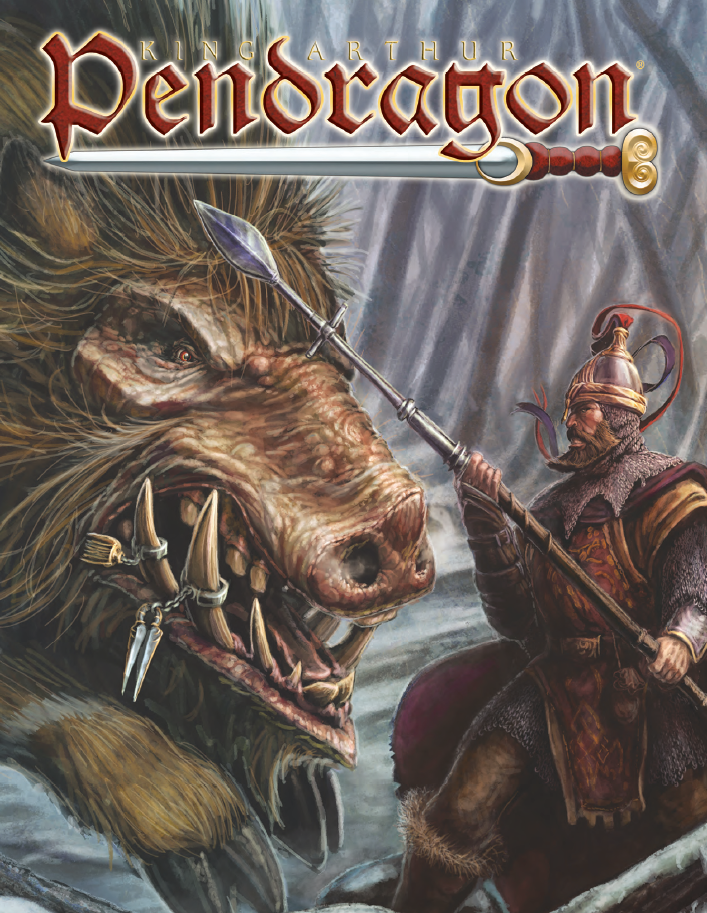
The cover of the
game-book
Even in that grounding, though, the game begins to run into commonplaces of treatments of the premodern: a focus on upper social strata and time-compression.9 The game flatly announces itself as focusing on knights, describing them as the chosen elite.10 While it makes some sense to do so--as I’ve noted elsewhere, “Peasant life is unattractive, particularly to those whom depictions of it might point up their own equivalent status,”11 and many others have attested far more eloquently to the same--to set as of little importance the deeds and doings of a majority of people is no boon to understanding or getting things right. For a game that purports to encapsulate “brutal reality,”12 it is hardly a commendation. Nor yet is the collapsing of the Middle Ages into a short span--“fifteen years of game time approximate a hundred years of real-world medieval history,” so that the noted game-span of 485-565 CE subsumes the late fifth through late fifteenth centuries,13 roughly Gildas to Malory.

Many or most of the sources upon which the game as a whole relies make much of religion, mostly Catholicism, as a prevailing backdrop against which the events of the narratives stand in sharp relief. Prevailing Arthuriana--exemplified in English by Malory--features the knights routinely hearing Mass, recoursing to hermits, and involving the Pope in their familial strifes, and the literary tradition of which Malory is the linchpin extends back to its beginnings through the writings of churchmen such as Geoffrey of Monmouth, Nennius, and Gildas.14 It follows, then, that Pendragon, for all its compressions and simplifications, would do the same--as is the case.

The game as a whole remarks at great length about religion in its primary setting; comments laying out the treatment of religion in the game take up almost as much of the text as explanations of the combats that typify both Pendragon and the RPG in general.15 Publication constraints suggest that space is only given to what is considered important for play. Many RPGs, including D&D, focus heavily on combat, in large part because the rules for combat occupy large parts, if not the majority, of the overall rules-sets. For Pendragon thus to accord religion nearly as much space to religion as to combat bespeaks the relative importance of religion to the game.

As might be expected and as is mentioned above, the focus of Pendragon’s religious discussion is on the shape of Catholic Christianity in Britain during the decades and centuries covered by the game, offering a gloss of history and chronicle, presenting some information on schisms, heterodoxies, and heresies at work, and providing what amount to character blurbs regarding historical religious figures such as the aforementioned Gildas. It must be noted, though, that the game treats a putative paganism still lingering from pre-Christian Britain in its rules. It must also be noted that the discussion of religion in the main game betrays some cynicism: “judgment is consistent--whatever most benefits the Church is upheld by its court.”16 And it further must be noted that, despite the attention given to religion in the main game rules--to the extent that “Knights who follow a strict religious way of life get an advantage in game”17--play-groups are advised against engaging overly much with religious conflict in the game.18

What becomes clear with Pendragon, generally, is that the game simultaneously acknowledges two things: the importance of religion to its venue and, at least obliquely, to the cultures in which its expected player-base exists; and the tensions that necessarily arise when treating such matters in what is an ostensibly fun activity.

About Lionheart

Lionheart is the title of a specific game of Pendragon played by post on the FallenAsh servers in September and October 2021.19 That is, the game was played asynchronously, with players posting in threads gathered into layered forums instead of in real time. Participants were encouraged to secure copies of the Pendragon rules for themselves, and the game, throughout, made ample use of the basic rules-set Stafford had laid out. Rather than taking the standard compressed Arthurian setting assumed by Pendragon, however, Lionheart focused on the coronation of Richard I of England, the eponymous Lionheart, and the short time thereafter that he remained in England before heading off to the Crusades--namely 3 through 12 September 1189.20

The landing page of the game, in all its glory.
While the game swiftly departed from attested history, with players’ characters--PCs--emerging from the players’ imaginations to take up great offices of state, for example, the game made a point of grounding itself in reported events and people. For one example, an option for character creation was to take historical personages as characters; players could have as their characters Henry of Brunswick or Marie de France,21 for instance, and Margaret de Beaumont and William de Warenne were PCs.22 For other examples, discussions of expected conduct were digested from known sources such as the Urbanus Magnus,23 and framing of relative social powers drew from such sources as the Domesday Book.24 Further, much was done to offer broad socio-historical context to the players, with a number of threads laying out general histories from 1066 forward and concerns known to have been current to the coronation.25 As such, Lionheart made a commendable, sustained effort to work within the confines of attested history.

I have to note that, while respondents from the FallenAsh community skew toward the highly educated and tend slightly towards humanistic and literary study, they are not, by and large, specialists in medieval European or medieval English history, broadly defined. Given that and the expected compression and elision of any simulation, any errors in interpretation and representation cannot be said to be made in bad faith. Rather the reverse is true; participants in the game worked to be as close as possible, given constraints of the gaming context, to the best possible understandings of the medieval available to them and to the most sensitive approaches to them circumstances would permit. None of what is noted in this paper should be taken as a condemnation; instead, the majority of participants in the game should be lauded for the effort to get things right.26

What Lionheart Gets Right about Medieval Religion

Participants’ efforts did lead to a number of things coming off as accurate or authentic. For one thing, the relative centrality of organized religion is emphasized in the design of the game itself. As a PBP game, Lionheart required an informational setting in which to exist; for PBPs on FallenAsh, this is almost always in the form of location-based higher-level fora. That is, before play begins, the game’s administrator--the GM, Cearnacht--sets up overarching places for discussion. Some will be for out-of-character talk, but most will be locations in the game where PCs can act and interact. Lionheart featured four general areas--Westminster Abbey, Westminster Palace, Westminster, and London--divided into a total of 19 sub-locations. Westminster Abbey, the first of the general areas, had eight of them, as many as any two of the others. It is a minor thing, perhaps, something that might well be called paratext, but still one that accurately underscores the importance of religion in the life of medieval England.

As noted.

Further, Lionheart openly acknowledged and faced both the presence of Others--and the postcolonial capitalization is apt--in England and the poor treatment of the same by official structures. One of the earliest topics developed by the GM is, in fact, “A Word about Otherness in the Middle Ages,” and it does not shy away from acknowledging that minority populations--including religious minority populations--existed in the England of the time and that they were mistreated by the majority and those in power.27 That alone marks the game off as distinct from many others, which often shy away from such topics by way of romanticizing them, if not flatly ignoring them.28 That is, RPGs, both in their basic settings and in their specific iterations, will frequently gloss over the social problems found in their settings’ sources. Lionheart did not, but very nearly opened with a direct engagement with the known challenges presented by the selected setting.

Lionheart also gets right another key point in its discussion of religion, namely “the Church’s role in adjudicating the acceptability of marriages.”29 Sandra Masters expounds upon that role and its development at some length,30 as do Ryan Patrick Crisp31 and Richard J. Warren.32 It must be noted, too, that the ultimate undoing of Arthur’s kingship lies in his (admittedly unwitting, in Malory) incestuous union with his sister.33 Clearly, incest is a problem, and consanguinity is a concern. Clearly, too, both are involved in concerns of religion in the “real” medieval, both its attested history and its “popular” culture. That the game makes note of such--especially given how infrequently other RPGs do the same--is a particular bit of accuracy.

Lionheart also makes explicit that religion is not a monolithic, all-or-nothing thing, adopting a nuanced view of the rules-set’s presentation of “good” and “bad” visions of the church. Preliminary materials for the game remark that “Most of the things described in the ‘good church’ section are true, or are at least aspired to by this very human institution. Many of the things described in the ‘bad church’ section are also true, at least of some church leaders.”34 The binary view espoused by the rules-set is fairly typical of RPGs. One common plot is for a pious character to become disillusioned by the corruption of an organized religion, and another is for a similarly pious character to be led into that corruption from a belief in the infallibility of such an organization; both require that the church, whatever church it is, be one or the other. In adopting a more nuanced view, Lionheart accords more fully with attested regard for organized religion in medieval Europe, specifically in England; Chaucer’s Canterbury Tales offers perhaps the best-known English example thereof, but traces of the same can be found even in Malory, where the Archbishop of Canterbury is complicit in Merlin’s maneuverings.35 More, it accords with the recognition by a number of scholars--Eleanor Janega36 and Elijah King’ore37 are accessible examples, but not the only ones--of the centralized church acting in ways both helpful and harmful. So Lionheart gets a fair bit about medieval religion right.

What Lionheart Gets Wrong about Medieval Religion

Participants’ efforts did not prevent all inaccuracies, however. Some of them are openly acknowledged. The GM noted, for instance, that the Commandments in the game are but one rendering among many,38 and some historical events of no small significance are outright elided.39

The Most Rev. and the Rt Hon.
the Lord Archbishop of Canterbury, himself
Not all of the errors are as overtly addressed, however. For one, despite structural indications of the importance of religion in medieval England, only two of the seventeen major non-player characters are noted as clergy.40 While one of them is the Archbishop of Canterbury--whose description does offer some of the kind of nuance noted favorably above--that the local priesthood (including the Abbot of Westminster) is not presented in detail seems at odds with that importance. So, too, is the lack of clerical PCs; only one PC is overtly in holy orders, while one other could be assumed to be so.41

Additionally, there are divergences in the services that are presented in the game. To be fair, the services, especially the depiction of Mass,42 hold true to current formal practice. The problem is that that practice, while centuries old, far postdates the times covered in the game. What the game shows is the Tridentine Mass, a standardization promulgated in direct response to the rise of Protestantism and revised repeatedly since, most notably in 1962.43 The form of Mass depicted, therefore, was not current in the 1189 Lionheart purports to reflect. While it may well be the case that the differences to be found are minor, as some older sources hold,44 it is also the case that those differences would have been regarded as of importance at the time, with the game itself remarking upon the problems occasioned by similar questions of doctrine.45 For the game to have missed the more likely Sarum Rite, information about which is accessible,46 seems an unfortunate oversight.

Why It Matters and What Can We Do

There is always, when discussing games, the opportunity for comment against looking too closely into things. A variation on Belisario’s Maxim47--in this case, “It’s just a game”--is usually trotted out, and the case can be made easily that “doing homework” gets in the way of “having fun.” It is true that more information than was deployed in Lionheart is readily accessible, but parsing that information for good and useful material is time-consuming, and serving as a GM is not often compensated labor.

Too, it is to be expected that RPGs like Pendragon, as simulations, will necessarily reduce and compress their sources in the interests of treating them conveniently and in allowing players, most often not specialists in the source materials despite prevailingly high levels of formal education,48 entry into the interactive narrative milieux in which RPGs operate. Making a game accessible, and therefore playable and more likely to be fun, usually means going with what players can find if they do decide to look. While there is substantial overlap between RPG players and people with institutional access (and the time to enjoy it!), the two groups are far from congruent. Many players, perhaps even most, cannot get into the deeper details of setting that breed more accuracy and richness. In effect, they have to take what they can get. What they can get, then, becomes all the more important to prevailing understandings, as such scholars as Sturtevant and Young assert.49

Regarding religion specifically, there may be an additional factor playing into such inaccuracies as are present. RPGs generally have difficulty with real-world religion, owing to several factors, including borderline persecution by organized religious groups.50 Pendragon directly speaks to additional concerns, noting that “Constant argument and bigotry [arising from theological disagreement] is almost sure to destroy a game, and players and Gamemasters alike are advised to use religious conflict in a campaign only with great care,”51 if they treat it at all. Concerns of access to the game may well prompt some elision of religious matters even in contexts where their presence is eminently sensible--such as a coronation of a sacral king in a major hub of worship in advance of that king’s pursuing holy war. Again, access to the game is cited explicitly in the framing of Otherness in Lionheart, with the GM noting explicitly that some deviation from attested history is in place while noting the fraught nature of making such a change and emphasizing that “We’re a community; let’s keep it a good one.”52

Perhaps that is the most relevant thing. RPGs often tend towards the creation of communities, bringing people together for sometimes intensive, sometimes extended, and sometimes extended and intensive, periods of time to make something together. They are formative, and because they are so, it becomes important to ensure that the information from which they work is as accurate as it can be--while at the same time creating an atmosphere in which community can form. An unfortunate truth is that no few gaming communities form in such ways as permit and encourage hate and any number of execrable behaviors, both through emphasis of certain “facts” and elision of others; what FallenAsh shows, in Lionheart and elsewhere, is that the juxtaposition of getting things right and getting them wrong--unavoidably and with intent--can conduce to better community formation. In effect, Lionheart is an example of things being done right; FallenAsh is a series of examples of things being done right.

As the printer puts it, “al is wryton for our doctryne, and for to beware that we falle not to vyce ne synne, but t’exersyse and folowe vertu, by whyche we may come and atteyne to good fame and renommĂ© in thys lyf.”53 Let us read well, and deeply, and often.

Appendix: Survey and Results

The informal survey conducted of the FallenAsh community in January 2023 consisted of a Google Form posted to the #general discussion thread on the community’s Discord. Participants were asked to answer a series of short-answer questions, with the explicit and repeated notes that their participation would be voluntary, anonymous, and uncompensated (save with my kind and polite thanks, which were tendered publicly and generally in the discussion thread). The questions asked after assorted demographic data that had at various times been subjects of discussion in the thread and in other associated venues. They were
  1. In what country do you live?
  2. In what timezone do you live?
  3. What is your primary language?
  4. What is your age?
  5. With what race and/or ethnicity do you identify?
  6. With what gender do you identify?
  7. How would you describe your sexual orientation?
  8. How would you describe your religious outlook / background?
  9. Which of the following best describes your socio-economic status?.
  10. What is the highest level of formal education you have attained?
  11. What was your major / primary field of study, or what is your trained trade?
  12. For how many years have you played tabletop roleplaying games?
  13. What tabletop roleplaying game do you most commonly play?
The survey received 19 responses, between 13.57% and 14.62% of the FallenAsh community. A larger sample size would, of course, be desirable, but for an informal survey, results should give some impression of the community as a whole. (I will note, however, that I am happy to be corrected in later work, if I am wrong in this.)

A large majority of respondents (13) reported living in the United States or one of its territories. Other respondents noted living in Brazil and Germany (2 each), as well as in Japan and in the United Kingdom (1 each).

Respondents were spread across time zones, with a plurality (5) living in US Pacific Time (UTC - 8). Several others live in each of US Central and US Eastern Time, as well as in UTC + 1 (3 each; UTC - 6, - 5, and +1, respectively). Two live in UTC - 4, and one each live in UTC - 9 and UTC + 9. Consequently, respondents live across 18 hours of the day--which does make for some challenges in coordinating player action in games where they all participate.

English is by far the most common primary language among respondents, with 14 of the 19 reporting it. Two respondents identify each of German and Portuguese as their primary language, and one Spanish; of interest, one German-primary respondent made a point of noting English proficiency, and one Portuguese-primary respondent noted working as a translator.

Ages of respondents ranged from 20 to 47. Mean and median age were both 37. Interestingly, no clear mode emerged; two respondents each reported being ages 36, 37, 40, and 46.

The question of race and ethnicity prompted interesting responses. Fifteen of the respondents replied with “White” or some variation thereof, with one reporting “Asian,” one reporting “African American,” and two others making reports not easily classified to someone perhaps overly accustomed to US Census Bureau rubrics. Two respondents identified as Hispanic, as well, with several others reporting national / regional identities not tracked by US Census data. One respondent offered an extended discussion (for a short-answer response) of ethnicity in their country.

The question of gender identification received a more unified response, with 15 respondents identifying as “male,” or a qualification or variation thereof (e.g., “trans,” “most of the time”). Two respondents reported identifying as female, and one as non-binary.

A large majority of respondents (12) identified as heterosexual or some variation thereof (e.g., “straight,” “for all intents and purposes”). Three identified as bisexual or a variation thereof (“bi-curious,” “homoflexible”), two as homosexual, one as asexual, and one as gynesexual.

A plurality of respondents explicitly identified as agnostic, with some addenda amid the responses (e.g., “appreciate many things in Buddhism”). Seven responded with some variation of Christian (three Catholic, two Protestant, and two without other description), and three explicitly identified as atheist. Three other responses were recorded, as well: “spiritual but not religious,” “Satanist,” and “nothing.”

In terms of socioeconomic status, reports from respondents were largely consistent. Sixteen of the 19 reported being among the middle class, with one in the upper and eight in the lower reaches of that group (one of whom noted precarity in that position); the remaining seven added no description. The other three respondents reported being in lower socioeconomic classes.

Respondents appear to be relatively highly educated; all but two reported having some higher education. Ten report having completed degrees, seven of them graduate degrees or the equivalent.

Respondents’ fields of study and training show some bias towards English and literary study, with four respondents indicating as much. Three also comment explicitly on work as teachers. No other clear curricular pattern emerges.

Reported length of experience playing tabletop roleplaying games among respondents ran high, ranging from five to 40 years. On average, respondents report having played for just over 21 years, with a median of 22 years and a mode of 25.

Regarding preferred games, respondents returned multiple answers; most gave more than one response. As might be expected from a long-standing gaming community, a majority of respondents (10) expressed a preference for playing Dungeons & Dragons. Owing to the origins of the community as an extension of a Legend of the Five Rings online game, it was similarly expected that a majority (10) expressed a preference for that game. Pathfinder, something of a spin-off of Dungeons & Dragons, was noted as a preferred game by four respondents, and a smattering of other gaming systems received mention.

As noted above, how representative the respondents are of the overall FallenAsh community is an open question. How representative they are of the overall gaming community is even more open. The responses, however, do seem to offer some indication of where at least a portion of the community falls, some idea what a gamer might actually look like, which is certain to be of some help.

Notes

  1. Daniel Mackay, The Fantasy Role-playing Game: A New Performing Art (Jefferson, NC: McFarland & Co., 2001), 4-5.
  2. Lawrence Schick, Heroic Worlds: A History and Guide to Role-playing Games (Buffalo, NY: Prometheus, 1991), 18-19.
  3. A quick check of the number of participants on the FallenAsh Discord returned 131 people, and a handful of members do not participate on Discord.
  4. See Appendix: Survey and Results.
  5. The work in question was originally a short talk given as part of a summative event at a National Endowment for the Humanities institute on law and culture in medieval England hosted by Western Michigan University in 2021. It was subsequently developed into the roundtable presentation “Laying Down the Law in the Pendragon RPG,” given at the 2022 International Congress on Medieval Studies. The present project both shifts and narrows focus from the earlier work, although it makes free use of the earlier materials without much comment.
  6. “Arthaus Publishing, Inc.” White Wolf Wiki, accessed 15 July 2021, https://whitewolf.fandom.com/wiki/Arthaus_Publishing,_Inc.
  7. “World of Darkness,” Paradox Interactive, accessed 15 July 2021, https://www.worldofdarkness.com/.
  8. Greg Stafford, King Arthur Pendragon, 5th ed. (Arthaus, 2005), 6.
  9. Geoffrey B. Elliott, “Some Notes about the Kerrville Renaissance Festival,” Travels in Genre and Medievalism, Tales after Tolkien Society, 4 February 2019, https://talesaftertolkien.blogspot.com/2019/02/some-notes-about-kerrville-renaissance.html.
  10. Stafford 15.
  11. Geoffrey B. Elliott, “About Oklahoma ScotFest,” Travels in Genre and Medievalism, Tales after Tolkien Society, 23 September 2015, https://talesaftertolkien.blogspot.com/2015/09/about-oklahoma-scotfest.html.
  12. Stafford 4.
  13. Stafford 5-6.
  14. Geoffrey B. Elliott, “The Establishment of Malory’s Le Morte d’Arthur as the Standard Text of English-Language Arthurian Legend” (doctoral dissertation, University of Louisiana at Lafayette, 2012), 1-6.
  15. Chapter 6: Combat spans pages 112 to 131, 19 pages in total. Chapter 7: Ambition and Faith spans 132 to 155; explicit discussion of religion begins on page 138 and ends on page 153, taking up some 15 pages.
  16. Stafford 149.
  17. Stafford 69.
  18. Stafford 138.
  19. It is of interest that the game took place just after the aforementioned National Endowment for the Humanities institute. Character development occurred while that institute was in progress, a happy coincidence that influenced at least some aspects of play.
  20. “Lionheart,” FallenAsh, accessed 6 April 2023, https://pendragon.fallenash.com; please note that following references to the site and its pages will be by URL rather than more formal citation.
  21. https://pendragon.fallenash.com/viewtopic.php?f=5&t=83.
  22. https://pendragon.fallenash.com/viewtopic.php?f=5&t=150.
  23. https://pendragon.fallenash.com/viewtopic.php?f=5&t=122.
  24. https://pendragon.fallenash.com/viewtopic.php?f=4&t=33.
  25. https://pendragon.fallenash.com/viewtopic.php?f=5&t=4, https://pendragon.fallenash.com/viewtopic.php?f=5&t=5, https://pendragon.fallenash.com/viewtopic.php?f=5&t=6, https://pendragon.fallenash.com/viewtopic.php?f=5&t=7, https://pendragon.fallenash.com/viewtopic.php?f=5&t=8, https://pendragon.fallenash.com/viewtopic.php?f=5&t=16.
  26. “Majority” because I was a participant in the game, and if others were not specialists and trained as medievalists, I (ostensibly) am; I worked to do better, but I am not certain I succeeded.
  27. https://pendragon.fallenash.com/viewtopic.php?f=2&t=2.
  28. Helen Young, “Racist Discourses in Fantasy Fiction,” Diverse Fictions, 28 May 2013, http://diversefictions.blogspot.com/2013/05/racist-discourses-in-fantasy-fandom.html.
  29. https://pendragon.fallenash.com/viewtopic.php?f=5&t=3.
  30. Sandra Masters, “Consanguinitas Et Ius Sanguinis: Kinship Calculation and Medieval Marriage” (master’s thesis, Western Michigan University, 1994), https://scholarworks.wmich.edu/masters_theses/3956.
  31. Ryan Patrick Crisp, “Genealogy, Consanguinity, and the Counts of Anjou in the Eleventh Century” (master’s thesis, The Ohio State University, 1999), https://tinyurl.com/2p82jf3z.
  32. Richard J. Warren, "Consanguinity Protocols, Kinship and Incest in Literature of the Anglo-Saxon through Early Renaissance Periods" (master’s thesis, University of Nevada at Las Vegas, 2016), http://dx.doi.org/10.34917/9112206.
  33. Thomas Malory, Malory: Complete Works, ed. Eugène Vinaver, 2nd ed. (Oxford UP, 1971), 27-28.
  34. https://pendragon.fallenash.com/viewtopic.php?f=5&t=3.
  35. Malory 7-10.
  36. Eleanor Janega, “JFC, Calm down about the Medieval Church,” Going Medieval, 7 August 2020, https://going-medieval.com/2019/11/05/jfc-calm-down-about-the-medieval-church/.
  37. Elijah Nderitu King’ori, “Fight against Corruption: A Christian Medieval Historical Period Approach,” European Journal of Philosophy, Culture and Religion 5, no. 1 (2021): 38–57, https://doi.org/10.47672/ejpcr.800.
  38. https://pendragon.fallenash.com/viewtopic.php?f=5&t=122.
  39. https://pendragon.fallenash.com/viewtopic.php?f=2&t=2.
  40. https://pendragon.fallenash.com/viewtopic.php?f=5&t=18.
  41. https://pendragon.fallenash.com/viewtopic.php?f=5&t=150.
  42. https://pendragon.fallenash.com/viewtopic.php?f=20&t=304.
  43. Paul Halsall, “Medieval Sourcebook: Mass of the Roman Rite,” Fordham University, May 2023, https://sourcebooks.fordham.edu/basis/latinmass.asp.
  44. Adrian Fortescue, "Liturgy," The Catholic Encyclopedia (New York: Robert Appleton, 1910), vol. 9, accessed 10 May 2023, http://www.newadvent.org/cathen/09306a.htm.
  45. https://pendragon.fallenash.com/viewtopic.php?f=5&t=7.
  46. Frederick Thomas Bergh, “Sarum Rite,” The Catholic Encyclopedia (New York: Robert Appleton, 1912), vol. 13, accessed 10 May 2023, https://www.newadvent.org/cathen/13479a.htm; William Renwick, “About,” The Sarum Rite, accessed 10 May 2023, https://hmcwordpress.humanities.mcmaster.ca/renwick/about/.
  47. “Bellisario’s Maxim,” TV Tropes, accessed 11 April 2023, https://tvtropes.org/pmwiki/pmwiki.php/Main/BellisariosMaxim.
  48. Note, however, that there are no few people who get into their areas of study in part because they started studying to be able to play their RPGs better.
  49. Paul B. Sturtevant, The Middle Ages in Popular Imagination: Memory, Film, and Medievalism (IB Tauris, 2018); Helen Young, “Who Cares if Game of Thrones Is Authentically Medieval?” Travels in Genre and Medievalism, Tales after Tolkien Society, 12 June 2014, https://talesaftertolkien.blogspot.com/2014/06/who-cares-if-game-of-thrones-is_12.html; Helen Young, “Who Cares About Historical Authenticity? I Do,” Travels in Genre and Medievalism, Tales after Tolkien Society, 16 June 2014, https://talesaftertolkien.blogspot.com/2014/06/who-cares-about-historical-authenticity.html.
  50. Geoffrey B. Elliott, “Unchurched: On the Relative Lack of Religion in Tolkienian-Tradition Fantasy Literature” (presentation, International Congress on Medieval Studies, Kalamazoo, MI, May 2014); Mackay 4.
  51. Stafford 138.
  52. https://pendragon.fallenash.com/viewtopic.php?f=2&t=2.
  53. William Caxton, preface to Malory: Complete Works, ed. Eugène Vinaver, 2nd ed. (Oxford UP, 1971), xv.

Thursday, October 27, 2022

Guest Post: Matt Tyler, "A Novice on Heraldry"

It's been a while, and we'll be getting back to regular posting soon. In the meantime, we have another answer to the Society's most recent call for contributions--which is still open; we'd still love to hear from you! This one comes from Matt Tyler, who says of himself "Experienced hobbyist, Matt dabbles in roleplaying games, board games, war games, writing, and playtesting. He considers himself a novice in many of them, and a master of none."

The text of the post below is provided by Tyler, who reflects on his experience and understanding of heraldic practice as it relates to gaming. Included images are those Tyler recommends, attested and used in accordance with Fair Use. Other editorial adjustment is kept to a minimum and is made without comment.


ℜoderick stared in disbelief as the forces of the High Marshal rallied against the charge. Lines that had been crumbling were now pushing back on the blood-soaked field. Soon, Roderick knew, he would have to signal for the retreat or lose everything. Though, after this catastrophic turn of events, the Iron Dane might still take his head.

But how? It had been a gamble, to be sure, but only a slight one, and no word from his agents within the High Marshals ranks intimated a knight on this flank capable of such a feat of arms.

Roderick “The Blood Hawk” Marleybone craned up in his saddle, his black tabard stretched across the armor beneath, the three golden arches on the black field displayed for the world to see. His eyes strained to take in the scene of battle. The livery of the knights who opposed him swayed back and forth, glimpsed through the glinting forms of his own forces.

No. It can’t be.

His eyes squinted against the dance of color in the midday sun, straining to confirm what he hoped was a trick of the mind. No, there! It was! A hint of sky blue on the shield of the knight leading the counterattack. With a nod to the officer mounted next to him, a relay of signals went up, and the Blood Hawks forces fell back in haste.

Impossible. The black wyvern on a field of light blue, but, that line was gone, by his own hand ended, not a decade since.

As Roderick wheeled his horse about, his mind swirled at the possibilities of seeing the Blackwater coat of arms again...

As a reader, you know next to nothing about either of the knights mentioned in the story, yet with the inclusion of heraldry for the mysterious Blackwater knight, you now begin to conjure images in your mind of not only what they are wearing, but pennants, horse livery, and servant tabards. The bleak field of battle and death begins to take on color and pageantry.

The Pageantry of Battle

What most recognise today when they hear the word “Heraldry” is the codified and registered forms made popular from the medieval period, still used to modern day for royalty, organizations, corporations, and geographical/political regions. This system has its own language and rules to govern its use. It’s through these regulations that historians can solve ancient mysteries when discovering an ancient site of battle, or need to determine the ancestry of uncovered remains based on heraldic evidence.

It’s believed by many that the system of heraldry as it’s understood today was introduced from mainland Europe, but given its necessity on the fields of battle of the time, it quickly grew into something more. Used in tournaments, land grants, inheritance law, if one had a registered label of heraldry, it could prove an invaluable tool in many facets of medieval life. It evolved with the owner, becoming more complex with not only each deed given honor for, but marriages, and successive generations of the family line. In an age with no real forms of identification, those with the means and honors to acquire such an important piece of recognition were viewed in an altogether different light.

From Kawanakajima no kassen
at the Library of Congress
Heraldry though, at its most basic form, is simply a means of identification, much as our modern-day soldiers wear the nation's flag, or indeed, ancient peoples would mark themselves with paints of their tribes’ colors. Even in those basic aspects you’ll see variations to reflect deeds, sub-factions, and genealogy. Samurai, who were active very much during the same time and practically a world away, were making use of family marked sashimono under their lords’ command, with individuals wearing horns or antlers, or sporting their own families colors on their lacquered armor. The “pageantry of battle”, as it’s sometimes known, is not limited to the romanticized concept most known from medieval Europe, but from many ages, and from around the globe.

Heraldry Design

Arms of King Henry IV, differenced by a bordure argent. That’s the heraldic description for the coat of arms used by Humphrey of Lancaster,1st Duke of Gloucester.

A shot from Branagh's Henry V
One of the easier descriptions to deduce, and a good place to start with understanding some basics of the language. First in the description is the field, or the shield. Next, one would expect to find a description of used “ordinaries”, or the basic geometric shapes that comprise the field, be they a band that runs down the middle of the field (known as a “pale”), or an X shape that crosses the field (known as a “saltire”). Given the nature of Humphrey’s coat of arms, the first two are implied with the description of the original arms of Henry IV, which given it uses no ordinaries would simply be quarterly of 4, 1 & 4 France, 2 & 3 England (Plantagenet). The last part of the description would include any lesser charges, which in Humphrey’s case would be differenced by a bordure argent, or more plainly spoken, made different by a border of silver or white. A bordure as a difference was commonly used for a younger sibling who had not been granted a coat of arms individually, or as would happen, Humphrey was the younger brother of Henry V (Henry V used the same arms as Henry IV).

You’ll naturally be curious why some terms are used instead of others, and that has to do with the nature of the system being adopted widely from that of mainland Europe. Argent is the French word for silver, though in heraldry silver and white are used interchangeably. Which brings us neatly to the notion of color use in heraldry.

The Maryland state flag
All patterns and designs should be discernible from a distance, and to help regulate this is the separation of colors into two categories, colours and metals (a third category exists known as furs, but I’ll leave those for you to investigate on your own). As a rule of thumb, you should never have a colour next to a colour, or a metal next to a metal. This is executed in Henry IVs yellow lions on red, and yellow fleur-des-lis on blue (or to use heraldic vernacular, Or on Gules and Or on Azure). Another more modern-day example would be the Maryland state flag. There you have a quartered design, using red with white, and black with yellow (Gules with Argent, and Sable with Or).

The inclusion of symbols is another major part of the craft, and it’s the combination of the two forms, color and symbols, and the combination with which they are combined, that one can convey a great amount of information with but the glimpse of an image.

Most anything can be used for the imagery it conveys. Animals and beasts both natural and mythical (birds, fish, bears), but also objects natural, mythical, and constructed (towers, swords, the sun, the Green Man). Many of these have been assigned meaning over the years, but like with most any language, those meanings will change over time and should not be seen as writ in stone. Horses in heraldry would typically be seen as “one ready for battle”, but there’s nothing to say it couldn’t be used for a messenger, or perhaps a noble lineage of scholars bearing the name Palfrey or Paulfrie.

In the opening narrative, we see arches used on Roderick’s tabard, which typically convey the position of a governor or magistrate. In this small way, if your reader takes it upon themself to investigate that aspect, you have given them a clue they can use to unravel your narrative without ever having to spell it out. This further brings them into your setting.

When I Left You, I Was But the Learner

Knowing even the most basic of information on the subject is usually enough to begin working on your own setting specific heraldry with rules or guidelines. Even in the lands of Middle-earth, Tolkien created a sense of heraldic arms for various houses and factions. The most recognizable being Aragorn's royal standard, unfurled on the fields of battle towards the end of the trilogy, though in the movies more basic versions of the Gondorian crest can be seen on the shields of the guards, and indeed in the helmet designs.

In writing fiction, we have a great tool to use here with the use of color and imagery to convey much about our characters and our setting. With the change of colour we shift preconceptions from one to another. In western movies the good characters wore white and the villains wore black. If a coat of arms is seen to have a dark motif, one might naturally assume villainous intent.

In running games, we have a way for our players to personalize the world. Guilds need emblems and crests, warriors need coats of arms, and kingdoms founded need banners. Some simple tracing paper, a laptop to get images from, and then an inexpensive drawing pad can allow players to make up their own heraldry to bring the world to life and leave their mark. Imagine some players leave and new ones arrive, tales of the Knight of Bonded Grove catch their interest and all they have to go on is a white stag rearing inside a golden wreath of ivy on a green field.

In playing wargames, we have a system to easily allow us to achieve wonderful color schemes for our armies. Using the basic rule of no color on color, or metal on metal, one can begin to devise a striking scheme for their troops that will draw the eye on the battlefield. Are your space warriors covered in variations of tan and green, or perhaps yellow and black, or maybe even orange and blue? Try using metallic paints to break up the colors you wish to use, say a shoulder pad or shield with black and silver trim to stand out from the blood-red armor.

Resources

I have been fortunate enough in my meager investigation of heraldry to exist in a time where the internet has made such searches easily accomplished. As one who dabbles in all aspects of the hobbies naturally drawn to a gamer, I have also encountered numerous sources from personal, individual communication. My favorite resources I’ll list here, though numerous stores of information are easily accessible with the click of a button.

  1. 1. Re-enactment. I live in an area where historical reenactment takes on several forms and is richly done. One major organization is known as the SCA (Society for Creative Anachronism). In these made-up kingdoms, the rules of historical use are as closely followed as possible, including preparing the same meals at events as would be made in medieval times. Among the many aspects of the system, those who wish to take on the role of a herald must apply themselves to the role as diligently as any would have done historically, including sometimes learning multiple languages and being fluent in the rules of heraldry and coats of arms. Just as colleges of heralds have enlisted throughout history, these reenactment scholars likewise preserve their worlds history and culture through heraldic knowledge and can be a wealth of personal experience to draw from.
  2. The Complete Book of Heraldry by Stephen Slater. A Beautiful book that can be found relatively on the inexpensive side of things. It covers the history and nature of heraldry in detail, though it doesn’t provide all the symbols and meanings one would need to generate historically accurate heraldry. The heart of the book is to provide a deep understanding of the system itself from its inception through to modern era usage.
  3. Modern History TV on YouTube. A fun channel that delves into rediscovering what life was like in the medieval period from the foods eaten through to travel times. Heraldry is touched on, but recommending more as a good resource for the setting and making it believable in roleplaying games, novels, or paintings.
  4. The Dictionary of Heraldry by Joseph Foster.
  5. An Encyclopedic Dictionary of Heraldry by Julian Franklyn.

Thursday, January 13, 2022

Once upon a Time Rewatch 2.7, "Child of the Moon"

Read the previous entry in the series here.
Read the next entry in the series here.


2.7, "Child of the Moon"

Written by Ian Goldberg and Andrew Chambliss
Directed by Anthony Hemingway

Synopsis

There's one way to get a break...
Image taken from the episode, used for commentary.
Following a recapitulation of earlier events, the episode begins with the dwarves at work in the mines under Storybrooke. They reach the end of their workday, but Leroy resists leaving work, inadvertently opening a new tunnel in his dudgeon. David rushes to the scene, along with Henry and the Mother Superior, and they find that the found tunnel contains the diamonds that can be processed into the fairy dust they need for magic to function. Hope returns that Emma and Mary Margaret can be returned. Celebration ensues, and Ruby tends to the restaurant until she is met by a local with whom she had been enamored before the curse was broken. He asks to get to know her better, and she demurs out of concern for her lycanthropy. Meanwhile, Henry voices his concerns about nightmares, David offering comfort until he is confronted by George. A tense exchange follows, as do preparations for restraining Ruby.

Peter Jackson oughta sue somebody...
Image taken from the episode, used for commentary.
Ruby recalls escapades with Snow White in the Enchanted Forest, the pair fleeing in the night to evade Regina's forces. Her hood is damaged, and Ruby, as Red, frets about the implications, sending Snow White away out of concern for her safety. She remains struck by Snow White's kindness--and she is observed as she departs from her friend.

Granny returns to the restaurant the next morning to find that Ruby has escaped restraint--evidently as the wolf. To add to matters, in the night, Henry had again suffered a nightmare of a flaming room, seeing another figure within it; he is roused from the dream by Regina, present because David is answering an emergency call. She notes a burn on his hand--as David and Granny find Ruby asleep in the woods. She has no recollection of events and panics that she has caused harm; David tries to comfort her until he is summoned away.

In a hole in the ground there lived a...pack of wolves?
Image taken from the episode, used for commentary.
Back in the Enchanted Forest, Red wakes to find her cloak still functioning. It is soon stolen from her, and she pursues the thief through the woods. The thief, Quinn, confesses being a werewolf and presses her about her experiences and attempting to recruit her into the local lycanthropic community, living hidden in the forest in what "used to be the grand hall of a castle, until it sunk underground." She is struck by the organization of the community and is introduced to the local leader, Anita--her mother.

David conducts Granny and Ruby back to town. Along the way, he stops off to address a reported illegal parking job--where the three find the dismembered corpse of the local who had expressed interest in Ruby before. David refuses to accept that Ruby is culpable, but she calls for her own incarceration against the threat of a relapse.

Regina consults with Gold about Henry's injury. Gold notes that the nightmare is a side-effect of the sleeping curse--and that the scene of the nightmare is a spiritual realm that stands between the living and dead worlds. Henry has been traveling there, and Gold offers some assistance to Henry: a talisman that will allow him to control his presence in that realm. Curiously, Gold attaches no price to his aid.

Red and Anita confer, Anita noting that Granny had stolen Red from her and explicating the nature of their shared lycanthropy. She notes, too, that embracing her lupine nature is required for controlling it, and she offers to teach her how to do it. Red begins to study the technique--but Ruby is jailed, as she requested. George intrudes, demanding the surrender of Ruby to the mob. David refuses.

Red exults in her lupine exploits, prompted by Anita and the others. She wakes at peace among them--unlike in Storybrooke, where George incites a mob against Ruby and David. They break into the jail, only to find Ruby's cell empty, David having taken her to the library and restraining her. David tries to find proof of Ruby's innocence.

Snow White makes to rejoin Red and is captured by the other lycanthropes. Red intercedes, and Snow White is spared. She tries to take Red off, but Red seeks to remain among the other lycanthropes. Surprised, Snow accepts the decision and readies to part in amity from her friend--only to be interrupted by an attack that, while handily defeated, kills Quinn.

Belle remains with Ruby, trying to comfort her. Ruby restrains Belle and departs to face the mob in an act of atonement. Meanwhile, David and Granny stalk through the town to search out the actual killer. They find Ruby's hood and a bloody axe--in George's car. Ruby's howl summons them.

Well, there's your problem...
Image taken from the episode, used for commentary.
In the wake of Quinn's death, Anita determines that Snow White is to blame and must be made to pay for his death. Snow White is restrained in favor of being eaten after the moonrise. Red refuses to participate, and Anita moves to execute her prisoner. A brief melee ensues, leaving Anita impaled. Red sorrows over the accidental matricide.

In Storybrooke, the mob George has gathered pursues the transformed Ruby. David and Granny arrive in time to intervene, saving Ruby and revealing George's perfidy. George flees, Ruby and David pursuing him. They find him on the beach with a fire burning, into which he casts Jefferson's hat. Hope for the return of Mary Margaret and Emma dims.

Red and Snow White reconcile and continue on their quest. Ruby considers David as he considers Henry and the loss of a means of inter-realm travel, offering comfort before she returns to her wolf form. Mary Margaret and Emma consider their return to Storybrooke, and Aurora dreams of terror--until Henry offers comfort and she wakes to report what she has found.

Discussion

The present episode clearly follows up on "Red Handed" from the first season, and I find it echoing or resonating with Hobb's presentation in the Realm of the Elderlings novel of the Wit (associated with lycanthropy, as I've noted) as a metaphor for homosexuality (discussed here and following). Both cases concern themselves with is an inborn quality that meets with a lack of understanding and anger, prompting sometimes-violent, sometimes-armed oppression that leads those with that quality to suppress it to the extent they can among the broader community. Both also see focal characters mentored by scarred, stern foster-parents to enact that suppression. Both also serve as uniting forces of hidden / sequestered communities that dwell in hiding in the forests, bringing in wayward members that happen their way. Certainly, there are more parallels to explicate. Just as certainly, enough time passed between the first mention of the Wit and the presumable drafting of the present episode's script that the writing staff could be familiar with it, although I'm not aware of any direct connection and am not accusing the writers of cribbing--any more than any writer ever really does. An adage about ideas under the sun comes to mind...because, again, the lycanthropy serves as a (somewhat frustrated) metaphor for homosexuality.

The episode does not frustrate the metaphor quite as much, however, in that it falls into the same problem with its stand-in for homosexuality that it does with many, many other minority groups: it reinforces stereotypes, rather than rejecting them. Hobb's Old Blood are presented with nuance and sympathy, and while there are evil people among them, they are themselves a minority within that minority. In the present episode, the werewolves are, overall, evil, with Red the token "good one," and only that because she was raised outside the community. Indeed, the episode seems to be working in the racial-essentialist paradigm that pervades fantasy literature and the RPGs that emerge from it (if less now than previously). And while that paradigm is prevalent in medieval literatures and cultures (though less than is often assumed), and some might argue that "it's how it was, so you have to show it," other arguments--including many of those linked above--rightly point out that there's a limit to how "realistic" a work that includes overt magic and such creatures as dragons and lycanthropes can be. (And, again, things were far more complex and nuanced than is often admitted by the people who want to argue "That's how it is." Funny, that.)

If it's alright to bring in magic, it's alright to move away from harmful tropes, as well.

Thursday, April 29, 2021

Some Thoughts about Some Dungeon Synth

𝔄s I have continued to work in this webspace and others, I have tended to do so with music of one sort or another playing in the background. It's often instrumental music; vocals tend to pull my attention to them to a degree I find incompatible with working on writing, as they sound too much like someone is trying to talk to me for me to be able to focus elsewhere. And as I was casting about for such music, I came across the Dungeon Synth Archives on YouTube, which both fit the kind of ambient, instrumental music I was seeking and suggested itself as presenting medievalisms that do not seldom make of themselves some kinds of tales after Tolkien.

Because I always try to have a blast when I work...
Gif from Giphy.com, deriving from Monty Python,
and used for commentary

While I have linked the channel above, plowing through examples does not necessarily or efficiently describe a genre. What dungeon synth is reported as being varies. Wikipedia, that first-use go-to reference, calls it here "a subgenre of dark ambient music that emerged in the late 1980s and early 1990s" that "employs aesthetics and themes typically associated with black metal and applies it to dreamier ambient songs" in which "use of dark soundscapes suggests medieval or fantasy motifs, often with a nocturnal aesthetic" and which "is often compared to video game music, as it is occasionally applied in those settings." Another source, Andrew Werdna's Dungeon Synth blog--much like this webspace-- describes it here as "the sound of the ancient crypt. The breath of the tomb, that can only be properly conveyed in music that is primitive, necro, lo-fi, forgotten, obscure, and ignored by all of mainstream society." Robert Newsome's 2017 comments on Bandcamp identify it as "Drawing its musical themes from Medieval and Renaissance compositions and its aesthetic sensibilities from black metal and fantasy literature [...] the perfect soundtrack for this kind of escapist fantasy," much like "the 'intro' track to your favorite metal album, but stretched out to album length"; Jonathan Carron's 2021 comments on Invisible Oranges call it initially "a style of grim fantasy ambient that would serve as intros, interludes, and full releases played and traded among black metal musicians in the 1990s" that works well for many internet subcultures

Admittedly, there is always peril in posting genre definitions; there are always exceptions, of course, and there are always ambiguities to consider. This webspace has noted such things in the past; consider, for example the boundaries of "the medieval," as here. My own attempts at offering definitions have been...less than inspiring, I think, as these all attest. So I will not pretend that the definitions I note above are complete, comprehensive, or definitive; they are functional, and that has to be enough.

You're gonna look at this and say it's not medievalist?
Image is one of the video thumbnails on the
Dungeon Synth Archives YouTube channel,
used for commentary
A quick glance at the albums uploaded to the Archive linked above notes a number of names that come from Tolkien or seem to evoke him and his work; "Aldaron" is both the name of a group with an album of dungeon synth and a by-name for one of Tolkien's Valar, while "Oshanoe" would read as well as a medievalist fantasy nation-state as it does as a performing name, and "Castle Zagyx" is a clear evocation of the Castle Zagyg that informs older Dungeons & Dragons--itself a decidedly medievalist  and Tolkienist construction. Other performance- and album-names are more overtly medieval: Walpurgisnacht and Tir, Mari Lwyd and Vale Minstrel, Fen Walker and Myrrdin all speak to northern and western Europe between the end of Western Rome and whatever temporal point might be used to mark the end of the Middle Ages.

It is clear that there are attempts to link the music back, either directly to perceptions of the medieval or vicariously through linking to works that link to the medieval. How accurate those attempts are, it surpasses me to say; there will be limits imposed due to instrumentation--"synth" is not exactly something attainable with the kinds of instruments available in the European Middle Ages, although I do know that time had more available than is commonly recognized--but I did not succeed as a music major, leaving that course of study before reaching the parts of it that would have let me speak with certainty to the accuracy of intonation and melodic and harmonic structures, for example, or performance practices. But this blog always welcomes outside contributions, so those who read it and who are thus knowledgeable would find their comments on the matter welcomed.

For myself, however, I have some reading and writing to do, and this should give me some more music with which to do both.

Thursday, April 22, 2021

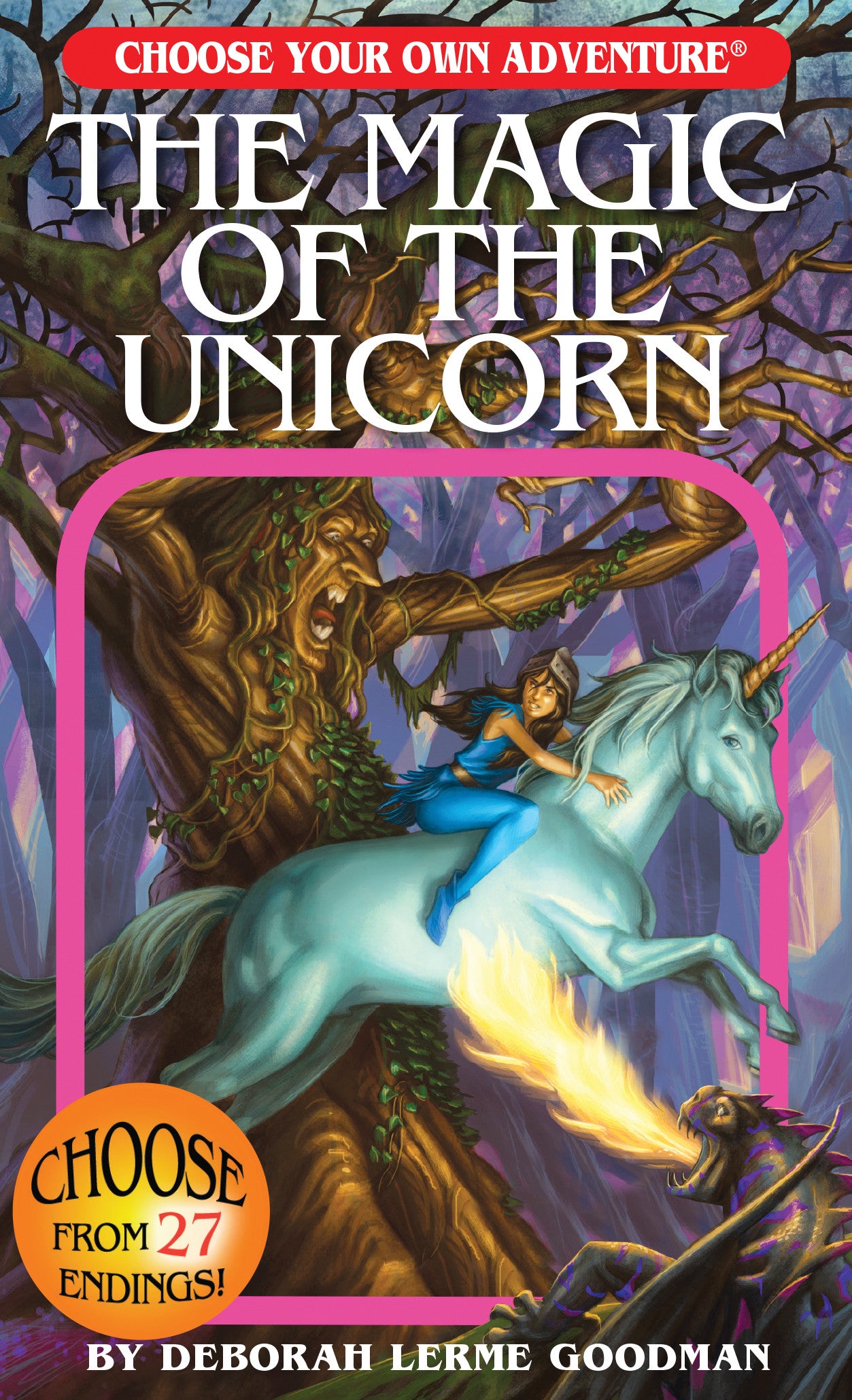
Thoughts about The Magic of the Unicorn

Read the previous piece in the series here.


â„‘ don't think it even approaches being a secret that I am a nerd, and a big one. I don't think its anything resembling a secret, either, that I (quietly?) encourage my daughter, seven years old as I write this, to follow along in my nerdiness. She's picked up a fair bit of it in musical taste so far, which pleases me, and there are glimmers of it in such things as a recent question she asked me: "Daddy, what's a gelatinous cube?" I am pleased to report that she appreciated a quick perusal of an older-edition Monster Manual for an answer, and it looks to be time to encourage her towards roleplaying games.

https://cdn.shopify.com/s/files/1/0079/6942/products/Unicorn_cover_RGB.jpg?v=1568797821
The cover, of course.
Image taken from the book's webpage,
used for commentary.
With that thought in mind, I looked at other bookshelves in my home than those where my RPG materials rest, seeing if I couldn't find something that might serve as a solid introduction to the genre for her but that would be accessible to her; she reads, and at or above grade level, and I'm proud of her for it, but there's a lot of RPG material that's dry and difficult slogging, especially for a seven-year-old. Fortunately, because I am a nerd and am married to a nerd, and both of us remember such things fondly from our own earlier years, we have a number of Choose Your Own Adventure books on hand--and Deborah Lerme Goodman's The Magic of the Unicorn (Chooseco, 2017; ISBN 978-1-937133-25-2) was the one that came off of the shelf for me.

Like all examples of the genre, The Magic of the Unicorn rewards re-readings and consideration of choices to be made; there are multiple endings to be found, and not all of them are particularly pleasant, although no few of them are. And while the specific text may be a bit ambitious for my daughter at this point--she's in first grade now, and the book checks out at a fifth-grade reading level--the ability to make choices and have them matter is something that my little girl appreciates. Too, she likes unicorns and dragons and the like that appear in the text, even though she doesn't always like every ending she runs into as we read it together.

The more pertinent stuff for this webspace, though, is how the text presents the medieval. It certainly presents itself as presenting it; ad copy on the book's webpage offers the following description:

Only a unicorn's horn can purify the water in your medieval village, so you set off to find one. Can you solve the town riddle and find the sorceress? Does a unicorn reside in the forest? A fire-breathing dragon, angry warlock, and powerful wood-witch all stand in your path.
So, that is there. The first sentence of the book complicates the matter, however; reading "The summer of 1507 is exceptionally dry throughout Flanders" (1), the statement regarding setting puts the events of the book into the ambiguous, liminal period that could be considered either medieval or early modern, depending on definitions of the terms (as noted here). While it does get the bit about the drought right, the ambiguous placement in time sits...oddly with me as I read it against the description of the book as medieval.

The rest of the text and the paratext work to make the book more medieval, however. Although there is much of the hovels-and-heraldry stereotyping at work, there are a lot of details that ring true. A weaver figures eminently, and weaving was among the major economic drivers of Flanders at the time. Too, monastic figures and churches take up a fair bit of space in the work, reinforcing the association with the medieval (yes, such figures extend well outside the medieval, but the medieval is often presented as typified by the interpenetration of Christian institutions into civil ones), and "typical" feudal structures are very much in place. In all, as might be expected from a children's book (and about which I have opined before), The Magic of the Unicorn works from an idealized, condensed, compressed understanding of the medieval that does well enough--again, unpleasant endings await readers, averting the Disneyfication of the period--and it could do better without losing narrative thrust or confusing younger readers.

That said, there are things the book does well. An early encounter along one narrative line in the text is with "Simon, a traveling peddler [the protagonist has] always liked" (7). The accompanying illustration (6), at least in the edition of the text I have, is of a dark-skinned man in what appear to be good clothes--they compare favorably with even some of the noble figures presented in the book, and better than the clothes worn by the prominent weaver (37)--so the problems of the monochrome Middle Ages and the Manichean allegory are averted (at least in part; tokenism may still be regarded as an issue of concern). Too, while there is much flattening of the medieval in the text, and there are decidedly fantastical elements in it--dragons, griffins, alchemy, and the titular magic and unicorn--the book does not avoid peril, injury, and death--including in what seems very much an oubliette, medievalist if not necessarily medieval; the book's medievalism is not all knights and princesses and pageantry, even as it is not all grim and grime and gory. And in maintaining at least that much nuance, it does decently enough for an elementary school read--although it, like all of us, could do better.

Thursday, January 2, 2020

She-Ra and the Princesses of Power Rewatch 2.4, "Roll with It"

Read the previous entry here!
Read the next entry here!

A punning title points to a potential set of references in an interesting aside.

2.4, "Roll with It"

Written by Noelle Stevenson and Josie Campbell
Directed by Jen Bennett

Synopsis

Screen and all...
Image taken from the episode, used for commentary
Adora, Glimmer, and Bow assail a Horde fortress that commands a passage. The assault goes poorly, despite some reasonable planning. It is fortunate, then, that the whole matter is but a game, soon reset.

The trio is gaming out strategies to take the real Horde fortress from its occupiers. Adora frets about the lack of successful planning in their past exploits, worrying about the quality of defenders--though Scorpia seems to be in command of the Horde forces in the fortress.

Glimmery.
Image taken from the episode, used for commentary
Glimmer takes control of the gaming situation; narrative and artistic styles change to suit. Even so, the proposed plan games out as unworkable. Others soon join the "planning" sessions, with narrative styles and planning change--though no more effective plan emerges.

In the fortress, the Horde becomes aware that princesses are in the area. They send out a robot to gather intelligence, finding the princesses amid planning. Scorpia is convinced of the "plans'" veracity before the reconnaissance feed ends.

Yep. That looks like victory.
Image taken from the episode, used for commentary
Adora has an outburst, from which Glimmer talks her down. United, the princesses and Bow proceed to assail the Horde fortress. It has hardened itself against the incoming assault, but it is not able to hold out against the attack. Despite a struggle, the Horde is beaten back.

Discussion

Given the content of the present episode, a passage from my earlier write-up of an episode of Voltron: Legendary Defender would seem to apply:
As a loving and evidently well informed call-out to Dungeons & Dragons, the episode is inherently medievalist; the game referenced is itself noted for its medievalist origins, borrowing extensively from Tolkien and from various military and political histories of the Middle Ages. Borrowing from it, in turn, is a continuation of the trope it embodies--one that itself pervades medieval literature and art, with the frequent appropriation and refiguring of characters and whole stories by other creators in other times and places. (The retelling of Chaucer's Miller's Tale in Heile van Beersele, per Frederick M. Biggs's 2005 Review of English Studies piece, "The Miller's Tale and Heile van Beersele," offers one example. The accretion of myth around King Arthur, beginning in Gildas and Nennius and extending through Geoffrey of Monmouth through Malory, offers another and more extensive. There are any number of others.)
The call-out is every bit as overt in the present episode as in the Voltron episode; a screen on the table is a giveaway, and references to "making checks" cement the invocation. It also hearkens back to Dungeons & Dragons' origin story; by report (attested in Daniel Mackay's The Fantasy Role-Playing Game, Gary Alan Fine's Shared Fantasy, and Lawrence Schick's Heroic Worlds, among others), the game emerged from tabletop miniatures wargaming, which gives occasion for the competing narrative views on display in the present episode. What was true of the Voltron episode, then, is also true of the present episode, in terms of its medievalist leanings.

Such 80s. Much wow.
Image taken from the episode, used for commentary
Notable also amid the call-out is the shifting narrative and animation style. While each shift presents an homage to another artistic style--including one to the original series--the shifts themselves echo the multiple textual traditions that emerge in medieval practice. To explain: a lecture by Prof. Chris Healy at the University of Louisiana at Lafayette makes reference to the "medieval Xerox," which, maugre some popular accounts, is not a person but a process. To wit: medieval copyists would, per Healy, not seldom work from oral readings. That is, one scribe would read aloud, while another or others would write what they heard. Owing to differences in pronunciation, hearing ability, and the lack of orthographic standards, different versions of the same text would emerge from such sessions. While a simplification of processes, it is a useful explanatory model, and one that seems to be at work in the present episode; each of the rebel narrators works with the same basic structure but imposes a wildly different interpretation on it. In the end, the fact is that something corresponding to parts of each is present; it is textual transmission in reverse, but inversion is a common appropriative technique...

Thursday, July 4, 2019

Galavant Rewatch 2.6, "About Last Knight"

Read the previous entry here!
Read the next entry here!

For the US Independence Day entry, how the series engages with some of the less fortunate legacies of that nation receives attention--as do a few other things.

2.6, "About Last Knight"

Written by Scott Weinger, Luan Thomas, Julia Grob, and Joe Piarulli
Directed by Paul Murphy

Synopsis

It's not a good start for him.
Image taken from the episode, used for commentary.
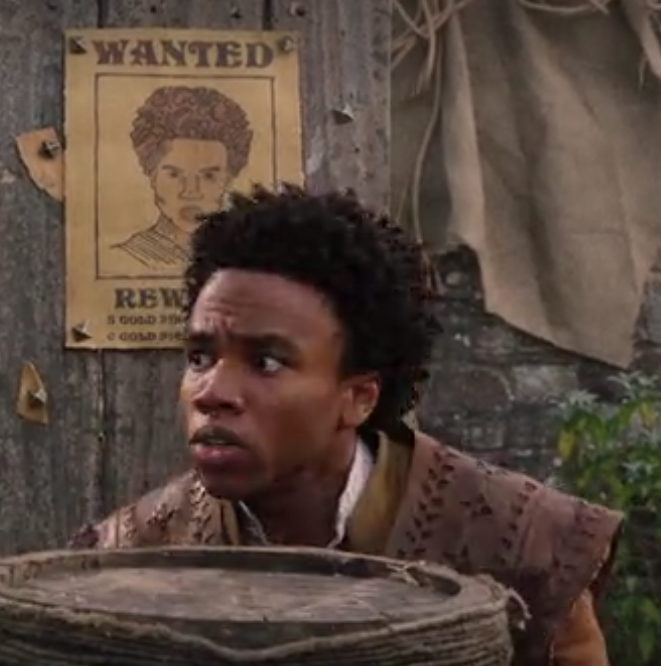
Sid flees through Valencia, where he is a wanted man. He attempts to filter unnoticed through the crowds, albeit without success (about which some comments below). He does manage to avert his recapture, however, by arguing the likelihood that the promised reward for his return will not be paid, and he attempts to foment rebellion--to no avail. He flees again.

Galavant, Richard, and Roberta are forced to halt in their progress by an unwilling horse. They dismount and recite their recent off-screen hardships (about which some other comments below). They find themselves on the borders of Galavant's father's--his name is Arnold--lands, which Galavant hates, but they appear obliged to call on him, even so.

In Valencia, Madalena throws a surprise party for Gareth. He reacts poorly at first, and is awkward even after, noting the mismatch between himself and the sumptuous surroundings. He asks to get a scar in a bar fight, and Madalena decides to take him out to get one.

This is not a happy person.
Image taken from the episode, used for commentary.
Isabella returns in anger to Hortensia (which I have evidently been misspelling previously; mea culpa). She interrupts his scheming, and he notes he cannot be killed save by the "sword of the one true king"--which happens to be in Richard's inept hands. Isabella banishes him; he leaves amid an intermittent monologue.

Galavant, Richard, and Roberta arrive at Arnold's home. The knight remains trepidatious, even when events suggest he should not be; Richard and Roberta opt to fill their bellies. Arnold welcomes the group warmly, inviting them in and showing them the school he now runs. His students clearly love him, and Galavant is skeptical.

Gareth and Madalene call on what appears to be an in-castle pub. Gareth explains how events usually unfold, and those in the pub fall over themselves in their submission to him. He leaves in disgust at their unwillingness to confront him.

Wormwood and his assistant, Barry, proceed through a forest--the Forest of Coincidence--away from Hortensia. They encounter Sid, who soon finds himself rearmed and sent on his way back to Galavant; he warns them of Madalena and Gareth, and Wormwood purposes to go there.

Galavant, Richard, and Roberta take some time at Arnold's school. Galavant and Roberta confer about Richard until Galavant is pulled into reminiscing about his own unpleasant childhood. The students refute his assertion and extol Arnold's virtues. Arnold hears Galavant's imprecations.

Isabella's parents are released from imprisonment, and she apologizes to them, citing her ensorcelment. They apologize in turn for their earlier treatment of her. The three are reconciled. They break off the marriage arrangement with Harry.

Arnold and Galavant also reconcile, Arnold noting his record of Galavant's life and acknowledging his own inadequacies as a father. Arnold sends him off with his blessing.

Gareth sulks about his inability to find a birthday fight. Madalena tries to comfort him, introducing Wormwood and the prospect of a war to fight.

Sid returns to Galavant in joy. He reports events, and, in his excitement, he accidentally runs the knight through...
The face of a man who gets the point.
Image taken from the episode, used for commentary.


Discussion

It is true that Galavant works in many episodes to avert the medieval-as-white paradigm so unfortunately prevalent in medievalist media and popular understanding of the medieval. That said, the opening minutes of the current episode appear to be treating in that dynamic, with Sid's easy identification as a fugitive seemingly enabled by his being the only person of color among a great many white people. That the scene makes so little use of persons of color among the extras is admittedly unusual, but it is still striking, and it is not to the series's credit.

Of note for a different reason is a comment made early on in the episode by Richard, that noting eating "that family of hobbits." The reference to Tolkien is clear (and makes the episode clearly fit for the Society's attention), especially given the long-known avidity with which Tolkien's estate defends components of Middle-earth. (The long-ago lawsuit against D&D is one of the more famous examples.) How to take the reference (other than a morbid joke that sets up an iteration of a running joke in the season) is less clear. Is it a lampshade (unneeded) that the series is a satire of medievalist fantasy? Is it a repudiation of Tolkien? Is it a biting commentary (I could not help the pun) about the voraciousness of the wealthy?

But on the topic of things the episode gets more correct than many in the presumed audience will realize: the school Arnold runs has clear antecedents in medieval history. One of the commonplaces of mainstream depictions of the medieval is that the period was one of little education outside the church (and damned little within it); learning was not only largely unavailable, but was derided. (It is a commonplace now, as well.) Yet Alfred the Great, in his preface to Cura Pastoralis, asserts that learning will be available to any who may pursue it instead of other occupations, and Charlemagne--the medieval king par excellence--established multiple schools throughout the Holy Roman Empire. They are the most accessible examples, certainly, but not the only ones. They also serve to suggest that schools, while perhaps not on the model of Arnold's, were far more readily available to medieval Europeans than is commonly understood (and higher education, at least, is far less accessible now than many want to realize). The reminder that medieval people were not quite so backward as is usually assumed is a useful one, indeed, even if it is embedded in a problematic context.