Showing posts with label George R.R. Martin. Show all posts

Thursday, December 23, 2021

Once upon a Time Rewatch 2.4, "The Crocodile"

Read the previous entry in the series here.
Read the next entry in the series here.


2.4, "The Crocodile"

Written by David H. Goodman and Robert Hull
Directed by David Solomon

Synopsis

Gold attempts to woo Belle with fineries from his shop, offering to take her out on the town. Leroy interrupts, demanding the return of his axe and chiding Belle. Gold erupts in anger at the insult to Belle and assails Leroy, reverting briefly to his Rumpelstiltskin form--and prompting Belle to wake in the night and stalk through the house she and Gold share. Snooping about, she finds him spinning straw into gold, working magic.

Be it ever so humble...
Image taken from the episode, used for commentary.
Back in the past of the Enchanted Forest, Rumpelstiltskin returns to his home, calling for his wife, Milah, and son. The latter greets him, the former is absent, and Rumpelstiltskin takes Baelfire out to find her. She is carousing with pirates in a tavern, making mock of him until Baelfire's appearance shames her into returning home. There, she pushes Rumpelstiltskin to relocate, and he argues against it.

In Storybrooke, Gold and Belle confer about his magic use. She rebukes him for his lack of courage with her.

In the past, Rumpelstiltskin is summoned to the nearby docks, where the pirates are taking Milah. He proceeds there as swiftly as he may, only to be refused and ridiculed by the ship's captain, Kilian Jones.

In Storybrooke, the dwarves attempt to mine fairy dust, David aiding them. Their efforts are unproductive, and David proceeds to take on law enforcement duties. Gold tries to talk to Belle, finding her fled from his home. He goes in search of her, seeking her at her father's; he is, understandably, greeted unkindly. Gold challenges him for information, receiving none.

In the Enchanted Forest, the empowered Rumpelstiltskin meets with Smee, who offers a realm-jumping magic bean. After a tense exchange, the two reach an agreement, and Smee leaves--as Jones arrives, and Rumpelstiltskin purposes to observe him.

Good advice. When in doubt, to the library!
Image taken from the episode, used for commentary.
In Storybrooke, Belle finds herself at the diner, and Ruby talks with her there. She offers to help find family, and the idea of Belle taking over the town library is raised. She heads there, inspecting it until confronted by Smee--who abducts her.

Rumpelstiltskin confronts Jones in the street, receiving the sobriquet "Crocodile" before challenging him about Milah. Jones notes Milah's long-ago death, and Rumpelstiltskin sets up a duel between them.

Gold calls on David, reporting the disappearance of Belle. David reluctantly agrees to help find her.

The duel between Rumpelstiltskin and Jones begins and is swiftly concluded, Jones getting the worse of the exchange. Milah, whose death had been falsely reported, calls for Rumpelstiltskin to stop before killing Jones.

Smee delivers Belle to her father, and the two are happily reunited. They exchange news, and Belle's father challenges her about Gold and his depredations; when she refuses to cut ties with Gold, her father has Smee take her away again. Meanwhile, David continues to search for Belle, fruitlessly. He also advises Gold that hard work and honesty support love, discoursing on the difference between precise wording and "honesty of the heart."

Rumpelstiltskin confronts Milah about Jones and her abandonment of her husband and son. She notes having fallen in love with Jones, and she offers Smee's bean in exchange for Jones's life and hers.

Forth, the Three Hunters?
Image taken from the episode, used for commentary.
David asks Ruby after Belle, disbelieving her denial of information about her. She relents and notes that Belle's interest in the library. She also notes her ability to track by scent, and moves off in pursuit, accompanied by Gold and David. They have to give off pursuit, Ruby discommoded by the flower shop Belle's father runs (and which puns off of Martin's series for its name). Gold confronts Belle's father again, and he notes her safety will be secured by sending her across the town line, with its concomitant memory loss. David realizes she will be sent out through the mines, and the three speed thence.

Rumpelstiltskin confronts Jones and Milah aboard their ship, where she shows him the bean. He mocks them and upbraids her for leaving Baelfire. He kills her and takes Jones's hand. Jones tries to kill him, in turn, failing and swearing vengeance. He takes up a hook after Rumpelstiltskin departs.

Smee sends a restrained Belle down the mineshaft, and she attempts escape without success. Gold's magic saves her from passing the town line and forgetting all. She thanks Gold but does not agree to return to him. Nor yet does she return to her father, citing his misdeeds. Later, Belle and Ruby confer again, and Belle takes lodgings at Granny's inn, receiving the key to the library, which she soon moves to use. Entering the library, she finds Gold, who admits his cowardice to her and reports his failures and his need and inability to leave to find Baelfire. His magic use is an attempt to allow himself to leave Storybrooke, and Belle offer a possibility of reconciliation.

Rumpelstiltskin finds Jones's hand empty, the pirate having retained the magic bean for himself as he sails away and Milah is buried at sea. Smee is conscripted into Jones's service, and they make for another realm: Neverland.

Gold returns to his basement, where Smee is restrained. He presses him for information about Jones--who is with Cora, the two conferring about how to proceed to Storybrooke, where they will find Regina and Gold.

Discussion

Hooray, anachronism!

As the effective introduction to the series of Captain Hook, the present episode necessarily makes much of stereotypical depictions of eighteenth-century pirates. I've noted on several occasions and in relation to several properties--including others from Disney--that the collapse and compression of the pre-modern (and I'll admit to using a fuzzy definition of "modern," here, but periodization is slippery at best, as I've noted) tends to attract a lot of attention to the putative Age of Piracy. Like the medieval, or conceptions of it, "traditional" piracy is easily and often romanticized (something I've touched on in other writing I've done), a seemingly removed and far-away thing onto which much can be projected. And there is some justification, certainly; I recall readings and lectures that associated the early modern English privateers with neochivalric movements occurring in the late Tudor and early Stuart courts, among others, and the clear parallels between eighteenth-century piracy and the Viking raids of a millennium before are, well, there. What purpose is served, what effect achieved, is less clear to me, although that may well just be me--but I think it's another example of the overall compression of all that came before. It remains a dangerous thing, a pernicious one, but how to address it...I do not know.

Thursday, December 24, 2020

The Dragon Prince Rewatch 2.4, "Voyage of the Ruthless"

Read the previous entry here.
Read the next entry here.

Intrigues deepen, both political and mystical.

2.4, "Voyage of the Ruthless"

Written by Neil Mukhopadbyay
Directed by Villads Spangsberg

Synopsis

Honestly, I'm impressed by the bird.
Image taken from the episode, used for commentary.

Following their escape from Soren and Claudia, Ezran, Callum, and Rayla continue eastward, carried by a phoenix. Callum attempts to commune with nature en route; Rayla chides him for it. The phoenix begins to falter from flying for so long with such weight, and it falls to earth.

Elsewhere, Amaya surveils the separation of Xadia from the western, human lands. She suspects that a forward position has been compromised, and she orders a sortie to determine the truth of it.

Ginsu, it ain't.
Image taken from the episode, used for commentary.
In Katolis, Viren continues to investigate the mirror. The figure within communicates with him via pantomime. Viren follows along with what seems to be a magical ritual, although not without his suspicions.

"Hello, again, fellow humans, human fellas!"
Image taken from the episode, used for commentary.
Ezran, Callum, and Rayla send the phoenix back to Lujanne and continue their journey. They purpose to take a boat across the bay that lies in their path, and they enter a port town to secure passage. Rayla resumes her "human disguise," entertaining Ezran immensely; Callum leaves Rayla behind as he and Ezran seek a captain. They find one in the blind Villads, and they arrange passage aboard his ship, the Ruthless. Despite the oncoming heavy weather, they proceed across the bay.

Villads proves an adept sailor, explaining seacraft to Callum in a way that suggests the possibility of his own connection to the skies and their magic. The coming storm approaches, and the Ruthless is obliged to put in on the lee side of an island by the wind and rain.

Viren follows the mirror-figure through the beginning of the ritual, mimicking its motions and channeling power between the pair of them. He hesitates at bloodletting, however, disappointing the mirror figure, whose identity remains unclear to him.

Quite the entrance.
Image taken from the episode, used for commentary.
Amaya leads her sortie to the forward outpost. She finds that it has been compromised, and a fracas ensues. Her forces are beset, and her earlier opponent returns. Amaya acquits herself well and secures her troops' escape, retreating with them back to a more fortified location.

Aboard the Ruthless, Callum purposes to connect to the skies. He remains out in the storm in an attempt to activate his message; Azymondias accompanies him, and the two leave the ship for the shore. Callum's efforts do not go well for him; his folly in enacting them does not help matters, though he does recognize his error.

Message for you, sir!
Image taken from the episode, used for commentary.
Viren considers the ritual as he sees messages return. He finds that they are from the other human kingdoms, agreeing to a summit. The news pleases him. When he returns to his sanctum, he covers the mirror.

Callum returns to the Ruthless, abashed. Rayla welcomes him back.

Discussion

The episode engages in some anachronism (in addition to the repeated reference to Martin via crow-messenging), which is not uncommon in medievalist works. For one, the Ruthless and her captain partake greatly of stereotypical pirate trappings, common enough in otherwise medieval-styled milieux (as noted here and here, among others). For another, Callum makes note of lightning rods, using the term, and while it might well be thought that a medieval person would see lightning striking tall objects more frequently than short ones, it is not until the eighteenth century that the term and the device came into use; the lightning rod is at least as post-medieval as the "typical" pirate. As in other examples, though, the anachronism serves to make the episode more accessible to audiences that typically compress all but the most recent past into a single, monolithic concept, as well as to allow for some narrative motions that would otherwise be difficult to carry out.

Too, the anachronism serves a useful purpose in reinforcing the fiction of the series. Because things are not in it as they were in the audience's world, although they are similar in many ways, the series is insulated from a number of concerns with which its presumed secondary audience--parents of the children likely to be watching, that is, or people like me--would be familiar. I am not alone in remembering the Satanic panic of the late 1980s and early 1990s, the protestations of Pat Pulling and those who heeded her; among the "concerns" was that "the things in fantasy are too real." While such things are erroneous, clearly, worries about similar reactions persist--and they are, in some senses, allayed by introducing eminently inaccurate elements into the narrative. Such elements provide some cover--an unfortunately still-needed thing.

Tuesday, October 6, 2020

Guest Post: Kristine Larsen, "A Tale of Tails: Medieval Fantasy and the Great Comets of the 1990s"

The following essay was kindly submitted by contributor Kristine Larsen, PhD, the editor of Reflector,as well as director of the Center for Teaching and Faculty Development and Professor of Astronomy in the Geological Sciences Department at Central Connecticut State University. It is presented with only minimal editorial adjustment.

𝔍oseph Goodavage argues that other than the explosion of a star as a supernova, “there are few splendors from the hand of God or man to match the drama of a great comet flaring across the vault of heaven” (6). Catastrophes from wars to epidemics, natural disasters to famines, have been blamed on the unexpected appearance of comets in the night sky. References to these superstitions are legion in the Western canon. From John Milton’s description of Satan as “like a comet” in Paradise Lost to Shakespeare’s famed claim in Julius Caesar that “When beggars die, there are no comets seen; The heavens themselves blaze forth the death of princes,” the equality comet = calamity appears ubiquitous in Western culture. Even Eastern cultures, historically meticulous documenters of the coming and going of heavenly apparitions including what became known in China as “broom stars,” widely regarded comets with suspicion.

But it was in medieval Europe that clear connections were drawn between the timing of cometary apparitions –malignant violations of the immutable and perfect heavens – and mishaps and misfortune. The Anglo-Saxon Chronicles feature many such correlations; for example, in the Year 729 the appearance of two comets is connected with the death of King Osric and “the holy Egbert” (Whitelock 28). But the most famous comet-linked event in the Anglo-Saxon Chronicles is clearly that immortalized in the Bayeux tapestry, the connection between the appearance of Halley’s Comet in 1066 and the Battle of Hastings. According to the Chronicle,

Then over all England there was seen a sign in the skies such as had never been seen before. Some said it was the star ‘comet’ which some call the long-haired star, and it first appeared on the eve of the Greater Litany, that is 24 April, and so shone all the week. (Whitelock 140)

The selection in question
Image from Wikimedia Commons, used for commentary
Immortalized in embroidery thread on the tapestry is the image of men pointing at the comet, noting “Isti mirant stella” (They marvel at the star). 

Given this historical precedent, it is not surprising that comets as omens appear in the medievalisms of fantasy literature. In the early chapters of E.R. Eddison’s classic 1922 work, The Worm Ouroboros, Lord Gro is deeply troubled by a prescient dream of doom. A central vision is “fiery signs” in the night sky, especially a “bearded star” (27) – a comet – that seemed to herald the shedding of blood (32). More recently a red comet appears in two 1990s fantasy novel series, George R.R. Martin’s still-unfinished A Song of Ice and Fire and Andrzej Sapkowsi’s Witcher series, a coincidence significant enough to make this astronomer sit up and take notice. Martin’s ongoing novel series – A Game of Thrones (1996), A Clash of Kings (1998), A Storm of Swords (2000), A Feast of Crows (2005) and A Dance with Dragons (2011) – is the more widely known of the two, in part thanks to the now-completed hit HBO series Game of Thrones and the fact that Sapkowski’s works have only recently been published in English.
The culminating event in Martin’s first novel is the funeral pyre of the Daenerys Targareyn’s Dothraki husband, Drogo, and the hatching of her dragons. The Dothraki search the heavens for a sign of the star that was kindled by Drogo’s soul. Instead, a “comet, burning red. Bloodred; fire red” is seen, and taken as a positive portent (Martin, AGoT, 804). Daenerys follows the comet across the desert to the city of Qarth, interpreting this “shierak qiya, the Bleeding Star” as a sign sent by the gods (Martin, AGoT, 188). Throughout A Clash of Kings, characters from different cultures note the comet in the sky, and interpret it through the lens of their personal belief systems and political allegiances. For example, the Brothers of the Night Watch on the Wall name it after their commander, referring to it as “Mormont’s Torch, saying (only half in jest) that the gods must have sent it to light the old man’s way through the haunted forest” (Martin, ACoK, 97). The followers of the Drowned God believe it to be a sign from their god, with Aeron Damphair calling it evidence that “It is time to hoist our sails and go forth into the world with fire and sword” (Martin, ACoK, 179). At the same time, Melisandre proclaims that the comet is the fulfillment of an ancient prophecy heralding Stannis Baratheon as the rebirth of the hero Azor Ahai (Martin, ACoK, 39; ASoS, 349). In Riverrun the comet is said to be a “red flag of vengeance for Ned” Stark’s death at the hands of King Joffrey, as well as an “omen of victory” for the Tullys (Martin, ACoK, 117). Ser Brynden offers the most honest interpretation of all, especially given Martin’s taste for killing off his characters: “That’s blood up there, child, smeared across the sky…. Was there ever a war where only one side bled?” (Martin, ACoK, 118). Even the wise Maester Cressen, not given to belief in omens, wondered at the uncharacteristic brightness of the comet and its “terrible color, the color of blood and flame and sunsets” (Martin, ACoK, 1). Thus the interpretation of the comet is clearly in the eye of the beholder. The comet was one of a number of details (e.g. Jon Snow’s parentage) introduced and quickly abandoned by the HBO series.
On the other hand, while Andrzej Sapkowski’s novel series is completed, the Netflix adaption is only in the pandemic-delayed filming stage of Season 2. The economics-trained travelling furs salesman initially introduced his unnamed medieval world in the short story “Wiedzmin” (Witcher), which took third prize in a contest in Fantastyka, a Polish science fiction and fantasy magazine in 1986 (Purchese). Additional short stories continued to appear in the magazine until they were published as book-length collections in 1992 (Sword of Destiny [Miecz przeznaczenia] ; English translation 2015) and 1993 (The Last Wish [Ostatnie Życzenie] ; English translation 2007]). A series of five subsequent novels followed: Blood of Elves (Krew Elfów 1994; English translation 2008), The Time of Contempt (Czas Pogardy 1995; English translation 2013), Baptism of Fire (Chrzest Ognia 1996; English translation 2014), The Tower of the Swallow (Wieża Jaskółki 1997; English translation 2016), and The Lady of the Lake (Pani Jeziora 1999; English translation 2017). Season of Storms (Sezon Burz), a novel set in the same time period as The Last Wish, appeared in Polish in 2013 (English translation 2018). Until the December 20, 2019, release of the wildly popular first season of the Netflix series The Witcher, the Witcherverse was perhaps most widely known outside of Poland through the internationally successful computer games created by CD Projekt Red: The Witcher (2007), The Witcher 2: Assassins of Kings (2011), and The Witcher III: The Wild Hunt (2015). In the mythology of the series, Witchers are monster hunters mutated as children using a variety of herbs, chemicals, and magic and trained in martial arts, magic, and monster physiology and taxonomy. In return they are rewarded with superhuman strength, agility, and senses, an extremely long lifespan, and resistance to disease; however, they are sterile. The adventures of the Witcher Geralt with his sorceress lover Yennifer and adoptive daughter Ciri (the eugenically engineered child of destiny) reveal that humans are the true monsters.
Sapkowski utilizes the metaphor of a comet for dramatic effect on several occasions. When a “red-hot horseshoe” is placed into a corrupt priest’s long johns he shoots “straight ahead like a comet with a smoking tail” (Sapkowski, BF, 167), while the deadly company of the Wild Hunt (disguised in the form of an ominous cloud] is repelled by Yennefer and shoots “upwards into the sky, lengthening and dragging a tail behind it like a comet’s as it sped away” (Sapkowski, TC, 100-1). Here Sapkowski draws upon a common misconception, that comets streak across the sky like meteors. This fallacy is inspired by centuries of paintings and later photographs of comets with their impressive gossamer tails breathlessly suspended as if captured midflight.
A literal comet is featured in The Lady of the Lake, a “golden and red bee of a comet” seen “crossing the sky from west to east, dragging in its wake a flickering plait of fire” (Sapkowski, LL, 207). The event was singular enough in Sapkowski’s universe to be used as an important chronology marker by Nimue, who features prominently in a “flashforward” into the future of Geralt’s world. She notes that “The red comet was visible for six days in the spring of the year the Cintran Peace was signed. To be more precise, in the first days of March” (Sapkowski, LL, 29). Nimue’s rather scientific detachment is contrasted with the reactions of characters of the comet’s time, who regard it with far more superstition. Jarre, a young scribe educated at the Temple of Melitele, privately “wondered what this strange phenomenon, mentioned in many prophecies, might actually auger” (Sapkowski, LL, 207).
Elsewhere a “seller of amulets and remedies” opines that the

red colour indicates that it’s a comet of fevers. Blood and fire, and also of the iron which springs from the fire. Dreadful, dreadful defeats will befall the people! Great pogroms and massacres will happen. As it says in the prophecy: corpses will pile up to a height of a dozen ells, wolves shall howl on the desolate ground, and men will kiss other men’s footsteps… Oh woe to us!
A wily mercenary has a different interpretation, noting that their Nilfgaardian foes also see the comet above their heads, so “Why, then, should we not assume that it foretells their defeat and not ours?” (Sapkowski, LL, 221).
Yet another interpretation is held by Aarhenius Krantz, “a sage, alchemist, astronomer and astrologer” who observes this comet and its “fiery red tail” with his (anachronistic) simple telescope, intrigued because he knows that such an object “usually heralded great wars, conflagrations and massacres.” Invoking a mixture of pseudoscience and science that characterizes the Witcher series, he decides that the comet is, indeed, a portent of war, but since there is already a war in progress, he will scientifically determine the orbit of the comet so that they will know when it will return and, hence, the next war will occur (Sapkowski, LL, 259).
Such an expectation – that the appearance of a bright comet should lead to doom and gloom – has unfortunately survived the Scientific and Industrial Revolutions in some quarters. The 1910 return of Halley’s Comet generated a wave of comet-hysteria when scientists announced their unexpected discovery of deadly cyanogen in the comet’s tail – a tail that the earth would pass through. According to the May 18, 1910, issue of The New York Times, the citizens of Chicago were terrified:
Especially has the feminine portion succumbed…. ‘I have stopped [up] all the windows and doors in my flat to keep the gas out,’ said one woman over the telephone. ‘All the other women in the building think it is a good thing, and all are doing the same.’… Physicians say that there were scores of calls to-day for their services from women who were suffering from hysteria. (Flaste et al. 63)

Astronomers’ subsequent assurances that the comet’s tail was far too ethereal to pose a threat did little to calm fears (much to the delight and financial gain of charlatans who sold “comet pills,” the modern equivalent of various medieval potions) (Kronk 2011). 
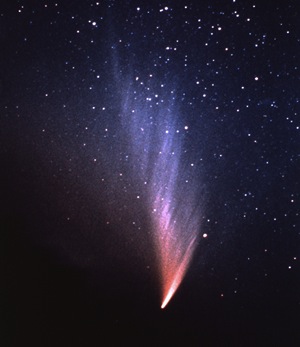
The ruddy Comet West
Image taken from Wikimedia Commons,
used for commentary
The last quarter of the Twentieth Century saw more than its share of great (and not-so-great) comets, and with them a rebirth of medievalist superstitions. Soon after its March 1973 discovery, Comet Kohoutek was hyped as the “Comet of the Century” (based on early observations) but failed miserably to live up to expectations. That didn’t stop the comet from being co-opted as a sign of the looming apocalypse by astrologers and doomsday cults, including the Christian fundamentalist “Children of God” (Ciarán). The downfall of the President Nixon via the Watergate scandal was also blamed on the comet in some circles (Daly). Comet West delighted skywatchers in 1975, setting the bar high for the next generation of Great Comets in the 1990s. It is therefore interesting that in an email response to a fan, George R.R. Martin explained that the appearance of the comet in his novel series was not motivated by, as the fan assumed, Halley’s Comet’s connection to the Battle of Hastings, but instead the reference in Shakespeare’s Julius Caesar and “the ones actually in the sky as I was writing” (Chris H.). Given the publication of his first two novels in 1996 and 1998, the mystery to be solved is precisely which comets he is referring to. Simultaneously, we have Sapkowski’s comet. If we accept that it was not a simple case of plagiarism (since the comet first appears in the 1999 novel Lady of the Lake), it suggests that we are searching for heavenly apparitions sufficiently famous and awe-inspiring to invoke awe similar to that apparent in the Bayeux Tapestry in the minds of two modern authors. Fortunately, three such objects immediately come to mind. 

Fragments of Shoemaker-Levy 9--red again
Image from Wikimedia Commons, used for commentary

Comet Shoemaker-Levy 9, discovered on March 23, 1993, by Carolyn and Eugene Shoemaker and David Levy, was peculiar from the start, as photographs quickly proved that it was actually an aggregate of separate pieces flying in formation that dive bombed into Jupiter in July 1994 (Levy et al. 86-7). For the first time in modern history, astronomers witnessed (from a safe distance) the collision of a comet with a planet. The “collisions” of the nearly two dozen dirty snowball fragments (the largest about a mile wide and liberating an energy equivalent to over 200,000 Hiroshima bombs) with Jupiter’s dense gaseous atmosphere actually occurred on the backside of the planet. The resulting “black eyes” of the debris fields – some the size of earth – astounded astronomers when the planet’s rotation carried them into view several hours later. I remember observing them through our university’s observatory telescope and then grabbing a much smaller instrument to see how obvious they would be to backyard observers. The answer was, very! The young Internet played a significant role in the sharing of observations in real time, making the demise of SL-9 the first viral event (Gorman). Hollywood responded to public interest in the event with a succession of impact-based disaster movies (the most famous being 1998’s Armageddon and Deep Impact), leading the U.S. Congress to support NASA’s plan for tracking of asteroids and comets that approach or cross the earth’s orbit (Gorman). This incident clearly set the stage for comets to percolate in the minds of Martin and Sapkowski.
One of the "black eyes"
Image taken from Wikimedia Commons,
used for commentary

On July 23, 1995, amateur astronomers Alan Hale and Thomas Bopp independently discovered a comet that, like Kohoutek before it, promised to deliver a spectacular show at closest approach in 1997, based on its unusually large size. But backyard observers did not have to wait that long for a naked-eye comet; on January 30, 1996, Japanese amateur astronomer Yuji Hyakutake discovered his second comet in five weeks. While more conservative in girth than Hale-Bopp, Comet Hyakutake’s orbit was forecast to bring it unusually close to our planet a scant two months later. Not only was it easily visible to the unaided eye from even light-polluted skies (as I can personally attest), but from dark skies, its tail stretched an impressive 100 degrees (Hale 2020). It is therefore quite possible that both Martin and Sapkowski joined millions of others amateur stargazers around the world in gaping skyward in awe. Not surprisingly, sensational false claims of an impending impact between the comet and our planet surfaced in supermarket tabloids (Kronk 2011).
Hale-Bopp's worth seeing.
Image taken from Wikimedia Commons, used for commentary

So's Hyakutake.
Image taken from Wikimedia Commons, used for commentary
The sensational success of Hyakutake set the bar even higher for Hale-Bopp’s 1997 flyby, but it was medieval superstitions and pseudosciences with a modern twist that captured the public imagination. Instead of witches and demons, the comet was claimed to be cavorting with extraterrestrials; in particular, a November 14, 1996, photograph became a media sensation due to false claims that the comet was being followed by a “Saturn-like object” (in actuality merely the distorted image of a star) that was alleged to be a UFO (Hale, 1997, 27-8). As the comet neared its “closest” approach to Earth (at a distance farther than the sun) in March 1997, doomsday predictions increased. In actuality, the world only ended for 39 members of the Heaven’s Gate cult, who committed suicide in the false hope that the alleged UFO was their magic chariot ride back to their true interstellar home (Robinson). In total, Hale-Bopp was visible to the unaided eye for an astounding year and a half, again increasing the likelihood that Martin and Sapkowski were not only familiar with the hype surrounding the comet but had personally seen it as well (Kronk 2011). 

The ruddy NEOWISE
Image from Wikimedia Commons, used for commentary
While we have easily unmasked the identity of three real-world comets that either consciously or unconsciously provided the role models for the fictional harbingers in Martin and Sapkowski’s secondary worlds, there remains an astronomical oddity – the description of both fictional comets as decidedly red. As rather oversized dirty snowballs, comets sublimate as they enter the relatively warm inner solar system, the frozen water, carbon dioxide, and other ices turning directly to gas, liberating bits of rock and dust like interplanetary glitter. Blue wavelengths of sunlight are absorbed by the gas, causing it to fluoresce and glow blue. At the same time, the liberated dust preferentially reflects sunlight’s yellow wavelengths. This is why most comets have two types of tails, a bluish, long, thinner, and straighter gas or ion tail, and a yellowish, shorter, curved, and fan-shaped dust tail. Note that the color red is nowhere to be found in this description. Elizabeth Howell maintains in an online article that it is not possible for a comet to appear red. However, the yellowish dust tail of a comet can take on a pale rusty cast in photographs. In fact, famed science popularizer Phil Plait publicly puzzled the red appearance of the summer 2020 apparition of Comet NEOWISE in some photographs, settling on a peculiarity in the way colors are processed in digital cameras. But not only are there no digital cameras in Westeros or Redania, but numerous historical references to red comets can be found in the historical records of many cultures in our primary world.
For example, Seneca described the comet of 146 BCE as “as large as the Sun. Its disc was at first red, and like fire, spreading sufficient light to dissipate the darkness of night” (Olivier 3). In 905 CE, a comet observed in China, Japan, and Europe was described as having “rays of 45 to 60 degrees and was blood-red in color” (Yeomans 387). The 1066 apparition of Halley’s Comet was also described as looking “like an eclipsed moon,” i.e. coppery red (Kronk, 1999, 77). As an adult, French surgeon Dr. Ambrose Paré recalled his boyhood observations of the comet of 1528:

This comet was so horrible, so frightful, and it produced such great terror in the vulgar that some died of fear and others fell sick. It appeared to be of excessive length and was of the color of blood. (Goodavage 17-8)
One of the most meticulous naked-eye observers of all time, Tycho Brahe, described the comet of 1577 as having a tail that “appeared a reddish dark color similar to a flame seen through smoke” (Yeomans 36). More recently, Halley’s Comet terrified indigenous people in Bermuda in 1910 on the night of King Edward VII’s death due to the red color of its tail. It was declared a sign of the end of the world and impending war (Flaste et al. 75). Well-known popularizer of astronomy Mary Proctor herself noted an uncharacteristic red hue in the normally yellow planet Venus at the same time (as well as a ruddy crescent moon), and ascribed the red color of all three objects to their light passing “through the mist, low down on the horizon” (“Comet’s Red Glare”). Other atmospheric effects can also explain an unusual red tint in a comet. For example, noted visual observer Stephen O’Meara ascribed the reddish tint in his July 2020 image taken from Botswana of the aforementioned Comet NEOWISE to “wind-blown dust in Earth’s atmosphere” (Irizarry). Similarly, I witnessed both Venus and the brilliant star Sirius to have a reddish tint in the predawn sky in September 2020 due to the presence of ash carried from the West Coast wildfires all the way to New England.
Throughout human history, comets have been a source of fear and wonder. They have inspired individuals to create both beautiful works of the hands and mind, and wish ill upon and commit atrocities against themselves and others. It appears to matter little whether the hands and minds are medieval, modern, or immersed in medievalisms. Andrzej Sapkowski has boasted that “My vision of Fantasy is almost real. You have to believe that which occurs in the stories, because they are not a fairy tale” (Lsrry). In the case of their use of red comets in their medievalist fiction, Sapkowski (and Martin) have taught this astronomer quite a few things about what is fantasy, and what is real.

Bibliography


The Tales after Tolkien Society welcomes contributions to the blog from members and from interested parties. Please send yours to talesaftertolkien@gmail.com, and thank you!

Thursday, July 16, 2020

She-Ra and the Princesses of Power Rewatch 5.6, "Taking Control"

Read the previous entry here!
Read the next entry here!

Another problem emerges for the resistance to the Horde as the final season of She-Ra continues.

5.6, "Taking Control"

Written by Noelle Stevenson, Laura Sreebny, Josie Campbell, Katherine Nolfi, and M. Willis
Directed by Roy Burdine and Mandy Clotworthy

Synopsis

Adora and company make for Etheria, Darla experiencing some difficulties as they do. Entrapta attempts to effect repairs, aided by Wrong Hordak. Catra convalesces. Adora, Glimmer, and Bow discuss the resurgent She-Ra, and Glimmer moves to celebrate. Their passage is marked by Horde patrol craft, however, which move to intercept them.

This is not the face of someone doing well.
Image taken from the episode, used for commentary.
Catra has difficulty processing what has happened to her. She flashes back to what she suffered at the hands of Horde Prime as Adora checks on her once again; she lashes out at Adora, rejecting attempts to assist her. Adora expresses confusion at it, and the two come to argue once again. Adora stalks off, and Catra is left hurting.

On Etheria, Swift Wind reports his findings to Micah as some of the princesses cavort. Micah frets about Glimmer and reports on Horde activity, and the lot proceed to work against it.

Yeah, that looks like it'll be a problem.
Image taken from the episode, used for commentary.
Adora frets about Catra to Glimmer. Glimmer continues to prepare a celebratory meal as the Horde patrol craft approach. Concerns about their detection are raised, as are concerns about evading the patrol.

Worrisome.
Image taken from the episode, used for commentary.
Micah, Frosta, Spinerella, Netossa, and Swift Wind proceed to where reports had had Horde activity. Micah makes awkward attempts to connect to Frosta along the way. They find the village, one they had previously saved, eerily quiet, and they are invited to dine in an uncomfortable situation. When they try to leave, they are prevented--and the locals attempt to place them under Horde control. It is a narrow thing, but they escape, aided by the power of She-Ra.

Yeah, that's definitely going to be a problem.
Image taken from the episode, used for commentary.
The Darla enters an asteroid field to try to avoid pursuit--unsuccessfully. The jarring triggers more flashbacks for Catra, and Adora recognizes that Catra is the source of the Horde's pursuit. Catra recognizes that she is not the only one who had been put under Horde control, but she still chafes at the prospect of Entrapta removing the control chip. Adora overrules her based on the safety of the ship but allows that she will let Catra go after, if she wants. Catra asks her to remain, however, and she is able to use her connection to the Horde to pull down information before Entrapta removes the control chip. Summoning the power of She-Ra, Adora defeats the patrol craft, and the group proceeds to a home under siege--from within as well as without.

Discussion

The control chips used by the Horde evoke demonic possession, of course, particularly given the appearance of Horde Prime and his many clones. A casual review of scholarship on medieval ideas of demonic possession indicates that the topic was far from uncommon in medieval European literature--and it is notable that a great many "cases" of it were associated with women; note that the two people shown in the present episode to carry the control chips are women: Catra and Spinnerella (voiced, interestingly, by showrunner Noelle Stevenson). It is a subtle touch, perhaps, but one that seems to align with the attested medieval, reinforcing the medievalism that pervades the series. It also serves as a reminder that the medieval continues to influence prevailing culture--and not only through inept "hot takes" on plagues and assertions on social media platforms that medievalism is "not a thing."

One area into which the present episode makes some foray--only some, because it remains a children's show--that much medieval work does not is in dealing with the emotional consequences of fighting. Certainly, medievalist works tend to avoid the issue, which betrays either an assumption that the kind of violence that marks chivalric works and those that borrow from them is "natural"* and appropriate, thus imposing no penalty and needing no redress or that the mental condition** that allows for such immunity is a desirable, "heroic" attribute. (I know Tolkien treats it somewhat with Frodo, but I also keep in mind Shiloh Carroll's comments about Martin and derivative works). The present episode, as much of the rest of the series, seems to share neither assumption, and if that is a deviation from the typical depictions of the medieval and the medievalist, then it seems to me to be a good one.

*Yes, I am using the term loosely if not sloppily.

**There is a reason I use the phrasing; I am the kind of doctor I am and not the kinds I am not.

Thursday, January 4, 2018

Voltron: Legendary Defender Rewatch 2.6: "The Ark of Taujeer"

Read the previous entry in the series here.
Read the next entry in the series here!

As the Voltron Force continues its quest across the cosmos, they return to one vision of the Arthurian chivalric, saving a forlorn people.

2.6. "The Ark of Taujeer"

Written by Mark Bemesderfer
Directed by Chris Palmer

Synopsis

The Galra have stripped a planet of its resources and forced the full population to retreat to a single ship with a single engine, described as an ark by the natives. Meanwhile, Allura asserts that Zarkon is tracking the Paladins through her; Keith retorts that he is the tracking agency. Pidge claims that the Black Lion itself is the issue, and Shiro asserts that the Paladins will be going on the attack.

Pidge presents a mechanistic means of finding targets, noting Taujeer is the nearest likely target. After, Keith and Shiro talk briefly; Keith makes to rest, but considers his strange dagger until interrupted by a seeming call to arms. The Red Lion rejects him, and he finds himself among the Galra--but only in dream.

Keith makes to leave, but is happened upon by Allura about the same business. They confer about the need to isolate tracking factors and decide to leave together. The other Paladins note the absence of Keith and Allura. Lance jumps to romantic conclusions, and Allura and Keith note their plan. Shiro rejects the plan, but Keith and Allura assert their continued intent--as the Castle of Lions enters a debris field emanating from Taujeer.

The Paladins deploy to investigate, and the Taujeer natives relate their plight. The Paladins agree to help as the gravity of the situation becomes clear. The lack of one Paladin and the accompanying Lion is noted, and work to assist proceeds apace.

Meanwhile, Keith and Allura confer about their own situation, and Keith broaches the idea of some few Galra, at least, as allies. Allura rejects the idea--and Zarkon continues his search, dispatching the nearest Galra commander back to Taujeer under duress.

Work to save the Taujeerians proceeds, and progress is made. Keith and Allura continue to confer. The situation on Taujeer becomes more urgent--for the Galra attack. The Paladins make to interdict the attack and support the Taujeerians. Keith and Allura make to return to action, but their small craft explodes, stranding them in space as the fight against the Galra continues.

The Red Lion launches itself to retrieve Keith and Allura amid the ongoing battle. The Yellow Lion manifests a new power, keeping the Taujeerians from falling to their doom. The Red Lion returns in time to save the lot. The Galra are repulsed and the Taujeerians saved--and Keith and Allura apologize for their departure, so Shiro puzzles out that the Black Lion is attracting the Galra.

Discussion

Early in the episode, the Galra commander comments that if the natives "are strong enough to survive, they will; that is the Galra way." The comment, an iteration of ad baculum or "might makes right," is an easy shorthand for evil or badness. It is also the kind of ethic that Arthurian knighthood, as often conceived by Victorian and later thinkers, explicitly rejects; White's take on the Round Table, underpinning many people's conceptions of chivalry, offers one example. While more formal students of Arthuriana will be aware that the Round Table Knights are not quite so noble--as modern thought conceives of the noble--as all that, the Pentecostal Oath to which the Round Table swears annually does at least move away from a flatly might-makes-right dynamic. And, again, more prevalent ideas of knighthood as a motion towards sainthood--the kind of ethos that Tolkien's knight-like protagonists display and against which Martin poses most of his own knighthood--align against force-as-justification.

Or they do so nominally. In the event, of course, the "good guys" do have more military might on their side than their opposition. Lancelot wins his fights because he is stronger and more skilled. Aragorn has a divine lineage, decades of experience, and a motley assortment of peculiarly capable companions. The Paladins have Voltron, described repeatedly as the ultimate weapon in the cosmos. Their rejection of might-makes-right becomes ironic or hypocritical in the event--but they are not the less correspondent to their medieval and medievalist forebears in being so.

Monday, December 18, 2017

Martin Re-Read: "The Mystery Knight"

Read the previous entry in the series here.


“The Mystery Knight”
Warriors, edited by George R.R. Martin and Gardner Dozois, 2010

(Important announcement follows the post.)

Anyone who thought that Martin was just writing random stories about these two people wandering around Westeros hasn’t been paying attention to the way he writes A Song of Ice and Fire. Throughout the three stories, he’s been planting the seeds for this one, in which a bunch of nobles and a would-be prince attempt the Second Blackfyre Rebellion—and it fizzles badly.

Dunk, being Dunk—“thick as a castle wall,” as Ser Arlan always said—stumbles into the would-be rebellion completely by accident. He decides to attend a wedding feast and tourney in hopes of winning a bit of money so he and Egg can continue their trip north. Egg, probably approaching puberty, is beginning to get frustrated about hiding his identity and mouths off a lot more than he used to, so Dunk has to tell him to shut it often enough that when Egg tries to tell him that “this is a traitor’s tourney,” he doesn’t listen.

On the way, they come across some lords and a hedge knight calling himself Ser John the Fiddler. Everything’s going pretty normally until after the bedding (during which Dunk finds himself holding the one single woman in this story while she’s completely stark naked, of course). Dunk gets really really super drunk and overhears a conversation he doesn’t understand (lords plotting), then has a conversation with Ser John. The Fiddler tells him that he’s had dreams of Dunk in Kingsguard white and a dragon “bursting” from an egg here at the tourney. He drunkenly rambles a bit about taking Dunk into his service, none of which Dunk remembers clearly in the morning. As becomes pretty clear to anyone who isn’t “thick as a castle wall,” Ser John is really Daemon II Blackfyre and nearly everyone here is plotting with him, so of course he expects Dunk to enter his service and rebel against King Aerys.


Dunk, thinking he’s cute, enters the lists as “the Gallows Knight” for the sigil on his new shield (which he hasn’t had time/money to get repainted yet), deciding that everyone loves a mystery knight. Of course, he doesn’t immediately realize that the true mystery knight here is Ser John. Subverting the trope of “fair unknown” a bit, Martin has Dunk knocked out in his first tilt, and it turns out that Lord Gormon Peake has been bribing all those who face “Ser John” to lose. Usually in a “fair unknown” tale, the unknown knight in question is a) noble (check for “John,” not for Dunk) and naturally has the prowess of a knight (clearly no check for either).

Everything goes completely chaotic for a bit—Egg goes missing; the dragon egg meant to serve as a prize for the tourney (and probably pretext for Daemon beginning his rebellion) disappears; a hedge knight who refused to take a fall for Daemon is accused of theft and tortured; and Lord Alyn Cockshaw decides that Dunk is a threat to his influence with Daemon (because of Daemon’s dreams) and tries to kill him by shoving him into a well. But Dunk shoves him down the well, locates Egg (who’s been unmasked as a Targaryen), and kills a lord who attempts to kill Egg. Egg has told everyone holding him prisoner that his father, King Maekar, is aware of the rebellion and on his way to put it down, not realizing that Brynden “Bloodraven” Rivers is aware of it. An army shows up at the gates, and Daemon tries to demand single combat with Brynden, who says no way and has him taken prisoner.


The reader, of course, is aware that Daemon’s first dream comes true later; Dunk does indeed serve as Lord Commander of the Kingsguard under Egg when he becomes Aegon V. The second part seems to pretty clearly refer to Egg revealing his identity toward the end of the story, as he stops being the little boy hiding a signet ring in his boot and becomes a Targaryen with the signet ring on his finger. Daemon just wildly misinterpreted the dream.

A couple of other interesting side notes: Walder Frey shows up in this story as a snot-nosed four-year-old who totally narced on his sister (the one getting married in the story) for having premarital sex with a scullery boy. Also, Martin includes an ubi sunt early in the story:


Where is our young prince now? Where is his brother, sweet Matarys? Where has Good King Daeron gone, and fearless Baelor Breakspear? The grave has claimed them, every one[.]


Readers of Tolkien will, of course, recognize this structure from Aragorn’s “Lament for the Rohirrim” in The Two Towers—“where now the horse and the rider?” Tolkien, of course, borrowed this from Anglo-Saxon poetry, specifically “The Wanderer.” This was a common poetic structure in Anglo-Saxon poetry, especially poems that examined the transitory nature of life and society (so, you know, all of them). It’s likely that Martin borrowed it from Tolkien rather than from medieval literature, because I haven’t been able to find any evidence that he’s read medieval literature extensively. (I mean, he’s probably read Beowulf and Le Morte Darthur, but beyond that nobody knows. If anyone sees him at a con or something and wants to ask about his familiarity with medieval lit for me, I will make you cookies.)

This is the last “Dunk and Egg” story to date, though Martin always plans more. The stories are fun, with a bit of bittersweetness (which is typical for Martin) because we know how the story ends, and it isn’t pretty. But getting to know these characters and some of the history just prior to A Song of Ice and Fire is nice. There are three more stories I really hope he writes: Dunk escorting Aemon and Brynden north to the Wall; whatever will give us a clear explanation as to how Dunk and Brienne are related; and the Tragedy of Summerhall (though that one might break me).


So, announcement time. I’m stepping back from the blog a bit; this will be the last of my regular posts. I’ll pop in occasionally when warranted, and I’ll definitely be back for Game of Thrones season 8 (which I hear isn’t coming until 2019? Darn). But other projects have started crowding my headspace, and it’s time to let someone else have the biggest voice here. Thanks for reading and commenting!


Art by Gary Gianni from A Knight of the Seven Kingdoms

Monday, December 11, 2017

Martin Re-read: "The Sworn Sword"

Read the previous entry in this series here!
Read the next entry here!


“The Sworn Sword”
Legends II, edited by Robert Silverberg, 2004

Almost 10 years after “The Hedge Knight,” Martin released a second Dunk and Egg story, this one taking place about a year and a half later.

Dunk and Egg have been travelling all over, spending some time down in Dorne chasing puppet shows, likely trying to find Tanselle, the girl Dunk has a crush on from “The Hedge Knight.” Now, Dunk is sworn to Ser Eustace Osgrey, a very very minor knight in the Reach. Sometime in the last year and a half, a massive plague rolled through the Seven Kingdoms, killing thousands throughout the kingdoms but nearly 40% of the populace in King’s Landing. Now, there’s a drought and terrible summer heat, and a feud starts between Ser Eustace and the neighboring Lady Rohanne Webber over rights to a stream.

Pride is the main theme in “The Sworn Sword,” though echoes of the chivalry/selfishness theme can be seen here, as well. Ser Eustace remembers when Osgrey was a more prominent house, before the Blackfyre Rebellion. Lady Webber is young and tiny and holding onto her lands with teeth and toenails, hampered by her father’s dying order that she marry within two years Or Else. Egg sometimes has trouble not acting like a Targaryen (he is only about 10 years old). Even Dunk shows a measure of pride when he discovers that Ser Eustace fought for the black dragon (the losing and therefore traitorous side) in the Blackfyre Rebellion; he leaves Ser Eustace’s service immediately.

And yet Dunk’s chivalrous side still stands up, and he protects Ser Eustace’s land and people despite having left his service because it’s the right thing to do. This gets him into yet another trial by combat, fighting Ser Lucas (who’s been out for Lady Webber’s hand in marriage for a while) to prove whether Lady Webber did or did not set fire (or send someone to set fire) to Ser Eustace’s drought-ridden forest.


The conflict begins with the stream, but it’s exacerbated by Ser Bennis, another hedge knight sworn to Ser Eustace, who’s Dunk’s foil in this story. He’s rude, slovenly, and quick-tempered. When he and Dunk confront the smallfolk workers who are building the dam that stops the water from entering Ser Eustace’s lands, he uses force to intimidate them and ultimately cuts one of them on the cheek. Up to that point, Ser Eustace had a beef with Lady Webber, but when Ser Bennis attacks one of Lady Webber’s smallfolk, Lady Webber now has an even more legitimate beef with Ser Eustace (since it turns out Ser Eustace has no legal claim to the stream anyway).

Ser Eustace puts Dunk and Bennis in charge of training the few smallfolk he has (and they actually get names this time!) to fight in case Lady Webber attacks. Watching this upsets Egg because he knows the farmers have no chance against knights like Ser Lucas. Part of why he’s out here, of course, is to learn that smallfolk have names and lives and are people, not cannon-fodder. He still shows some difficulty with this, throwing Dunk’s remark about knights not naming their horses because it makes it harder when they die back at him; they shouldn’t have given the smallfolk their own names (all of them are named some variation of Wat or Willis) because it will make it harder when they die. That he’s concerned about the fate of the smallfolk is good; that he’s talking about them like they’re pets isn’t. Egg wants to stop the whole fight by using the Targaryen signet ring he keeps in his boot, but Dunk won’t let him, partially because it could put Egg’s life in danger and partially because this sort of thing is exactly why he’s squired to a hedge knight.

In order to prevent unnecessary bloodshed, Eustace sends Dunk to offer Lady Webber a blood price for the injury to her peasant man. Rohanne isn’t interested, instead insisting that Eustace turn over Bennis. Eustace isn’t willing to do that, so Rohanne comes to get him—though she denies burning down the forest. Dunk puts himself in the place of the smallfolk they’ve been training, despite having left Eustace’s service by this point, and goes to treat with Rohanne. He sacrifices his own pride by slicing open his cheek as repayment for the injured smallfolk, then letting her in on Egg’s identity and what will happen if Dunk dies here. Rohanne takes that, but she also objects to Eustace accusing her of burning the forest, at which point she demands trial by combat. In the middle of the stream. Dunk wins, but gets beaten half to death in the process.

While he’s recuperating, Rohanne and Eustace put aside their pride enough to talk to each other, and decide the best way to handle their mutual issues is to get married. Rohanne needs a husband, Eustace wants the prestige of his house back. Eustace lost all his children in the Rebellion; Rohanne was in love with one of those children, who’s now buried on Eustace’s land. Marrying means Eustace’s smallfolk can have some of the water because the lands are joined. In other words, all of this could have been avoided if it weren’t for the pride of the lords and ladies. Given that they’re very minor lords and ladies, the amount of pride they have is rather outsized, as well.

Poor Dunk is the only one who comes out of this without his pride salved. He manages to develop a pretty major crush on Rohanne, as well, and she says at one point that if he weren’t just a hedge knight, she’d marry him. While he’s unconscious from the fight, Rohanne and Eustace get married, so he wakes up to discover that any chance he had for any kind of relationship with Rohanne is gone. So he leaves, but not before Rohanne gives him a new horse and he steals a kiss and a lock of hair.


Martin’s issues with the common folk are much less pronounced in this story than they are in A Song of Ice and Fire and “The Hedge Knight.” They’re not just a faceless mob here; they have names and personalities. The nobility still treat them like trash (Rohanne, for example, turns down Dunk’s offer of a blood price knowing that the injured peasant—Wolmer—would probably have liked the money and refers to him as “some peasant”), but at least the narrative shows that this is a really bad attitude instead of subtly (and probably accidentally) reinforcing it.

His issues with women are also less here; Rohanne is a well-developed, strong character and the only time her breasts are mentioned is when Dunk has a dream about her being naked. There are still far more male characters than female ones, even in Rohanne’s court. Rohanne’s insistence on being “strong” in a male fashion is explicitly addressed; Rohanne says if she can’t hold the land the way a man would, she’d be summarily removed from power.

There’s one really interesting side mention that comes up several times in “The Sworn Sword,” and that’s Brynden “Bloodraven” Rivers’ position as Hand of the King. Those who have read A Song of Ice and Fire and paid close attention will recognize Brynden as the Targaryen bastard who served Aerys I through three Blackfyre Rebellions but was imprisoned for murder when Aegon V took the throne. He swore to the Night’s Watch, was escorted north by Dunk himself (along with Maester Aemon), became Lord Commander of the Watch, then disappeared while ranging north of the Wall, reappearing in the narrative when Bran Stark encounters him in a cave far north, calling himself the three-eyed raven. (On a very side note, this is why I’m confused that Game of Thrones calls Bran “the three-eyed crow” like it’s a title; there’s all sorts of reasons to call Brynden a raven or a crow, but zero reason to refer to Bran that way.)

Next week: the last of the Dunk and Egg novellas (so far) sees the duo embroiled in intrigue at a tourney again.

Art by Gary Gianni from A Knight of the Seven Kingdoms