Showing posts with label Season 6. Show all posts

Thursday, August 23, 2018

Voltron: Legendary Defender (Re)Watch 6.7, "Defender of All Universes"

Read the previous entry here!
Read the next entry here!

The Paladins conclude a battle and find a new purpose as the sixth season of Voltron: Legendary Defender comes to an end.

6.7, "Defender of All Universes"

Written by Tim Hedrick
Directed by Rie Koga and Chris Palmer

Synopsis

The battle from the previous episode continues, Lotor and Voltron facing off as a shuttle arrives at the Castle of Lions. The Paladins are hard-put to it, with Lotor's evident skill showing. The difficulty of coordinating five fighters against one is clear, as well, and the Paladins seek to strategize, using their surroundings to advantage. The attempt is successful, at least in part, but Lotor displays additional, surprising abilities.
No, Voltron does not have an easy time of it.
Image taken from the episode, used for commentary.

Meanwhile, Coran and Krolia tend to the retrieved Shiro clone. And the battle continues to go poorly for Voltron. Allura explains his strange abilities, accepting responsibility for them. Lotor exults in his triumph and presses his attack, and Voltron is disabled, temporarily. The Paladins follow Lotor into the quintessence field, guided by Allura.

In the field, the Paladins face Lotor again. Battle is joined, and the effects of the quintessence begin to manifest in increased capabilities for Voltron. Increased aggression also begins to manifest; Allura recognizes psychosis as an effect of the field. They make to escape while under attack by Lotor; Allura determines to overwhelm Lotor with energy; to all appearances, it works, and Lotor is defeated. The Paladins must flee before being destroyed by the field; they leave Lotor behind them as they return to normal space.
For varying definitions of "normal"
Image taken from the episode, used for commentary.

After, Allura explains what she knows of events. The others thank Allura for her efforts, and Coran notes the destabilization of local space in the wake of their battle. Work to repair the damage begins under great pressure. Coran notes that the Castle will need to be sacrificed against the rifts, and work to use it in such wise proceeds. The Paladins retrieve what they can and evacuate, and Coran bids his family's handiwork goodbye--but not in vain, as the efforts to rebuild reality succeed. A single crystal remains of the Castle; Hunk retrieves it.
Appropriate that the Lion associated with earth retrieve a stone.
Image taken from the episode, used for commentary.

The Paladins proceed to find a safe haven where they can tend to Shiro. Allura is able to retrieve his spirit from the Black Lion and return it to the cloned body. Shiro returns, although he is somewhat changed by the experience. And the Paladins purpose to return to Earth.

Discussion

There is much going on in the episode, and no small part of it partakes of the medieval and medievalist. Lotor's resonance with Mordred is one such thing. He describes himself in the episode as offering a "new Altean defender" as he assails the old one--Voltron--that has done much to bring freedom from Galra tyranny to the universe; in so doing, he continues to refigure Malory's Mordred, who presents himself as offering a new order to supplant that of Arthur. And his actions do result in the final ruin of the Altean kingdom, though, as in the late medieval work, hope remains for the Paladins.

Allura continues, too, to exhibit saintly qualities--not so much in beatific patience, as contemporary usage often associates with the term, as in the miracle-working depicted throughout medieval hagiography. She effects a transition into and return from what might well be called heaven; the quintessence field is a luminous realm that fills people with power that mortal flesh cannot endure, and Dante's Paradiso comes to mind as one of many antecedents. Too, it is through her that Lotor--in demonic guise--is defeated, with clear parallels to the stories of holy people that were popular in what we now call the Middle Ages. And Allura brings Shiro back from the dead, corresponding to what has often been regarded as among the holiest of works.

There is also an echo of an earlier medieval in the episode, an elegiac thread that brings to mind Old English poetry. Allura is clearly saddened at having to leave Lotor in the quintessence field; it is clear that, despite his perfidy, she has some feeling for him. Coran must destroy the work of his forebears, work in which he takes no small pride. The Paladins have to give up what has been their home. Each is ample cause for sadness, and it is evident that the Paladins feel that sadness. But they also look to hope to come as they propose to return to Earth, and "Deor" comes to mind: "Þæs ofereode; ðisses swa mæg."

As a special note, this appears to be the 250th post to the Tales after Tolkien Society blog. Thank you for reading! We hope you'll keep doing so!

Thursday, August 16, 2018

Voltron: Legendary Defender (Re)Watch 6.6, "All Good Things"

Read the previous entry here!
Read the next entry here!

As the sixth season of the series nears its end, matters appear to worsen for the Paladins, although some things begin to become clear.

6.6, "All Good Things"

Written by Joshua Hamilton
Directed by Steve In Chang Ahn

Synopsis

In an astral experience, Keith hears Shiro. Keith calls out in confusion, and Shiro appears. He reports that matters are well with the other Paladins and that he, himself, has been in another realm--not alive as had been thought. The Black Lion retains his essence, Shiro explains, and he has tried to warn others against the impostor, but he has not the strength, and he cannot maintain his current projection, fading away.
Better to burn out?
Image taken from the episode, used for reporting.

Keith wakes on the damaged Black Lion, his impostor opponent unconscious nearby. And the Paladins and Coran slowly work to restore power to the Castle of Lions. Allura is downcast as she begins to restart the Castle, and Lance looks on with some concern. Krolia and Romelle move to assist Coran, and Lance voices his concerns to Allura. She rebukes herself for not stopping Lotor and Shiro. He works to ease her conscience--and Keith returns with news. Lotor's ships are on their way back.

Allura briefs the other Paladins as they make for their Lions and seek to destroy the access to the quintessence field. And as Lotor and his lieutenants approach, he briefs them on his plans. Efforts to hinder Lotor ensue despite problems--including those Coran faces with the Castle.

Lotor and his lieutenants attack after Lotor makes a plea for understanding. The Paladins resist. It does not go well. And Coran fares little better, though his plan succeeds.
Setting off bombs in castles is usually not a good thing.
Image taken from the episode, used for reporting.


The Castle enters the fight to some effect, but the repairs made to it prove insufficient to turn the fight. And Lotor rages as he continues to fight Allura directly. Madness is in him, and his lieutenants abandon him. Lotor moves against them, taking control of their craft and ejecting them into open space. The ships combine into what amounts to an anti-Voltron, and prospects are poor, indeed.
The tail is almost as good as a goatee for indicating evil.
Image taken from the episode, used for reporting.

Melee continues, with the Paladins faring badly, and Lotor's lieutenants flee. Coran tries to help, but his intervention has little effect. Lotor's retaliatory stroke is telling. Keith continues to rush to aid, hearing the travail of his comrades and pleading for aid; his extravagance puts him back into communion with Shiro amid the astral. The older Paladin coaches the younger into more effective use of the Black Lion, and his progress is accelerated greatly. He arrives to aid his colleagues, who are left adrift by Lotor in advance of the final blow.

Voltron is formed, and battle re-joined.


Discussion

There seems little overtly medievalist about the episode, as has been the case more than once throughout the series. But there may be something of note in looking at the numerology at work; the Paladins, being five working as one in an avowedly defensive position, call to mind the blazon of Gawain's shield in Sir Gawain and the Green Knight (as the University of Michigan's Corpus of Middle English Prose and Verse has it, with some layout changed for ease of reading):
THEN þay schewed hym þe schelde, þat was of schyr goulez
Wyth þe pentangel depaynt of pure golde hwez.
He braydez hit by þe bauderyk, aboute þe hals kestes,
Þat bisemed þe segge semlyly fayre.
And quy þe pentangel apendez to þat prynce noble
I am in tent yow to telle, þof tary hyt me schulde:
Hit is a syngne þat Salamon set sumquyle
In bytoknyng of trawþe, bi tytle þat hit habbez,
For hit is a figure þat haldez fyue poyntez,
And vche lyne vmbelappez and loukez in oþer,
And ayquere hit is endelez; and Englych hit callen
Oueral, as I here, þe endeles knot.
Forþy hit acordez to þis knyȝt and to his cler armez,
For ay faythful in fyue and sere fyue syþez
Gawan watz for gode knawen, and as golde pured,
Voyded of vche vylany, wyth vertuez ennourned
in mote;
Forþy þe pentangel nwe
He ber in schelde and cote,
As tulk of tale most trwe
And gentylest knyȝt of lote.

Fyrst he watz funden fautlez in his fyue wyttez,
And efte fayled neuer þe freke in his fyue fyngres,
And alle his afyaunce vpon folde watz in þe fyue woundez
Þat Cryst kaȝt on þe croys, as þe crede tellez;
And quere-so-euer þys mon in melly watz stad,
His þro þoȝt watz in þat, þurȝ alle oþer þyngez,
Þat alle his forsnes he feng at þe fyue joyez
Þat þe hende heuen-quene had of hir chylde;
At þis cause þe knyȝt comlyche hade
In þe inore half of his schelde hir ymage depaynted,
Þat quen he blusched þerto his belde neuer payred.
Þe fyft fyue þat I finde þat þe frek vsed
Watz fraunchyse and felaȝschyp forbe al þyng,
His clannes and his cortaysye croked were neuer,
And pité, þat passez alle poyntez, þyse pure fyue
Were harder happed on þat haþel þen on any oþer.
Now alle þese fyue syþez, for soþe, were fetled on þis knyȝt,
And vchone halched in oþer, þat non ende hade,
And fyched vpon fyue poyntez, þat fayld neuer,
Ne samned neuer in no syde, ne sundred nouþer,
Withouten ende at any noke I oquere fynde,
Whereeuer þe gomen bygan, or glod to an ende.
Þerfore on his schene schelde schapen watz þe knot
Ryally wyth red golde vpon rede gowlez,
Þat is þe pure pentaungel wyth þe peple called
with lore.
Now grayþed is Gawan gay,
And laȝt his launce ryȝt þore,
And gef hem alle goud day,
He wende for euermore.
It is possible, given the already-noted elemental resonances of the Lions and the long associations of the classical elements with temperaments, to read them as being in much the same mode as the multiple resonances identified with the multi-colored five-fold emblem on Gawain's shield. And, against the long-established Arthurian overtones of the series, it might well be useful to read them in such a way, tying each of the Paladins to one or another of the classical elements, Galenic humors, or traditional attitudes.

How they would interact, then, with the interestingly trinitarian anti-Voltron that Lotor pilots becomes a point of interest. Formed from three ships that Lotor can commandeer rather than from five that are independently but collaboratively piloted, and partaking of extra-natural energies, it does seem to have something trinitarian about it--but inverted, with the craft taking on an appearance that reads as demonic (in opposition to the pseudo-angelic Voltron). As such, the craft reinforces the notion of bastardization that it actually is--as a product of having perpetrated fraud on Allura--and presents trinitarian ideas as devolved darkenings of prior, fuller patterns of behavior. The religious overtones invite attention--hopefully from those more thoroughly versed in matters of faith.

Thursday, August 9, 2018

Voltron: Legendary Defender (Re)Watch 6.5, "The Black Paladins"

Read the previous entry here!
Read the next entry here!

More revelations shake the Paladins as the sixth season of Voltron: Legendary Defender approaches its end.

6.5, "The Black Paladins"

Written by Joaquim Dos Santos
Directed by Eugene Lee

Synopsis

Not good.
Image taken from the episode, used for commentary
The fight between Voltron and Lotor's lieutenants continues, with Voltron faring less well than could be hoped. Shiro continues to flee with Lotor. The Castle intervenes, helping Voltron, and the battle continues, with the Galra seizing Voltron and permitting Shiro to escape through a wormhole created by Haggar. Voltron breaks, and Keith leaps to pursue his former leader, following narrowly. the other Paladins are left behind.

Keith emerges into a Galra fleet, which opens fire on him. He evades the attacks and continues his pursuit--until Acxa intervenes. They fight, and Shiro delivers Lotor to his lieutenants. They deliver him to Haggar, who orders Shiro to lead Keith away from the fleet.
The plan seems to be working.
Image taken from the episode, used for commentary

The other Paladins confer on the Castle until its systems begin to shut down as a result of being hacked. Pidge tries to intervene, isolating the problem--temporarily. Pidge realizes the source of the problem and moves to make repairs.

Lotor is brought before Haggar, who claims him as her son. He rejects the claim again as she tries to explain herself. She orders him confined, and Axca attacks Haggar, who flees. The conspiracy between them is noted, and Lotor and his lieutenants flee, making to return to the Castle.

This kind of thing rarely leads to a good place.
Image taken from the episode, used for commentary
Keith continues to pursue Shiro, following him into a cave that leads to a Galra facility. Entering, he finds it full of clones of his former leader--with the one he had pursued ready to fight. Melee ensues between them, and it goes badly for Keith for the most part--until his Galra heritage begins to become visible. Keith pleads with Shiro, to no avail. And the facility begins to collapse around them, pushed by Shiro's artificial arm.

Meanwhile, Pidge explicates the nature of the problem afflicting the Castle and works to correct it. She succeeds, narrowly, and remarks on having planned for Shiro's betrayal--sadly.

At length, Keith disarms Shiro. As the facility continues to collapse, Keith recalls his earlier interactions with Shiro and finds strength in sudden purpose.

Discussion

The title of the episode calls back to the first-season finale, "The Black Paladin." The episode reveals that Zarkon had been the Black Paladin earlier in the show-universe's history, a wicked black knight from whose grasp and twisted minions more noble warriors must rescue an imprisoned princess. And it sends the Paladins drifting apart, cast across the cosmos--from which separation they reunite in the succeeding episodes, to be sure. But it is a decidedly medievalist piece within a series that makes much use of the medieval, and recalling it in the name of the present episode sets up an expectation that it will, in turn, be heavily medievalist.

In the event, the episode does not meet that expectation (which is not an indictment; the episode was entertaining). It does seem to echo parts of Return of the Jedi, to be sure, but how much of that resonance speaks to the medieval in anything other than the most oblique ways is not at all clear. Of course, not every episode need make much of the medieval, and there are other sources that are well worth pursuing in any wide-spread media item.

Thursday, August 2, 2018

Voltron: Legendary Defender (Re)Watch 6.4, "The Colony"

Read the previous entry here!
Read the next entry here!

A revelation returns the Paladins and the Galra to their former tension--and more is added on--as the sixth season of Voltron: Legendary Defender continues.

6.4, "The Colony"

Written by Mark Bemesderfer
Directed by Chris Palmer

Synopsis

Not an auspicious opening...
Image taken from the episode, used for commentary

The Castle of Lions approaches the ruined Daibazaal, carrying with it the ships made from the interdimensional comet Lotor had purloined. Lotor and Allura confer about current circumstances and purpose to harness immense energies from the interdimensional rift that had ruined the planet. The two pilot a craft to begin efforts to that end, the other Paladins and Coran looking on with skepticism and voicing concerns.

There's no doubt when that door opens.
Image taken from the episode, used for commentary
The pilots breach the gate between Daibazaal and an energy realm, vanishing from sight of the Castle and emerging into a seemingly endless sea of light. Subtle structures reveal themselves--and an alert sounds on the Castle as a craft approaches--an Altean shuttlepod carrying Keith. Keith asks after Lotor and expresses angst that the latter is amid the energy field.

Allura and Lotor confer about their findings, Allura voicing concern as Lotor collects samples. Keith returns to the Castle of Lions and is challenged--briefly. Keith claims Lotor has been lying--with Krolia and the Altean woman they found--Romelle--confirming his claim. Shiro stalls for time as Allura and Lotor continue in the field, taking in power--and Haggar watches from afar, through Shiro. News is exchanged, with Coran noting his own doubts as Romelle explicates the history of her people; they are something of a pet project of Lotor's, collected by him and hidden on a colony in the quantum abyss.

It seems too good to be true.
Image taken from the episode, used for commentary
A second colony was spun off from the first, one selecting Alteans with particular characteristics and isolated utterly from it. Doubts of Lotor soon emerged, and Romelle learned that the second colony was, in fact, meant only to harvest quinetessence from the taken Alteans. The arrival of Keith and Krolia allowed her to prove her allegations and to escape from the colony. And the revelation stuns the Paladins, who cannot act against him until Allura is secured.

Lotor is changed as he and Allura return to the Castle and kiss. The Paladins confront him, and his perfidy is revealed. He tries to explain himself, but Allura rejects him. His erstwhile lieutenants take the chance to attack, and Haggar psychically assails Shiro, turning him against the other Paladins. A melee ensues, with Shiro absconding with Lotor and damage being inflicted on the Castle. In its wake, Keith resumes both command and the Black Lion, and the Paladins move with dire purpose against their suborned comrade.

Battle resumes, and Keith tries to restore Shiro--to no avail--as the latter seeks to escape with Lotor to Haggar. Voltron is formed, and the battle rages on.

Discussion

That Lotor is revealed to be perfidious is not a surprise, nor yet is it a surprise that Haggar's machinations conduce to him. Given the long-established Arthurian resonances of the story, it is easy to read the two--Lotor and Haggar--as Mordred and the Morgan/Morgause amalgamation that pervades late 20th and later Arthurian presentations, but that is also not a surprise. That the revelations in the episode and the readings they suggest are not surprises does not mean they are not interesting, however, or that the Arthurian reading does not reinforce the prevailing medievalism of the series.

And there is some interest in the specific form of Lotor's perfidy. He is described as exhibiting a messianic figure to the scattered Alteans, offering a great many who would otherwise be adrift in a diaspora a chance at a new home and offering a select few an even more reified one. That he is so described--and that the promises made are as patently false as they are--evokes ideas of heretical religious movements springing up, something with which orthodox institutions were necessarily concerned. Since, in Voltron: Legendary Defender, the Paladins are as close to an orthodox institution as seems to exist, that they would swiftly align themselves against the perpetrators of such heretical acts makes sense. Whether they will act to free those led badly remains to be seen--but it would be very much in line with their knightly forebears for them to do so.

Thursday, July 26, 2018

Voltron: Legendary Defender (Re)Watch 6.3, "Monsters & Mana"

Read the previous entry here!
Read the next entry here!

Something of a diversion presents itself as the Legendary Defender presses on in the quest to save the universe.

6.3, "Monsters & Mana"

Written by Mitch Iverson
Directed by Steven In Chang Ahn

Synopsis

Pidge and hunk run through a fog-shrouded forest, arrayed strangely and chased by what appears to be an ogre. After a fraught chase, they are able to defeat their pursuer, gaining a reward and continuing on a quest to save Hunk's village. They come to an inn, finding it full of fantasy medievalist tropes.
This scene looks familiar...
Image taken from the episode, used for commentary.

The Paladins confer with the innkeeper, finding information about an evil wizard, Daken, whom they must defeat. And they find a dark stranger who seems willing to help: Shiro, a Paladin. They confer about their circumstances and backgrounds, with Shiro explicating his instruction in a knightly code and mission for revenge. He joins them in a bit of a rush, only to have an attack from a giant rodent follow immediately.
It does seem to be of an unusual size...
Image taken from the episode, used for commentary.

A fight ensues, and the scene shifts to the players rather than their character--and discussion of the game itself. Coran explicates his history with the game, bringing the other Paladins into the experience as he explains the concept of the role-playing game. The circumstances allowing them to play are explicated, and play resumes with an expanding party.

New characters are introduced, with Allura saving her compatriots and introducing herself in a dramatic monologue. Lance follows similarly, with Pidge's character background emerging, as well. The quest continues, with no few role-playing game tropes (arguments over equipment, puzzle-solving, out-of-character references, metagaming, and game-master hijinks) pervading the continued action.

After an adventuring montage, the characters come across a treasure hoard that offers them much of use.
Among the offerings is a strangely familiar sword...
Image taken from the episode, used for commentary.

But it is at that point that the party is attacked--by the putative innkeeper, who reveals himself as Daken. Battle is joined in fine role-playing game style, with the players facing great difficulty in their efforts but ultimately prevailing--and realizing solutions to their immediate circumstances in the resolution to the game.

Discussion

Medievalist, not medieval, to be sure.
Image taken from the episode, used for commentary.
As a loving and evidently well informed call-out to Dungeons & Dragons, the episode is inherently medievalist; the game referenced is itself noted for its medievalist origins, borrowing extensively from Tolkien and from various military and political histories of the Middle Ages. Borrowing from it, in turn, is a continuation of the trope it embodies--one that itself pervades medieval literature and art, with the frequent appropriation and refiguring of characters and whole stories by other creators in other times and places. (The retelling of Chaucer's Miller's Tale in Heile van Beersele, per Frederick M. Biggs's 2005 Review of English Studies piece, "The Miller's Tale and Heile van Beersele," offers one example. The accretion of myth around King Arthur, beginning in Gildas and Nennius and extending through Geoffrey of Monmouth through Malory, offers another and more extensive. There are any number of others.) And that medievalism is evident even from the beginning of the episode, with Pidge's armor and Hunk's monk-like attire (and tonsure!), as well as in no few other touches throughout the episode. Shiro's seven-fold knightly code is an obvious one, evoking Malory's Pentecostal Oath (which can, itself, be read as offering seven commands).

Older guy, hooded and in the dark. Looks like Aragorn to me...
Image taken from the episode, used for commentary.
Similarly, like Dungeons and Dragons, the episode borrows tropes from Tolkien--in this case, from Peter Jackson's Lord of the Rings movies. The oversized innkeeper and the shadowy introduction of Shiro both call back to the Prancing Pony in Bree. And they, themselves, call to mind an idea, admittedly romanticized and with some anachronism, of the tap-rooms and taverns that inform not only medieval literature (Chaucer's Tabard comes to mind), but also medieval (and later!) histories. In so doing, the episode connects itself to long narrative traditions, situating itself and the series in which it exists within them, linking a fictional story of the far future to a historical and legendary past that continues to enrich all who would attend to it.

Thursday, July 19, 2018

Voltron: Legendary Defender (Re)Watch 6.2, "Razor's Edge"

Read the previous entry here!
Read the next entry here!

Love looms large as the Legendary Defender continues its sixth season.

6.2, "Razor's Edge"

Written by Joshua Hamilton
Directed by Eugene Lee

Synopsis

In the wake of their previous adventure, Keith and Krolia continue to travel through the cosmos, Keith barraging his mother with questions. She defers answering against current exigencies--and over Keith's objections. She has intelligence on a fuel source for a superweapon--and the "quantum abyss" that seems to give rise to it--and directs them thither.

Aren't they sweet?
Image taken from the episode, used for reporting.
Aboard the main Galra ship, Lotor confers with Allura again, prevailing upon her to replicate her father's work for his Empire. She believes his stated hope for peace, and there is some romantic tension between them broken by the arrival of Lance, Pidge, and Hunk. Lance views the situation amiss.

Keith and Krolia proceed to the abyss. The initial foray into it goes as smoothly as could be expected until local fauna makes itself known. Evasive maneuvers ensue, but the fauna continue to prove problematic--and the two abandon their ship. They are stranded amid the field, but they proceed--only to encounter more trouble as an energy wave approaches and envelops them.

It does seem strange.
Image taken from the episode, used for reporting.
Keith finds himself alone amid an energy field--and in civilian clothes. He sees his parents and confers with a distorted Shiro before returning to himself and asking Krolia about what he saw. She explains his visions as effects of the local distortions.

Lance, Pidge, and Hunk continue their work to integrate Galra technology into Altean. Lance remains disturbed, and the others tease him for it.

Keith and Krolia continue to navigate the abyss. It does not go well, and another vision presents itself to him. He sees Krolia's approach to Earth and her betrayal of her then-commander prior to her arrival on-planet. The Blade of Marmora's interference in the early search for Voltron's component lions is noted, and another energy wave reveals the continued secrecy of the lions, as well as the burgeoning involvement of Keith's parents. Krolia notes her regrets.

Lance continues to fret about Allura and Lotor. He considers his own emotions and his own inadequacy (along with his Cuban origins).

Keith and Krolia continue their progress toward the abyss. Difficulties are noted, and more local fauna presents itself--benignly. Another energy wave recalls the time after Keith's birth to him--and Krolia's return to service. Keith's father is injured amid a sabotage attempt, and Krolia interdicts the other Galra. The incident spurs her to return to the Galra to halt their progress toward Earth. After, the two of them use the local fauna to navigate toward the abyss, finding that the local fauna offer enough biosphere to sustain life. And more visions of the past present themselves as the two proceed, their time strangely dilated.

Allura continues her work, exhausting herself in it. The romantic tension between them emerges again, and Allura is advised by the Castle mice of Lance's feelings.

Keith and Krolia emerge to find a Galra base, which they investigate. It reveals a strangely bucolic scene, in which they find an Altean woman.

*insert dramatic music here*
Image taken from the episode, used for reporting.


Discussion

While the dominant narrative thread of the episode is that between Keith and Krolia--and it deserves more explication and analysis than can be readily applied to it here--that with what seems the most obvious medievalist overtones is the romantic triangle among Allura, Lance, and Lotor. Lotor demonstrates romantic longings for Allura, in no small part because she is the heir of the magic Altean kingdom, not unlike his antecedent Mordred's covetousness of Guinevere (although without the overt incestuous overtones in play). Lance has long been infatuated with Allura, although much of that infatuation has been adolescent (generously) and/or partaking of the kinds of toxic masculinity that are rightly decried. For Lotor to act as though he has romantic feelings for her has the predictable results shown in the episode; Lance grows angst-ridden and acts out of sorts. And in doing so, he mimics his medieval Arthurian antecedent, Lancelot.

To a modern reader of Malory, Lancelot acts as a moody teenager writ large with regards to Guinevere. He does outsized deeds in the hopes of impressing her, despite the social mores that ought to bind them both (and the violation of which effectively enables the downfall of Logres), and when she expresses displeasure with him, he mopes and swoons in ways that far too closely echo those I recall from my own adolescence to be anything like comfortable reading. (I wonder how widely shared the sensation is of being embarrassed by the reminder of teenage folly offered by a book.) This is particularly pronounced at the end of Malory's text, when Guinevere rejects Lancelot's advances in favor of atonement for their misdeeds; in essence, Lancelot whines himself to death. And while Voltron's Lance is more comedic and less "heroic" than his medieval antecedent, he is clearly following the same pattern--and with possibly similar results, since a romance gone awry could imperil the continuing function of the Legendary Defender itself.

Given the context, it is not likely that Lance will lead Voltron to ruin--at least, not from thwarted lust. It can be hoped that the showrunners have learned from what has come before and will offer more satisfying endings for the characters than that.

Thursday, July 12, 2018

Voltron: Legendary Defender (Re)Watch 6.1, "Omega Shield"

Read the previous entry here!
Read the next entry here!

The Paladins of Voltron begin their work to unite the Galra as the sixth season of Voltron: Legendary Defender begins.

6.1, "Omega Shield"

Written by Mitch Iverson
Directed by Chris Palmer

Synopsis

This sort of thing never bodes well.
Image taken from the episode, used for reporting.
With the Castle of Lions still near the Galra mothership, Lotor reaffirms his peaceful intentions to the Paladins, citing Allura's role. She commends him in turn, prompting sour expressions from Lance. As they continue to confer, returning to the Galra ship, they are confronted by a Galra disciplinarian, Lotor's former governess, Dayak. Lotor makes introductions all around, and Daia notes spread of news of Lotor's ascent through the Empire, exulting in the triumph of her former charge. Lotor commends her to the Paladins for instruction about the Galra--and she reveals the intensity of her belief. Hunk is tasked with undertaking the instruction, and the rest proceed to a briefing on the current state of affairs among the Galra. Sendak is noted as leading the most threatening splinter group, and Lotor purposes to address the issue of the splintering Empire via providing unlimited quintessence.

This also does not bode well.
Image taken from the episode, used for reporting.
Meanwhile, Hunk's instruction proceeds. The methods are much as one would expect for a people who were, even before their former leader's descent into evil, rigidly stratified and bellicose. He does, however, learn about the Galra history of conquest and genocide. Their combat-centric society is explicated amid the beginning stages of his training.

Lotor and Allura continue to confer about the need for her to follow her father's work. She is unclear of how to proceed, and is left to work as Lotor makes a speech to his people, claiming his throne openly and calling for their loyalty in exchange for receiving unlimited energy. There is resistance among the various Galra groups, and Sendak works to capitalize upon it, attacking those who would pledge to Lotor.

Hunk progresses in his training as Sendak's attack progresses. The Paladins intervene in the attack, expressing concern over Sendak's return. Shiro experiences some distress amid the conversation, which is noted by the others as their intervention proceeds.

It's a kind of magic.
Image taken from the episode, used for reporting.
Elsewhere, Haggar proceeds along the path to Oriande that Allura and Lotor had followed--and the interferes with Shiro as Voltron forms and joins battle with Sendak's forces. Sendak strikes at the civilian population and flees; Shiro continues to suffer from Hagar as efforts to protect the planet from natural phenomena begin. Voltron separates so that the individual Paladins can work to their strengths simultaneously, and repairs commence--as does a mutiny. Hunk's training emerges, and the Galra fall into line, averting the conflict. Hunk also awakens new abilities in the Yellow Lion, speeding progress. But Shiro's connection to Haggar also continues to cause problems; he experiences the assault of the White Lion, and the shield fails. Lance is injured, and Allura and Hunk respond. Allura heals Lance as Hunk tries to make a stopgap repair--that narrowly succeeds.

In the wake of the event, matters are eased, and the Paladins return to the Castle--with Shiro yet suffering. And Haggar emerges from Oriande greatly empowered and restored to her Altean self.

Discussion

There is not necessarily much of the medieval in the present episode, aside from the long-established patterns the Paladins. A bit may emerge in the (admittedly brief) cross-training program Hunk undertakes (reluctantly, it must be admitted--but then, yellow is associated with cowardice, and Hunk has frequently been described as fearful). There is something that echoes, if quietly, the practice of fosterage--the exchange of children across households, done as a lesser peacemaking gesture than marriage and in the interest of easing feudal succession. The cultural competency Hunk displays--which suggests that his training went on for some time; spans between scenes are not always clear--and that results from his training becomes useful to him in carrying out his work int he episode.

It also, by explicating some of the Galra history, serves to depict them as having been nobler warriors than they now are. That depiction is complicated, however, as are all warrior ethics, by the necessity of violence to them, and further complicates through the open admission of early genocidal practices among the Galra. That is, Dayak openly asserts that the Galra homeworld hosted multiple sentient species early in the Galra history--but those species do not seem to appear in the series, evidently wiped out long before. But that necessary, even horrific violence is not without its medieval--and earlier--antecedents; the knights of old were necessarily killers, and if the best of them pretended to be restrained by such codes as Malory's Pentecostal Oath, the pretense was thing and not engaged in by many.

Perhaps more fortunate a medievalism is in the interactions between Lance and Allura in the episode. While he still remains a lecherous adolescent, his unthinking, headlong rush to get her clear of an energy discharge bespeaks the best parts of the chivalric idea his name evokes--Lancelot readily and repeatedly entered into seeming danger, doing so because he knew at an intuitive level that it was his place to do so. Similarly, Allura's evidently magical healing of Lance's injuries speaks to the wondrous fantastic so often couched in medievalist settings. As the putatively virginal monarch, and one who has been empowered through a journey into a paradisaical realm, she is an amalgamation of no few tropes prevalent in medieval art and literature--Marian overtones abound in her, and the royal ability to heal is evident, as well.

As such, the sixth season of Voltron: Legenday Defender seems poised to continue to deploy the medievalisms that have populated the series previously. What will happen with them will be interesting to see.

Monday, July 31, 2017

Game of Thrones (Re)Watch 6.10: "The Winds of Winter"

Read the previous entry in the series here. 
Read the next entry in the series here.


6.10 “The Winds of Winter”
Written by David Benioff & D.B. Weiss
Directed by Miguel Sapochnik
Commentary by David Benioff, D.B. Weiss, Len Headey (Cersei), and Peter Dinklage (Tyrion)

Well, here we are. The end of season 6; the true end of any claim to rewatching. The end of an era, almost, as something like 90% of the characters get murdered in this episode. The rest of it is just wrapping up loose ends and getting ready for season seven.

I don’t know if I talk up the good parts of this series enough. The writing, plotting, and adapting might be terrible, the costuming sometimes questionable, and the acting occasionally slippy, but usually the acting is really good, the cinematography gorgeous, the effects well done.

And the music. You guys, the music. Ramin Djawadi is a master. I’m still not tired of the main theme. “The Children” gives me goosebumps every time. And in this episode, he completely changes technique and instrumentation and gives us “The Light of the Seven,” which is a gorgeously melancholy piece that plays for nearly 10 minutes over the extremely long opening of this episode that leads up to the boom. Near the end, the piano shifts to organ, which, combined with the introduction of the main motif, adds menace, then shifts back to melancholy piano, then back to organ, following the main beats of the scene.

Here, just listen:


This plays over a montage as the various King’s Landing personages get dressed and prepare for Cersei’s trial at the Sept. The militant collect Loras from his cell. Pycelle is stopped on his way to the Sept and redirected elsewhere.

Loras’ trial is held first, and he confesses to sodomy, perjury, depravity, profligacy, and arrogance. He agrees to renounce name and title, to never marry or father children. Instead, he’ll join the Faith Militant. They carve the seven-pointed star on his forehead, much to Mace’s dismay. Margaery is angry; she reminds the Sparrow that he promised not to hurt Loras. The Sparrow says he didn’t, much, and Loras is free to go as soon as Cersei’s trial is over, and where is Cersei, anyway? And Tommen?

Cersei’s still getting dressed. Tommen’s trapped in his room by a looming Ser Gregor Robert the Strong. Pycelle’s been led to Qyburn’s lab, where the little birds stab him to death. Meanwhile, Lancel discovers another kid running away from the Sept and follows him, discovering the racks and racks of wildfire under the Sept.

Margaery takes stock of the Sept and figures out Cersei’s plan. She tries to get everyone to evacuate, but gets pooh-poohed because everyone on this show is an idiot. Just as panic starts to spread and the Sparrow realizes that just maybe someone besides himself can be right about something, the Sept explodes in green fire. From the Red Keep, Cersei and Tommen watch the Sept burn.


Cersei goes downstairs to torment Septa Unella, who she’s got tied to a table, tells her that sinning is fun and feels good, so ha, then leaves her with Gregor Ser Robert, who starts stripping off his armor and frankly I don’t even want to know what’s going on in there. Meanwhile, Tommen gives up on everything and throws himself out his bedroom window. (Benioff and Weiss, of course, blame Cersei for this plot point—if she “had been more focused on her family” instead of torturing Unella, maybe it wouldn’t have happened. I—what? After all of this, you’re telling us Cersei isn’t focused enough on her family?! That’s all she’s been focused on since episode one! Also, don’t even get me started on the issue of Cersei as a bad mother being the reason bad things happen to her.)

So, rather than actually deal with complicated politics, Benioff and Weiss decided to just axe the entire King’s Landing storyline by getting rid of everyone but Cersei and Jaime in one fell swoop. Kind of like they did with Dorne at the beginning of the season (so at least there’s some symmetry!).

Jaime returns to King’s Landing and arrives just in time to see Cersei in her new badass dress of badassdom ascending the throne. Qyburn crowns her queen and everyone looks grim, including Jaime. Is he finally realizing that Cersei is a Bad Person and that, by association, he’s a Bad Person, too? Better late than never! (Martin got him there two books ago.)


It’s not just King’s Landing where death is happening, either. Back at the Twins, Walder’s cackling about how Brynden was killed by common foot soldiers. Jaime (who hasn’t left yet at this point) tells him that he’s a bad leader and if the Lannisters have to keep giving him the Riverlands because he can’t hold them, then they’re not likely to keep backing him. That shuts Walder up for a second. Later, a serving girl brings Walder his dinner, which just so happens to be Lothar and Black Walder very badly baked into a pie. The serving girl, of course, is Arya wearing a face, and she opens Walder’s throat while making her dead-eyed murder-face.


Now, the whole pie thing does happen in the books (not like this, of course). However, I don’t understand why it’s happening here. In the books, it’s set up with Bran’s story about the Rat Cook and how breaking guest-right is an unforgivable sin. Then Wyman Manderly feeds the “envoys” from the Twins—three Freys sent to keep him in line—to the Boltons at the wedding feast for Ramsay and “Arya” in meat pies (after having the bard sing the song about the Rat Cook to make it that much less subtle). In the show, there’s no indication that Arya’s particularly familiar with the story; she’s probably heard it, but Bran’s the one who loves scary stories. There’s no reminder of the Rat Cook and the story’s theme about breaking guest right. It feels more like Benioff and Weiss remembered this particular plot point and thought it would be macabre, so they threw it in without any of its accompanying context (because they’ve never done that before).

Benjen/Coldhands gets Meera and Bran to the Wall, leaving them at the godswood where the Night’s Watch men say their vows. Bran wargs into the tree again and goes back to the Tower of Joy, where he sees Lyanna giving birth. There’s a hard cut from the baby’s face to Jon’s, and this apparently confused a lot of people because it wasn’t made clear enough that the baby was Rhaegar’s (some people thought he was Ned's by Lyanna and got rightly squicked out), so the major R+L=J reveal was completely botched. Thanks, guys.


The rest of the episode is really wrapping things up. Sam and Gilly reach the Citadel, and Sam is introduced to the library, which he totally abandons Gilly for because women and babies aren’t allowed in. Davos finally gets to confront Melisandre about killing Shireen, which gets her expelled from Winterfell. Olenna, Ellaria, and Varys create an alliance to support Daenerys, who’s on her way after she dumps Daario, names Tyrion Hand of the Queen, and gets on her Ironborn fleet with . . . Varys. Who has magically appeared back at Slaver’s Bay The Bay of Dragons. I don’t even attempt to keep up with the timeline/geography of this show anymore. Petyr corners Sansa in the godswood and pervs on her, which she’s finally having none of, thank the gods.

Finally, Jon gets to have the same argument with the northern lords that he had with the Night’s Watch—they need the Wildlings to help them fight the coming winter. Lyanna Mormont declares that Jon should be King in the North despite so many reasons why he shouldn’t, and Sansa doesn’t assert her own rights as the rightful heir of Winterfell.

So that’s season 6, which might be the bloodiest season so far. I’d argue it’s also the worst in terms of everything—characterization, plotting, writing, pacing, internal consistency. As gleeful as Benioff and Weiss were about leaving Martin behind and getting to tell their own story, they sure made a hash of it.

RIP:
Grand Maester Pycelle
Lancel Lannister
The High Sparrow
Loras Tyrell
Margaery Tyrell
Mace Tyrell
Kevan Lannister
Tommen Baratheon
Black Walder Rivers
Lothar Frey
Walder Frey

Next week: Dany comes home. Jon can’t lead. The Wonder Twins plot.

Monday, July 24, 2017

Game of Thrones (Re)Watch 6.9: "Battle of the Bastards"

Read the previous piece in this series here.
Read the next piece in this series here


6.9 “Battle of the Bastards”
Written by David Benioff & D.B. Weiss
Directed by Miguel Sapochnik
Commentary by Miguel Sapochinik, Sophie Turner (Sansa), and Kit Harrington (Jon)

Well, it’s a penultimate episode, so in keeping with the traditional pacing of this series, it’s time for a knock-down, drag-out battle! Now with even less tactical sense and more dumb luck!

First, though, we have to wrap up the siege of Meereen. Dany plans to do that by burning everything to ash, but Tyrion stops her initial Targaryen impulse by reminding her that that’s the sort of thing Aerys would have done and suggests maybe using diplomacy instead. So she meets with the masters down on the beach and they give her their (completely unacceptable) terms. This prompts Dany to hop on Drogon’s back and set the entire fleet on fire, because it’s not like she needed those ships or anything. While she’s off playing Aegon the Conqueror, Tyrion, Missandei, and Grey Worm negotiate the surrender of the masters, which ends with two of them dead and one left as a messenger.


Luckily for Dany, the Ironborn fleet magically appears in Slavers Bay. Yara and Dany negotiate their alliance, Yara flirts with Dany, and they agree to terms—Dany gets the fleet, Yara gets her help “murder[ing] an uncle or two who don’t think a woman’s fit to rule” and ultimately the independence of the Iron Islands when Dany’s queen. But first they have to get the non-verbal approval of their men—Tyrion and Theon—before sealing the deal with a forearm-grab.

The entire rest of the episode takes place in the north, near Winterfell, where Jon and Ramsay finally have their face-off. They start with a parley, which Jon tells Sansa she doesn’t have to attend, but she says of course she does. Ramsay thanks Jon for returning Sansa to him and demands that he kneel and swear fealty, which Jon is not doing under any circumstances. Jon suggests single combat, and Ramsay says that’s idiotic because he’s well aware his army can stomp Jon’s into the ground. He reminds them that he has Rickon, and Sansa asks how they know that for sure, at which point Shaggydog’s (incredibly well-preserved) head gets tossed on the ground again. So much for parley.

Back in camp, Jon et al. discuss their plans. They know there’s going to be a battle because Ramsay’s not the type to just wait out a siege. Tormund’s worried about the cavalry ripping through the Wildling forces, but Jon says he’s digging trenches to prevent that. Sansa finally speaks up and reminds them that she’s the only one here who knows Ramsay and nobody’s asking for her opinion. This kind of reminds me of Catelyn’s plight (more in the books than the show, since the show dumped her entire tactical mind) in that nobody will listen to her (even though she’s right) because she’s a woman. She says that they’ll never get Rickon back alive anyway, and they should wait to fight him until they have more men. She doesn’t, however, tell them that more men are coming because she’s got the Vale army on its way. For some reason.

Davos and Tormund have a talk about loyalty, and Davos has apparently written off Stannis just as hard as Melisandre did. So much for undying gratitude for not executing him for smuggling. Davos then wanders away from the camp and miraculously discovers Shireen and Selyse’s graves and discovers the stag he carved for Shireen—scorched. Dun dun dun. This is the point when Ramsay’s army arrives and everything hits the fan.

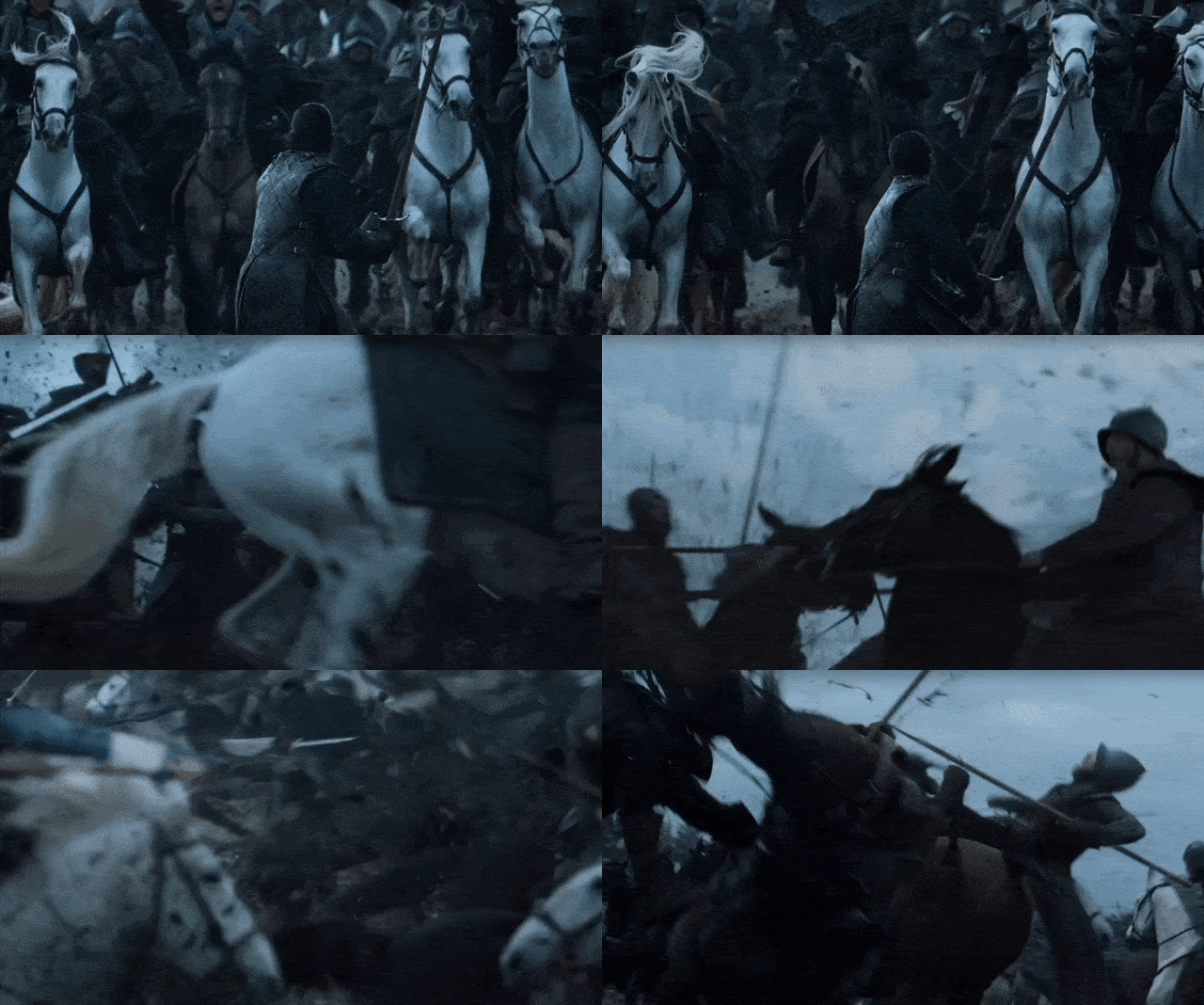
Ramsay’s set up a bunch of crosses with flayed bodies on them and taunts them with Rickon’s impending freedom only to shoot him just as he reaches Jon. (And Benioff and Weiss continue to clean house.) Jon has to charge forward a bit more to get inside the range of Ramsay’s archers, but his horse still gets shot out from under him. Ramsay’s cavalry is charging, and Jon pulls Longclaw, all ready to go out in a blaze of glory, just as his own cavalry charges past him and it’s actually kind of a funny moment.


Both sides queue up their archers again, but while Davos realizes the folly of firing into the fray, Ramsay doesn’t give a crap and keeps his archers firing. At this point, there’s a big, strategic pile of bodies, and everyone sends in their reserves.

Ramsay has a shield wall, which Jon manages to allow to surround his army, pushing them into that strategically-placed pile of bodies which would in no way have fallen that conveniently. (This is the point in the episode where my husband actually left the room because he couldn’t stand how bad the tactics were on both sides, but especially on Jon’s.) The shield wall keeps pushing the Wildlings back, crushing them into the body-pile, which is covered with Bolton men who are slaughtering everyone back there. Jon gets knocked down and almost trampled but somehow manages to climb up the men around him and break through to get a breath in a moment that’s clearly meant to be symbolic of rebirth but that symbol makes no sense in this context.


Finally, the Vale army arrives with Sansa and Peyr and destroys the shield wall. Ramsay flees, and Jon and Wun Wun go after him. Ramsay thinks he can still wait out a siege in Winterfell, but he forgot about the giant; Wun Wun takes down the gate and then takes an arrow to the eye. Ramsay offers to take Jon up on the one-on-one combat offer, and Jon beats the crap out of him, almost killing him until he notices Sansa and realizes she should be the one to get to kill him.

And then Darth Sansa feeds Ramsay to his dogs. And smiles about it. Because violence is the only answer.

Yes, Sansa getting to be the one to take out Ramsay is dramatically satisfying (once again, though, she’s not really wielding the power; Jon had to subdue Ramsay and get him in a position where Sansa could use the dogs to finish him off). But the north is supposed to be all about codes of conduct, and killing Ramsay like this doesn’t fit it. Also, we again get a woman wielding power through violence. Ramsay totally needed to die—there wasn’t any other way around it. However, rather than beheading him for treason (along with all his other crimes), which is what Ned would have done, they lower themselves to his level and essentially torture him to death. This doesn’t make me super optimistic for Jon’s upcoming rule of the North. It makes it feel like this whole fight was less about returning law, order, and the status quo to the North and more about revenge and power-grabbiness, which makes them not at all better than the Boltons.

RIP:
Belicho Paenymion
Razdal mo Eraz
Rickon Stark
Jon Umber
Wun Wun
Ramsay Bolton
Slews of wildlings and northern fighters and probably some Vale knights

Next week:


Stills from screencapped.net; gifs from Giphy and Tumblr