Thursday, August 29, 2019

A New Rewatch Series: She-Ra and the Princesses of Power

𝔄s I've commented before, I have a vested interest in materials meant for children because I have a daughter, born in 2014, and I try to be interested and engaged in the media she consumes. I'm also the person I am, born when I am and shaped by the media available for my consumption when I was her age and in the following years. I remember the delightfully terrible cartoons of my childhood--such as Voltron and He-Man--and the much better work that came out during my adolescence--such as Avatar: The Last Airbender--with varying degrees of fondness, and I've applied my faculties to those things and others for my daughter and for this blog.
So, faced with more my daughter and I have been watching, and seeing so much that seems amenable to treatment by the Society, I put a question to some friends of mine as to which of two series we've recently watched (so far as they are out yet; neither is concluded as is Galavant, which I treated most recently, or Voltron: Legendary Defender, which actually got to end rather than simply stopping) they would like to see treated here: She-Ra and the Princesses of Power or The Dragon Prince. My daughter and I enjoyed both thoroughly, and I am given to understand the groups of friends to whom I put the question did, too.
In the end, though, there seemed to be a slight preference for She-Ra and the Princesses of Power, at least in as long as I left the question open before putting together this post. I have every expectation that I will take up The Dragon Prince later on, perhaps after it gets another season added to it (and I hope it does!), but, for now, I will be turning my attentions to Etheria and the ways in which it pulls from and makes (sometimes awkward) use of the medieval.
I hope you'll begin to read the series here soon!
She-Ra and the Princesses of Power (2018)
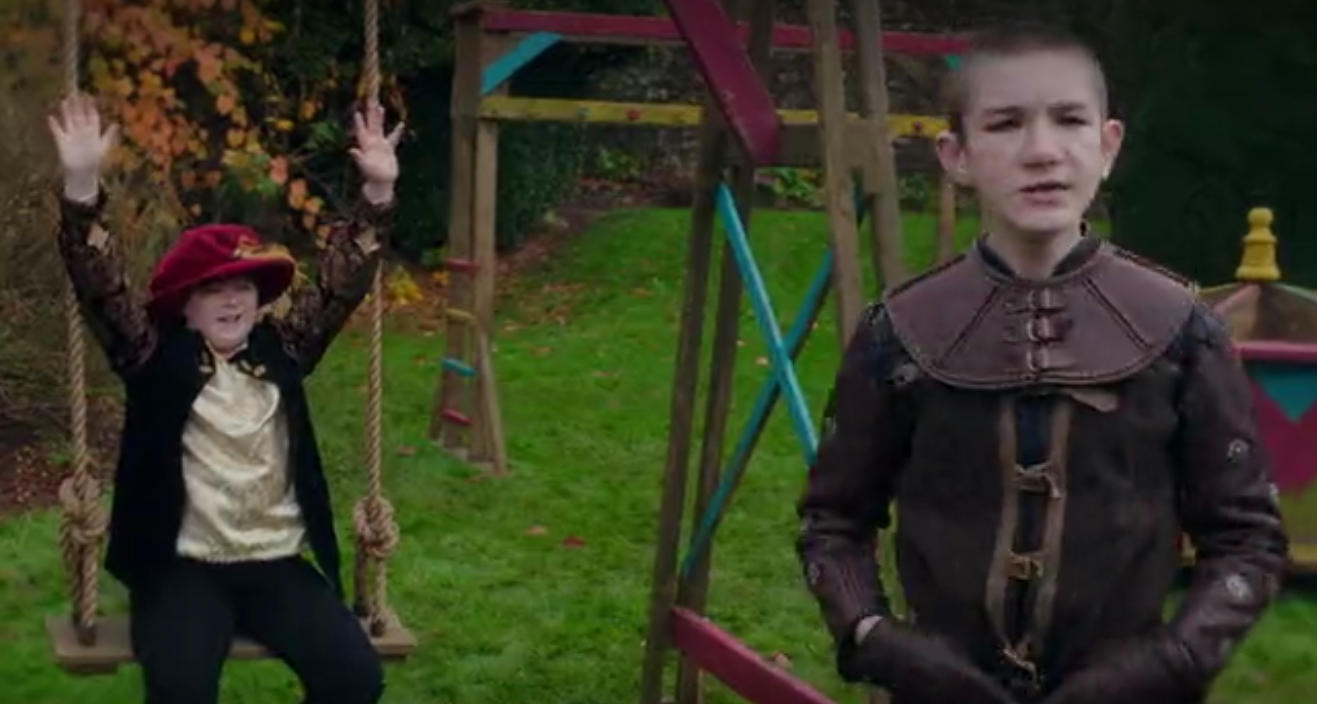
The promo poster seems fitting here, too.
I'm borrowing it from IMDB for purposes of reporting and commentary.

Thursday, August 22, 2019

A Few Comments about a Comic

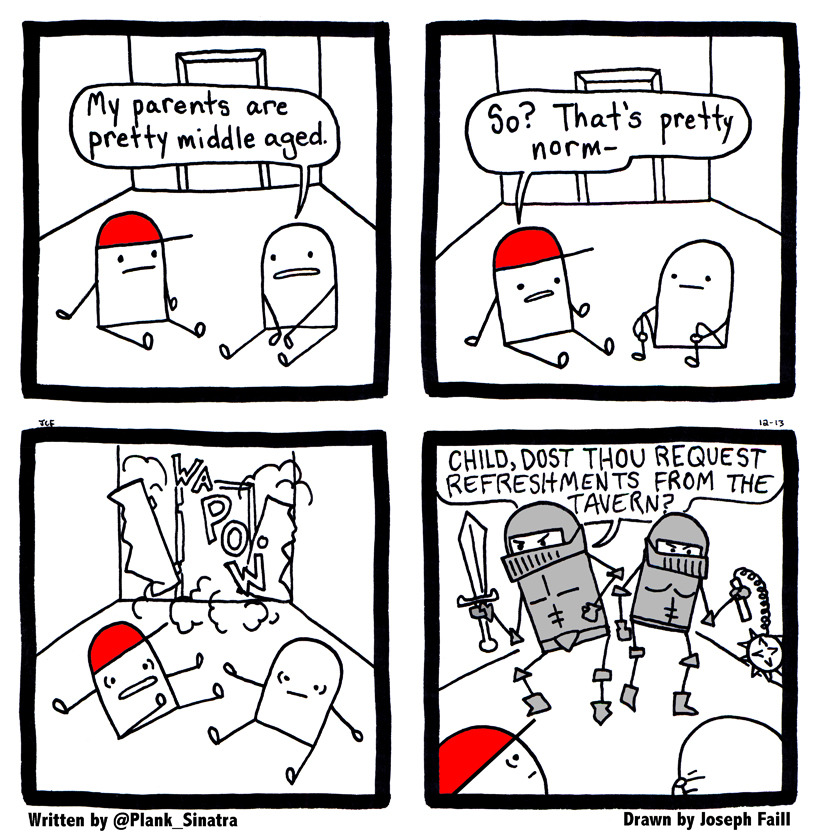
“ My parents are pretty middle aged. “So? That’s pretty norm-” *two knights bust in* “CHILD, DOST THOU REQUEST REFRESHMENTS FROM THE TAVERN?”
— WILL RETURN 2014 (@plank_sinatra) August 23, 2013”
The cartoon in question, by Joseph Faill on A Pleasant Waste of Time.
Image used for commentary.
𝔄 while back, I ran across Joseph Faill's comic about having middle-aged parents (it's linked in the caption of the comic where I reproduce it for the sake of commentary). As might be expected of a four-panel piece, it relies on a pun, in this case multiple meanings of "middle aged": early- to mid-40s through -60s, per Cambridge, and pertaining to the period between the fall of the Western Roman Empire and the emergence of the modern West, ambiguously defined. And as might be expected, there are some things that the comic gets wrong, though it can and probably should be argued that looking for too much historical accuracy in a short comic is not the best possible use of time.
That noted, it is important to look at such things. Jokes only work when their audiences understand the references being made, so what jokes play upon can be taken as a reflection of the knowledge-base from which the expected primary audience operates. Given the comic's original situation on a widely-accessible blog, it can be presumed that the expected audience of the piece is a broad one, rather than a targeted one; that is, the comic will play to popular conceptions of things, which are muddled through the oft-discussed-in-this-webspace (examples here, here, here, here, here, and here, among others) tendency of people to learn about the medieval through products of popular culture, which are concerned with marketable entertainment value rather than historical accuracy.
The comic seems very much to play into the popular conception of the pre- and early-modern past, which is typically compressed into a few "similar" ideas that elide much of the difference, nuance, detail, and glory of each. The wording in the final panel, making use of a now-obsolete -st ending and the "medieval" thou, as well as referencing a tavern, speaks to an idea of difficult-to-understand speech (though it seems to present no trouble in the event) and a fixation on common life centered on alcohol (which is hardly uniquely medieval; there are still quite a few taverns that advertise themselves as such). Similarly, the array of the parents in armor--without surcoat--that shows gendered characters--codpiece and boob-plate--and has the seeming mother wielding a flail (about which, see Sturtevant here and here) speaks to the same set of misconceptions. It indicates that those misconceptions are the prevailing ideas of the medieval, and that is a problem for reasons that have been amply attested in this webspace and many, many other places.
Again, though, I do not find fault with Faill for engaging those (wrong) ideas. The point is to get a laugh, and getting a laugh means making sure the presumed audience has access to the references being made. I'm not sure that getting more things "right" would have helped with that; putting the parents' words into even Chaucerian Middle English--let alone that of the Gawain-poet or the West Saxon of Beowulf--would have produced more confusion than amusement. Other clothes than plate armor would not have said "middle ages" as clearly, particularly given the art style. They would not have carried the joke, which would have defeated the purpose.
Even so, that the joke needs to be the way it is to land is unfortunate. It serves as a reminder that we, as scholars of the medieval and its appropriations, need to do more to teach people how things were and how they can be than we have yet done, particularly given all the misuses to which the medieval is being put.

Thursday, August 15, 2019

Thoughts about King Alice

King Alice
The cover of the book
Image taken from Macmillan, used for commentary

Read the previous piece in the series here.
Read the next piece in the series here.


𝔒ne of the things I try to do when I travel to the International Congress on Medieval Studies is come back with a gift for my daughter. Some years, it has been a piece of jewelry of one sort or another. This year, I picked up the gift not at the Congress itself, but on a sort of side-excursion on which I went after the formal events wrapped up. Part of it was Matthew Cordell's 2018 King Alice, a book that follows the adventures of Alice and her family as they make good use of a snow day (putting together a short story-book) that has them all--Alice, her younger sibling, and their parents--at home.
The book works well, or it did for my daughter; she enjoyed getting it and looking at it, and she has asked me to read it to her several times since I first gave it to her when I got back to the Texas Hill Country from Kalamazoo. The narrative action reads authentically to my eyes (the paternal reactions in the book line up with what has happened for me with my own daughter, for example), and the illustrations blend the consistency of mastery with the raw quality of childhood work--entirely appropriately for the genre, and not unexpectedly for a Caldecott winner.
My interest in the book is not only as a father looking for something to read to and share with his daughter, though. Even with me largely out of academia, with the Society being one of my few continuing engagements with that community, I remain interested in how the medieval is portrayed, how it is accurately and inaccurately presented. And there are things King Alice gets wrong, though many of them inhere in presenting materials as understood by a younger child to an audience of younger children (Macmillan reports that the expected target audience of the book is three- to five-year-olds). In the event, I am less concerned about what the book gets wrong than I am in what it gets right, and it gets some things surprisingly right.
Interior Image
One of the two-page spreads in the book, featuring a two-page spread in the making.
Image taken from Macmillan, used for commentary
To give one example, the opening of the story-book Alice and her father compile centers on King Alice and her knights gathered at a meal. Many chivalric romances center on such meals; the opening of Sir Gawain and the Green Knight comes to mind, when Arthur and his court are assembled before a waiting feast, and there are no few instances of the same in Malory's Le Morte d'Arthur, when the Round Table sits to dinner before an adventure begins. Indeed, a strange thing happens shortly after, with pirates intruding upon the whole affair. Aside from the prevailing association of pirates with the medievalist (about which I've commented here and here), the interruption reads as very much in keeping with the chivalric works from which the book works, however removed in practice it is from them. (The fart joke that intrudes into the narrative is also far from unknown to the medieval, as Chaucer's Miller's Tale and any number of other works attest.)
Something else that ends up reading as authentic or accurate to chilvaric forebears is the relative brevity of the chapters in the story-book Alice and her father work on. No few of Malory's chapters are short, indeed, and while it is a minor point of correspondence, it remains one.
Even the title of the book itself, King Alice, hearkens back to medieval antecedents. Early in the book, Alice introduces herself as "King Alice," and she rejects utterly the title of queen about which her father inquires. Both Tamar of Georgia and, to a lesser extent, Empress Matilda come to mind as antecedents; a less medieval example, but a neomedieval or proto-medievalist one, comes to mind in Elizabeth I. It is a somewhat subversive correspondence, particularly given the typical depiction of medieval monarchs as not only masculine but male, and it is a welcome corrective to at least some of the many, many misguided and wrongheaded assumptions about the medieval that populate popular culture and the misuses of the medieval by execrable groups towards despicable ends.

Thursday, August 8, 2019

Thoughts about Good Times Travel Agency: Adventures in the Middle Ages

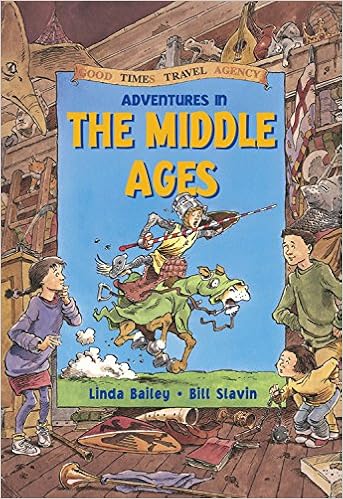
The cover, of course.
Image taken from Amazon.com, used for commentary
Read the previous piece in the series here.

t is no secret that I have an interest in children's literature for the simple reason that I have a child. And I think it no strange thing that I want to share what I do with my child. So, on a recent trip to our local library, I picked out a book to read with her from the children's stacks, one that talked about the kinds of things I do: Linda Bailey and Bill Slavin's Good Times Travel Agency: Adventures in the Middle Ages (Kids Can Press, 2000; ISBN 1-55074-538-7 or 1-55074-540-9).
The text is itself an entertaining enough read, at least enough to keep a five-year-old's attention through two nights of bedtime readings. The tone is accessible, with distinctions in voice between the focal characters--each of the Binkerton children sounds different--and others. (The snarkiness in Pettigrew's commentaries is delightful, honestly, occasioning laughter from my daughter and from my wife as she listened to me read to our child.) The illustrations are clear and engaging, splitting the difference between field guides, graphic novels, and short essays reasonably well. Small details contained in it contribute to the narrative presented by the words, helping to make the piece a more cohesive whole. My daughter enjoyed it, and I admit to having had a fair bit of fun reading it aloud to her. In that, then, the book is clearly successful.
Additionally, I appreciate that the book makes clear efforts to include contextual and historical information. The toil and drudgery of medieval life comes across clearly, as do concerns of hygiene and the possible perils of starvation--even in times of peace. Having the Disney-esque colors and cleanliness common to depictions of the medieval given to children offset is helpful. Children's works often shy away from unpleasantness out of an understandable desire to help kids be happy and to insulate them from the many things wrong in the world, but presenting some of those to them helps them to handle the problems they encounter. (The reminder that medieval children did not have easy times is also helpful.) And that the information is presented along the way, rather than being dumped on readers, eases its reception, which is to its benefit.
That all being said, there are problems with the text. Some of them result from the need to compress information for younger readers; the book does direct itself toward children--a note on the copyright page identifies it as a juvenile work in the Dewey decimal system, for example--and it is the case that minds with less experience need to have the information given them parsed somewhat. Even so, the reduction of the centuries and continents of the medieval to the "traditional" High Middle Ages in what is likely either France or England (judging by names given in the text) is somewhat vexatious; there is more to find following the fall of Western Rome than half-timber cottages and stone keeps. Related is the issue of the traditional framing of the medieval as being less than the preceding Classical and subsequent early-modern periods; it is not overt, perhaps, but children can pick up on subtle clues, as I have learned from experience. Too, while there is some passing mention of the influence of Christianity on the period, it is only passing mention, rather than situating it as one of the major cultural forces at play (for better and for worse, both). It's a remarkable oversight, really.
More problematically, the book follows the monochrome Middle Ages model that is being used to promote racism and fascism. There are few, if any, people of color depicted in the book at all, and certainly none in positions of power. While the publication date limits its direct engagement with the issue (i.e., Bailey and Slavin cannot have been responding to an argument that happened after the work was put into print), its presence and its direction at younger readers does not help with the just and appropriate opposition to that use.*
In the end, I am glad that such a work is available in a small-town local library. It's better than it could be, certainly, but I have to wonder if there isn't something better I could buy for the place--or if there isn't something better I could make for it.

*For some discussion of why this is particularly important, read Paul B. Sturtevant's The Middle Ages in Popular Imagination, of which the Society's review is here and my own is here.

Tuesday, August 6, 2019

Invitations

𝔗he Society has a number of writing opportunities available to all interested parties; we invite you to submit ideas to them and to let others know about them so that they can send stuff along!

Of particular note is the Call for Papers for the 2020 International Congress on Medieval Studies, about which more is here: https://talesaftertolkien.blogspot.com/2019/07/doing-more-for-kzoo2020.html.

We're also happy to have guest posts like Chrissie Perella's, here: https://talesaftertolkien.blogspot.com/2019/05/guest-post-chrissie-perellas-marvels.html. We accept them on most any medievalist topic, and the papers are read and reviewed by Society membership before being posted for view and comment. (Yes, it's peer-reviewed.)

Finally, we invite pitches for new re/reading and re/watching series, such as Shiloh's towering Game of Thrones series (beginning here: http://talesaftertolkien.blogspot.com/2016/05/game-of-thrones-rewatch-i-winter-is.html) or Geoffrey's consideration of Galavant (beginning here: https://talesaftertolkien.blogspot.com/2019/03/a-new-rewatch-series-galavant.html).

For any, send your ideas along to talesaftertolkien@gmail.com. We'd love to hear from you!

Sunday, August 4, 2019

A Comment about Recent Events

If any of the Society's membership is in El Paso or Dayton, we hope you're safe and that those you love are, too.

The Society again affirms its condemnation of all such attacks and the execrable ideologies of hatred that inform them. The Society again affirms its opposition to the frequent misuses of history, particularly the histories of the medieval world, broadly conceived, that too-often undergird those ideologies, and it reaffirms its commitment to pulling out what gets done wrongly in medievalist properties in an ongoing effort to root out the thin and faulty justifications used to provide pseudo-intellectual cover to evil.

There should be no place for it in this world or any other.

What the Society can do, it will do, in the hopes of denying hate a place.

Thursday, August 1, 2019

Galavant Rewatch 2.10, "The One True King (to Unite Them All)"

Read the previous entry here!

The final episode in the series thought it might well be the last. And there is something in that.

2.10, "The One True King (to Unite Them All)"

Written by Rick Wiener, Kenny Schwartz, Luan Thomas, Julia Grob, and Joe Piarulli
Directed by John Fortenberry

Synopsis

Some things seem not to change. Others very much do.
Image taken from the episode, used for commentary
A young Richard and Gareth proceed among other children, playing and commanding applause from the others. The child-king realizes his incompetence and privilege and muses on his possible futures; the future Richard intrudes upon the musing, answering the youth's questions and falling into his own introspection.

Richard rouses from his reverie to find the besieged Hortensian forces looking askance at him in advance of the renewed zombie onslaught. A strange sound reaches them, though, as another force arrives--one which Madalena and Wormwood mark, as well. It is Sid, armed and leading the forces encountered in Galavant's previous adventures.
Quite the striking image.
Image taken from the episode, used for commentary

Sid forces his way through the undead army and reports on how he marshaled the army he brought to Galavant's aid in atonement for killing the knight. Galavant lays out a plan of attack, and battle is rejoined. Galavant and Gareth make themselves targets in the hopes of enabling a flanking maneuver on Madalena and Wormwood. Wormwood distracts Madalena so that he can more easily eliminate the two.

I'm sure I've seen this struggle before...
Image taken from the episode, used for commentary
Isabella comes across Madalena while she is distracted. And Richard confronts Wormwood. Fights break out among them. Wormwood informs Richard of his sword's purpose before disarming him; Richard attempts to invoke his "dragon" against Wormwood, to no avail. Wormwood attempts to retrieve Richard's sword, also to no avail, before the erstwhile king attacks him in cold rage, breaking the spells that turned and enhanced Galavant's army.

The fight between the two attracts the attention of the other focal characters, and they recognize him as the foretold king. Too, the "dragon" is, in fact, alive; Richard had thought him killed. Galavant congratulates him, and Richard charges him with the care of his "dragon" while he rushes off.

Gareth tries to reconcile with Madalena, but she refuses him in favor of greater power. Isabella retrieves the crown of Valencia and reconciles with Galavant; he proposes marriage to her, and she agrees

She seems happy.
Image taken from the episode, used for commentary.
Richard rides to reconnect with Roberta, who is about to embark for another land. He intercepts her in time to stop her, and they reconcile.

Galavant and Isabella wed. Gwynne and Vincenzo, having survived the battle, resume their lives. The Valencian monarchs are restored and their palace put to rights. Gareth and Sid go on a quest to retrieve Madalena--who commits herself to the study of dark magics. Richard and Roberta enjoy their lives together--with what is, in fact, a real dragon.

Discussion

At this point, with the series having ended years ago, now, not much else needs saying about it in the present context. More learned work that can afford to take more time and that has more access to resources than an academic expatriate might well find more on which to comment, and in greater detail. Period dress, various social practices, deeper literary allusions could all take more bearing-out, certainly. And more "critical" criticism might happen, too, though I have tried in these short rewatch commentaries to ground what I say in what I have studied and what I know of the world in which I live. But I am as I am, trained as I am trained and farther away from that training than is perhaps comfortable for me to consider. I wonder if it is thus uncomfortable for others.

In any event, there is something that comes up at the end of the present episode, what ultimately is the end of the series as aired, that hearkens back meaningfully to the medieval (though to other sources, as well). In the Weird Al number near the end, in which he sings of the unlikelihood of another renewal for the series, there is something of the medieval memento mori, the recognition that all things in this imperfect world end and die. It does not mean, of course, that there is no looking ahead to more and better--the song does motion towards possible third-season plots that are never realized, but there was an idea that more would come. There is some comfort in such thoughts, certainly for people living in the world we now recognize as being medieval, as well as for people living in the still-flawed world that allows for such follies and worse things as continue to beset it--too many of which continue to invoke the medieval badly and inaccurately in the service of horrible, terrible agendas that would do better to be stomped out than to be celebrated as they now too often are.

And there is more to come in this webspace, as well. The medieval continues to be used, not always badly if too often so, and how it is used continues to merit consideration. And even if so easily accessible an example as Galavant is not immediately forthcoming, that does not mean there are not many to be found, or that the work of the Tales after Tolkien Society will not go on.

Monday, July 29, 2019

Doing More for #Kzoo2020

𝔄s a follow-up to "Starting for #Kzoo2020," expanded CFPs have been submitted to the UPenn CFP list. The text of them is below:

Legacies of Tolkien's Whiteness in Contemporary Medievalisms

A roundtable session at the International Congress on Medieval Studies at Western Michigan University (www.wmich.edu/medievalcongress) examining the continuing effects of Tolkien's depictions of race in medievalist works; Rachel Cooper will preside.

Much criticism directs itself towards racial studies and postcolonial readings of the works of JRR Tolkien, arguing whether his works should be regarded as racist and what attitudes contemporary readers would be well served to adopt in response to them. Much attention in popular media has directed itself towards the use of medieval and medievalist works such as Tolkien's by white supremacist groups to offer themselves pseudo-intellectual and pseudo-historical support for their execrable agendas. The session looks for ways in which contemporary medievalist work (hopefully) unintentionally supports such efforts and what can be done to oppose them as things deserving all opposition.

Deadscapes: Wastelands, Necropoli, and Other Tolkien-Inspired Places of Death, Decay, and Corruption

A paper session at the International Congress on Medieval Studies at Western Michigan University (www.wmich.edu/medievalcongress) examining depictions of what comes in the wake of war and death in works in the Tolkienian tradition; Carrie Pagels will preside.

Many of the "standard" fantasy works, ranging from the epics through Arthuriana into Tolkien and beyond, make much of grand wars fought on massive scales. They also, at times, look at what is left behind when the war is done, the graveyards filled and memorials erected. The session looks at how such things are constructed in works in the Tolkienian fantasy tradition and what functions they serve for readers in the late twentieth and early twenty-first centuries.

For both, short proposals are welcome; please send to talesaftertolkien@gmail.com on or before 15 September 2019. Proposals from graduate students, those outside traditional academe, and traditionally underrepresented groups are especially welcome.

Thursday, July 25, 2019

Galavant Rewatch 2.9, "The Battle of Three Armies"

Read the previous entry here!
Read the next entry here!

The final confrontation of the series begins in earnest in the penultimate episode of Galavant.

2.9, "The Battle of Three Armies"

Written by Rick Wiener, Kenny Schwartz, Juan Thomas, Julia Grob, and Joe Piarulli
Directed by John Fortenberry

Synopsis

It's an interesting look.
Image taken from the episode, used for commentary
Steve, armored and still in motley, sings a recap of the series's recent events. Major tensions are laid out that have emerged throughout the series, and Steve's performance is acknowledged within the show as a good one.

Immediately after, Gareth marshals his large army, while Wormwood and Madalena withdraw to observe from afar. Gareth is understandably upset at the plan, and becomes more so as evidence of Madalena's trafficking in dark arts emerges.

Across the field, Isabella confers with her parents about the relative states of the invading and defending armies.  Isabella tries to rally her forces, doing surprisingly well at it--though she realizes their precarity.

Galavant, Richard, and their army arrive to see the invading and defending armies arrayed against one another. Richard begins to realize his peril, and Galavant makes to ease him. Richard also tries to get his "dragon" to breathe fire, to no avail.

Gareth agitates to get started as Wormwood and Madalena delay. The changing plans vex him, as does the continuing involvement of magic. The three mark the arrival of Galavant and his army, and Gareth moves to attack, Madalena remaining behind.

They had been doing well for themselves.
Image taken from the episode, used for commentary
The armies advance upon each other, their strains of the marching song that emerges reinforcing their relative strategic positions. In the middle of it all are Vincenzo and Gwen, whose cottage lies amid the battlefield that is soon to be. Vincenzo sees the advancing armies and muses on their likely impending doom.

Battle is joined. Madalena and Wormwood muse on the battle's progress, and Wormwood recognizes the Sword of the One True King in the opposition to their forces. Madalena demurs at the proposed use of the dark arts, and Wormwood plays upon her vanity to convince her to employ magic. And amid the chaos, Richard reconsiders his choices, Gareth advances upon him, and Galavant and Isabella meet again. She is not happy to see him, nor Richard to see Gareth; both pairs reconcile before a wave of magic turns the undead army upon the living. Wormwood enhances them and tutors Madalena in how to work her will.

Gareth realizes that he has been betrayed by the woman he had loved and had thought loved him as the living armies retreat to the fortified town of Hortensia. The undead press the attack against the barely-fighting retreat to the inner ward. A pause in the attack permits a parley. Madalena tries to reclaim Gareth; he refuses, deciding to stand with Richard and the others against Madalena's outright evil. The attack resumes.

Discussion

There might be a seeming disjunction at the beginning of the episode in seeing Steve, the jester, in armor. The incongruity of the demonstrably cowardly comedian in armor amuses, certainly, and the idea of a court performer as a warrior seems at odds with itself. It does have a significant medieval antecedent, however: Sir Dagonet. In Malory's Le Morte d'Arthur, the linchpin of English-language Arthurian legend, Sir Dagonet is the fool of Arthur's court, explicitly described as such. The story in Malory of Le Cote Male Tayle offers one of the clearer examples of that description; Dagonet is used as a challenger to discredit Le Cote Male Tayle, as I have argued. For the court fool to appear in knightly array, then, has a centuries-long literary history; for Steve to show up in it is not a bad thing, nor altogether at odds with the "medieval" in which Galavant trades.

More prevalent than the connections to the medieval, though, are the connections to the medievalist, particularly in references to Tolkien. The title of the episode calls back to The Hobbit and its climactic battle at Erebor. Isabella's rallying speech borrows heavily from Theoden's at the Pelennor. So does Galavant's armor (with a helmet in the present episode, no less!). Both tie back to one of the major avenues through which people apprehend the medieval, per Paul B. Sturtevant's The Middle Ages in Popular Imagination. But the avenue is not the destination, certainly, and many people stop on the road long before reaching its end.

There is another thing to note, as well. As in previous episodes, the expectation seems to be that the audience's sympathies will turn towards those who have done horrible deeds because they are focal characters who have been hurt by others. In the present episode, Gareth seems to be the character with whom audience sympathies are expected to run. But that he feels himself betrayed by Madalena--who has already betrayed several others and who should not be trusted therefore--and that he reconciles with his friend and king--whom he had himself betrayed--does not erase the evils he himself has done. Gareth may try to make a distinction between being "a horrible human being" and "evil," but it is a distinction without much difference; an afternoon of humane feeling does not offset years of foul deeds and seasons of on-screen wrong-making.

Forgiveness may be possible, but it is not so swift or easy as all that.

Thursday, July 18, 2019

Galavant Rewatch 2.8, "Do the D'DEW"

Read the previous entry here!
Read the next entry here!

The final confrontation of the season is set up, and kinks are introduced into other threads of the plot, as the second season of Galavant proceeds.

2.8, "Do the D'DEW"

Written by Jeremy Hall, Luan Thomas, Julia Grob, and Joe Piarulli
Directed by Chris Koch

Synopsis

Night time is the right time to lead zombies along.
Image taken from the episode, used for commentary.
Galavant, Sid, Richard, and Roberta proceed at the head of an undead army towards Valencia.
The complications of such work are noted--and demonstrated as Galavant has to micromanage the zombies' motions while they mindlessly follow him. And Richard frets over how to proceed romantically with Roberta, doing so ineptly. She is not inept, however.

Isabella and Steve approach Gareth and Madalena's headquarters under flag of truce.
Steve is understandably nervous; Isabella is resolute. They confront Gareth and Madalena over surrender terms; Madalena's terms are excessive, and Isabella rejects them. Battle looms, and the Sword of the One True King is noted as the only available hope for Hortensia and Valencia--a sword they do not have. But Madalena does not know Isabella's forces do not have it, and she frets about the prophecy foretelling the unification of realms by the sword's wielder. Gareth makes to reassure her, and Wormwood reminds them that he is a practitioner of dark magic--and Madalena is immediately interested, though Gareth is hesitant. Madalena purposes to engage such magic, even so, and despite averring to Gareth that she will not.

Kind of them to leave a note.
Image taken from the episode, used for commentary.
Galavant and his cohort arrive at Valencia, finding the castle deserted, its forces diverted to Hortensia. Galavant notices Richard and Roberta, and the two explicate their assignation in song amid a song-and-dance number with the zombies.

Madalena persists in her drive to attain dark magical power. She calls upon Wormwood to teach her, thinking that she will need to sacrifice a child to attain the power. She does not, but does need to sign away her soul. Her evident relish of evil acts--infant-killing, signing in blood--unnerves even Wormwood.

Isabella reviews her forces and their potential arms. They are less than might be desired, and Isabella tries to make the most of it and motivate the Hortensians--to no avail.

Galavant reviews his own troops, finding them similarly less than optimal. He frets about his chances, stumbling onto the idea that the zombies are motivated by the expression of love. He, Richard, and Roberta make to head out; Sid has left a note saying that he has left to atone for his failure with Galavant, and Richard muses over his changes in character. Roberta notes that Richard will not do well in battle, and in detail. He tries to set aside her concerns, and she tries to get him to flee with her. He refuses, and she leaves.

As the episode ends, three armies march towards one another in preparation for a final battle, while others proceed to their own ends.

Discussion

Example I
Image taken from the episode, used for commentary
Example M
Image taken from the episode, used for commentary
One issue that emerges in the episode that reads poorly for me is that of boob-plate. As shown in Examples I and M, both Isabella and Madalena appear in it. (I do read Madalena's outfit in the example as moving towards armor, despite its material. No few of the other focal character are shown in leather armor, after all--including Gareth in the same scene, as witness his gorget and spaulders or pauldrons.) And it is stupid in both cases, looking like it would serve the function Emily Asher-Perrin and others describe of directing weapons towards the body's center mass--and the vital organs housed therein. That both characters display notable gaps in coverage on their sternums only highlights the folly. Yes, it appears meant to accentuate their femininity, to remind viewers that the characters are women (as if the series as a whole and the vocal registers they display during their "catfight" song--and the descriptor is itself a problem--do not do enough to do so already), but it also serves to reinforce ideas that are flatly wrong-headed. (Yes, there are anatomical realities that need accommodation. Exposing vital areas to attack is not an appropriate accommodation.) It's one more point at which the series, which is in many ways in line with what it needs to be, fails to live up to its promises.

There's actually a fair bit to say about the armor in the episode. Near the end, Galavant appears--for the first time in the series--in (nearly) full plate armor. It is relatively unornamented, as well, marking it through its lack of ostentation as a serious piece of equipment. Notably, though, it lacks a helmet (which Gareth wears in the final musical piece of the episode), as well as the surcoat that would keep the naked metal from growing intolerably hot in the sun. While the lack of helmet can possibly be justified both in-milieu--Galavant is not yet at battle--and for concerns of medium--having the character's face exposed eases audience recognition and improves the clarity of voice for singing--the lack of ornamentation stands out. Galavant is a known warrior; it makes little sense that he would not have a recognizable coat of arms, even if only his father's with a mark of cadence upon it. Oddly, such accoutrements as coats of arms are among the most recognizable "medieval" items, so the lack of one on the eponymous character of the series is strange. What is to be made of it is not at all clear...